3D Point Cloud & LiDAR Annotation Services
Turn raw LiDAR and 3D point cloud data into perception-ready training data. Shaip pairs 10,000+ in-house specialists with a 6 Sigma quality process to deliver 3D cuboids, bounding boxes, segmentation and sensor-fusion labels at a 99%+ accuracy SLA — for autonomous driving, ADAS, robotics and physical AI teams.
What is 3D Point Cloud & LiDAR Annotation?
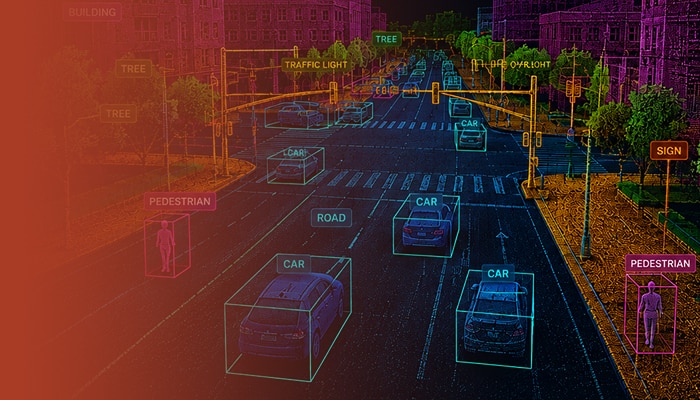
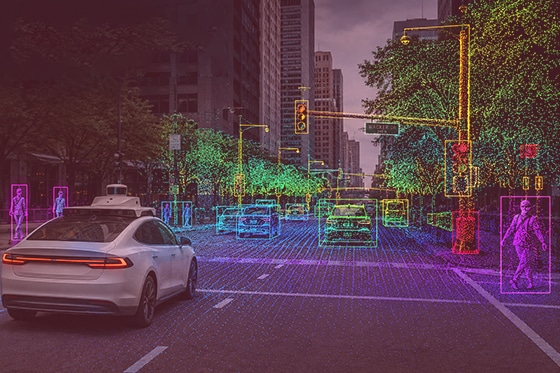
A point cloud is the millions of 3D data points a LiDAR sensor, radar or depth camera captures of a scene. Shaip turns that raw sensor data into labeled ground truth — 3D cuboids around vehicles and people, point-level segmentation of the environment, and object tracking across frames — so your models perceive shape, distance, orientation and motion the way the physical world actually presents them.
This is the foundation for every machine that has to act in three dimensions. Whether you’re training a self-driving stack, an autonomous mobile robot or a humanoid, the precision of your 3D annotation directly decides how safely and reliably that system perceives its surroundings and acts on them. Shaip delivers that precision at scale — with trained specialists, model-assisted pre-labeling and multi-stage QA built for perception-grade data.
LiDAR & Point Cloud
LiDAR & 3D Point Cloud Annotation Types
Every LiDAR and 3D point cloud labeling technique your perception model needs — from 3D cuboids and point cloud segmentation to sensor fusion and object tracking, on single frames or across full LiDAR sequences.
3D Cuboid Annotation
Tight, orientation-aware 3D bounding boxes around vehicles, pedestrians, cyclists and static objects — capturing length, width, height and heading for precise localization.
3D Bounding Box Annotation
Fast, consistent 3D bounding boxes for object detection datasets — ideal for high-volume autonomous vehicle and ADAS training pipelines.
Point Cloud Segmentation
Point-level semantic and instance segmentation that classifies every point — road, sidewalk, vegetation, buildings, dynamic objects — for rich scene understanding.
Semantic Segmentation
Dense labeling of drivable surfaces, lane markings and terrain across the full point cloud to power path planning and free-space detection.
Sensor Fusion (2D–3D Linking)
Cross-referencing camera images with LiDAR point clouds so objects are labeled consistently across modalities for robust multi-sensor perception.
3D Object Tracking
Frame-to-frame tracking with persistent object IDs across LiDAR sequences to capture trajectory, velocity and behavior over time.
Applications
Where 3D & LiDAR Annotation Powers AI
Perception models across industries depend on high-quality 3D ground truth. Here’s where our annotation teams deliver the most impact.
Autonomous Vehicles & ADAS
Vehicle, pedestrian and lane annotation for self-driving perception and advanced driver-assistance systems — the core of safe autonomy.
Robotics & Physical AI
Obstacle detection, grasp targets and 3D spatial mapping for humanoids, autonomous mobile robots and industrial systems — explored in depth in our Physical AI segment below.
Smart Cities & Mapping
3D annotation of streetscapes, infrastructure and traffic flow for HD maps, digital twins and urban-planning models.
Drones & Aerial LiDAR
Terrain, vegetation and asset labeling from aerial point clouds for surveying, agriculture, mining and inspection use cases.
AR / VR & Spatial Computing
Scene reconstruction and object labeling that anchor immersive AR/VR experiences to accurate 3D geometry.
Geospatial & Surveying
Large-scale point cloud classification for environmental monitoring, land management and infrastructure digitization.
Physical AI & Robotics
3D & LiDAR Annotation for Physical AI
Embodied machines learn the world in three dimensions. Shaip annotates the LiDAR, depth and point cloud data that teaches humanoids, autonomous mobile robots and industrial systems to perceive space, avoid obstacles and act safely — trained on the messy real world, not just clean lab footage.
Sensors & modalities we annotate
Environments we cover
Humanoids & Imitation Learning
3D labeling of demonstrations — object interactions, grasp points, joint states and spatial context — to power imitation learning and vision-language-action (VLA) models for humanoid and embodied AI.
Autonomous Mobile Robots (AMRs)
Point cloud annotation for warehouse and logistics fleets — pallets, racks, forklifts, people and dynamic obstacles — so AMRs navigate crowded indoor spaces and run pick-and-place reliably.
Robotic Manipulation & Pick-and-Place
3D object and grasp-target annotation that lets robotic arms locate, orient and manipulate items in cluttered bins, on assembly lines and across long-horizon task workflows.
Navigation, SLAM & Free-Space
Segmentation of floors, walls, doorways, ramps and moving actors to train mapping, localization (SLAM) and free-space detection for autonomous navigation on any surface.
Multi-Sensor Fusion
Synchronized LiDAR + depth + camera + IMU labeling with full calibration metadata, so perception holds up in low light, occlusion and changing conditions.
Worker Safety & Human–Robot Interaction
3D labeling of people, safety zones and unsafe actions for PPE detection, ergonomics review and collision-safe collaboration on factory and warehouse floors.
Why Shaip
The 3D Data Partner, Not Just Another Labeling Vendor
Most providers hand you point annotation and an anonymous crowd. Shaip is an end-to-end 3D data partner — data collection, annotation, validation and synthetic data — delivered by managed, in-house specialists and guaranteed by an accuracy SLA. That’s the difference between labels you hope are right and ground truth you can ship.
Flexible Global Workforce
Leverage a 10,000+ in-house global workforce and 500K+ crowd-scale credentialed contributors, with real-time workforce capacity and efficiency.
Diverse, Accurate & Fast
Our process streamlines collection through easy task distribution and data capture directly from the app and web.
Patented Platform
A patented, web-based platform — Shaip Manage, Work & Intelligence — with model-assisted pre-labeling and full audit trails, integrated with AWS, Azure, GCP, SageMaker & Databricks.
Enterprise-Grade Accuracy
Multi-tier QA with GDPR & HIPAA-compliant, fully transparent delivery.
Domain-Trained Human Experts
Domain-trained specialists — not generic crowd workers.
High-Quality, Model-Ready Data
Multi-layer QA and human-in-the-loop validation for consistent, accurate datasets.
How It Works
From Raw Point Cloud to Perception-Ready Data
A transparent, milestone-driven workflow designed to de-risk your project from day one.
Scope & Free POC
We align on ontology, edge cases and guidelines, then label a sample dataset so you can validate quality before you commit.
Annotate at Scale
Trained 3D specialists label your point clouds with model-assisted tooling, ramping capacity to hit your volume and timeline.
Multi-Stage QA
Our 6 Sigma Stage-Gate process runs multi-pass reviews and automated checks against your 99%+ accuracy SLA.
Secure Delivery
Data is delivered in your required format (KITTI, ROS, JSON and more) via NDA-protected, compliant pipelines.
Success Stories
LiDAR Annotation for SmartCity Autonomous Vehicles
Shaip annotated fused LiDAR and camera data from diverse urban environments to help a metropolitan smart-city program deploy safe, efficient autonomous vehicles.
Problem: Annotate 15,000 frames of 2D + 3D data from 3 Velodyne VLP-32C LiDARs and 4 cameras across dense-urban to suburban scenes — within 4 months, with strict masking of all personally identifiable information.
Solution: A dedicated team of 50 annotators, 10 quality controllers and 3 project managers used proprietary fused 2D/3D tooling with AI-assisted pre-annotation and rigorous privacy training.
Result: 450,000+ objects annotated at 99.7% accuracy with 98% ID consistency — delivered in 3.5 months (two weeks early) and cutting real-world testing time by 30%.
Scaling Physical AI & Humanoid Robotics for Motion Data
Shaip built a scalable VR motion-capture pipeline delivering thousands of valid hours of egocentric data every month to train embodied AI and humanoid robots.
Problem: Scale from pilot workflows into a recurring 5,000 valid-hour monthly program spanning 300–400 customer-defined tasks — while holding consistent tracking accuracy across varied real-world scenes.
Solution: A structured collection framework — 50+ distinct capture settings, five-sensor calibration, moderated capture with screencast verification, and multi-stage QA with retake protocols.
Result: 5,000 valid hours/month across 1,500–2,500 participants, with standardized scene governance and QR-based mapping — delivering task-validated, annotation-ready data for embodied AI and sim-to-real.
Security & Compliance


Have a 3D or LiDAR annotation project in mind?
Get a free proof-of-concept and see Shaip's 99%+ accuracy in action — on your data, before you pay.
Contact UsFrequently Asked Questions (FAQ)
1. What is 3D point cloud annotation?
3D point cloud annotation is the process of labeling 3D sensor data — millions of points captured by LiDAR, radar or depth cameras — with 3D cuboids, bounding boxes and point-level segmentation. It gives perception models the ground truth they need to understand object shape, position, orientation and motion in three dimensions.
2. What is the difference between LiDAR annotation and 2D image annotation?
2D image annotation labels flat pixels, while LiDAR (3D) annotation preserves depth and geometry. That means 3D annotation captures how far away an object is, its true size and its heading — essential information that 2D labeling cannot provide for autonomous driving and robotics.
3. Which 3D annotation types does Shaip offer?
Shaip delivers 3D cuboid annotation, 3D bounding box annotation, point cloud segmentation, semantic segmentation, sensor fusion (2D–3D linking) and 3D object tracking across LiDAR sequences — on single frames or full sensor recordings.
4. Do you support 3D annotation for robotics and physical AI?
Yes — physical AI is a core focus. Shaip annotates LiDAR, depth and point cloud data for humanoids, autonomous mobile robots (AMRs), robotic manipulation and industrial automation. That includes multi-sensor fusion, grasp-target labeling, navigation and SLAM segmentation, and human–robot interaction safety, captured across warehouses, factories, construction sites and other real-world environments.
5. How does Shaip ensure annotation accuracy?
Every project runs through our 6 Sigma Stage-Gate quality process with multi-pass human review, automated validation checks and dedicated QA leads. We commit to a 99%+ accuracy SLA — and if a delivery falls short, we re-annotate at no additional charge.
6. Is my data secure during annotation?
Yes. Shaip is HIPAA, SOC 2 Type II, ISO 27001, ISO 9001:2015 and GDPR compliant. All 3D and LiDAR annotation is performed under signed NDAs, role-based access controls and audited, controlled environments — your data never leaves a secure pipeline.
7. Can Shaip handle large-scale LiDAR datasets?
Yes. With 10,000+ in-house specialists and a 500K+ global contributor network, we scale dedicated teams up or down to meet your volume and timeline — as demonstrated by projects delivering 450,000+ object annotations ahead of schedule.
8. Do you offer a free proof-of-concept?
Yes. We label a sample of your dataset so you can validate quality, turnaround and fit before committing to a full project — you see results before you pay.
9. What output formats and tools do you support?
We deliver in the formats your pipeline needs — including KITTI, ROS bag, JSON and custom schemas — and integrate with AWS, Azure, GCP, Amazon SageMaker and Databricks, as well as leading annotation platforms.
