-
-
Company
Build always-listening voice apps with custom wake word training data. Higher detection accuracy, fewer false activations.

Voice assistants have dramatically transformed the way customers interact with their devices. They have made it easier for users to explore products and services – quickly and efficiently. However, is the voice application listening? To put these applications in high drive, they need to be woken up and transition from passive to active listening with the help of WAKE WORDS. ‘Alexa’ and “Hey Siri’ are two of the most popular wake words in the world.
By 2024, the number of digital voice assistants is predicted to reach 8.4 billion units – more than the world’s population.
The voice assistant app market size is predicted to increase from $2.8 billion in 2021 to $11.2 billion in 2026, at a CAGR of 32.4%.
A wake word is a specific word or phrase such as ‘Hey Siri’, ‘Okay Google’, and ‘Alexa’; designed to activate a voice-activated device to respond when uttered. However, an always-listening wake word that is locally integrated with the device reduces the response time drastically and increases the identification and processing accuracy of the wake word even without an internet connection. Shaip collects wake word training data across 100+ languages, diverse accents, age groups, and real-world noise environments to maximize detection accuracy and minimize false activations. They are also know as:
With Shaip’s offers always-listening wake word training, your voice assistant models are always tuned to listen for the wake word, but without actually recording or transmitting data to the cloud. Partnering with Shaip gives you the advantage of working with experts. With our extensive experience using AI and ML technology in developing voice assistant training, we help you can eliminate privacy risks, improve user experience, reduce development costs and enhance scalability.


Shaip builds training data for fully branded wake words so customers say your brand name — not a generic assistant. Every dataset is tuned to your exact activation phrase, reinforcing brand recall with each interaction and keeping the voice experience inside your own ecosystem.

Shaip supports always-listening wake word models that run on-device without recording or transmitting audio to the cloud. On-device wake word training data reduces latency, lowers privacy risk, and keeps detection working reliably even without an internet connection.
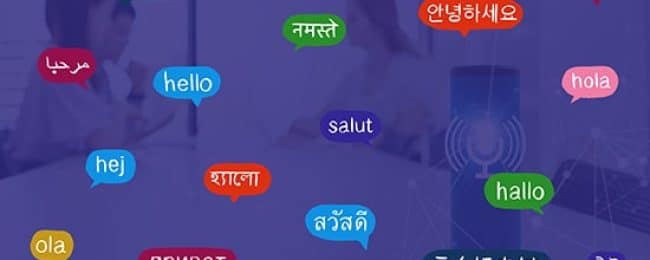
Shaip collects wake word utterances across 100+ languages and regional accents — Scottish, Canadian, Australian, Indian English and beyond — so detection accuracy holds across global user bases instead of degrading for non-native speakers.
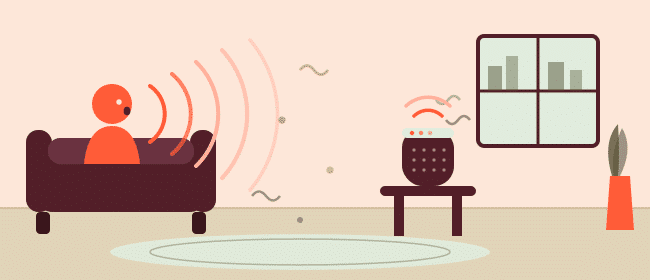
Shaip captures wake word data in silent, noisy, in-car, outdoor, and far-field conditions. Training on real-world acoustic variation reduces false rejects when users speak from a distance or in background noise.

Beyond the wake word, Shaip provides utterance and phrase-spotting data so devices process longer natural-language commands with low latency. Embedded keyword detection data supports on-browser and on-chip processing for high accuracy and privacy.
Different phonemes generally create a more distinct signature and ensure better accuracy in the results. Hence, pick phrases in your data that produce various sounds.
Make wake words more effective by affixing them with prefixes like “Hi,” “Hello,” "Hey," or "OK." It will keep the wake word unambiguous & ensure no accidental matching occurs when using trigger word in regular speech.
Make your wake words a combination of at least six phonemes that are easily discernible by a machine and easy to say by humans. For instance, "Alexa" has six phenomes while “Ok Google” has eight phenomes.
Do not make the mistake of using a single word as your wake word. Wake words must be long enough to be distinct.
Ensure the trigger words that you create must be simple and unique so that they can be easily remembered.
Longer multi-word wake phrases are hard to pronounce and make the process unnecessarily harder.
A wake word model is generally trained to recognize a no. of different utterances, so that it can respond to different invocations. However, having too many distinct wake words can simply activate the speech pipeline without you knowing which utterance did the user spoke.
Factors like noise, distance, and variations in accents and language makes accurate hotword detection harder and complex for your AI model.

Our experience in voice technology helps us develop always-listening tailored wake words and branded wake phrases quickly. With voice recognition in tandem with natural language processing understanding, ML algorithms help transcribe speech & execute voice commands effectively.

We focus on rapidly developing wake word prototyping to ensure customization of the branded word. A prototype acts as a proof of concept and helps in accurate training, faster time to market, accelerated testing, and elimination of risks.

Experience uninterrupted growth and unhindered customer engagement with an exceptional voice assistant. We provide multilingual speech recognition capabilities so that the application can accurately spot words and phrases even in high-noise environments.
It is a way of collecting crucial user data such as their identity, country of origin, age, sex, language, accents, etc. Data diversity is used for improving user-oriented algorithms to achieve more accurate outcomes.
Data usually tend to generate built-in biases. Therefore, when we collect data from diverse sources, the bias in the results significantly reduces.
Here are a few parameters of data diversity that Shaip addresses while building wake words and other conversational commands.

| Race and Ethnicity | Hindu, Muslim, Christian, Afrikaans, Europeans |
| Level of Education | Undergraduate, Graduate, Ph.D., Masters |
| Country | China, Japan, India, Korea, Dubai, Nigeria, USA, Canada |
| Sex | Male, Female |
| Age | Less than 10 yrs, 10-15, 15-25, 25-45, 45 yrs & above |
| Language | English, Japanese, Turkish, Chinese, Thai, Hindi |
| Environment | Silent, Noisy, Background Music, Background Sound/Speech, Indoor, Outdoor, Theatre, Stadium, Cafeteria, In Car, Office, Shopping Mall, Home Noise, Staircase, Street/Road, Sea-side (Windy) |
| Accents (English) | Scottish English, Welsh English, Hiberno-English, Canadian English, Australian English, New Zealand English |
| Speaking Style | Fast/Normal/Slow speed, High/Normal/Soft volume, Formal/Casual |
| Device Positions | Handheld, Desktop |
Wake word data for speakers, TVs, and appliances that must activate instantly and reject background chatter.
Far-field, noise-robust wake word datasets for hands-free in-cabin assistants.
Low-footprint wake word data for always-on, battery-constrained devices.
Custom wake word and utterance data to localize assistants across languages and dialects.
Privacy-first, on-device wake word data for hands-free clinical and patient settings.
Multimodal wake word and command data for robots that respond in real time without the cloud.
Shaip works with you to select a phonetically distinct, brand-aligned wake word and define collection guidelines.
Shaip’s global workforce records the wake word across required languages, accents, ages, devices, and noise environments.
Each utterance is transcribed, labeled, and quality-checked against your acceptance criteria.
Shaip delivers structured, policy-controlled wake word training data formatted for your model pipeline.
To effectively deploy your AI initiative, you’ll need large volumes of specialized training datasets. Shaip is one of the very few companies in the market that ensures world-class, reliable training data at scale complying with regulatory/ GDPR requirements.
Create, curate, and collect custom-built datasets (text, speech, image, video) from 100+ nations across the globe based on custom guidelines.
Leverage our global workforce of 30,000+ experienced & credentialed contributors. Flexible task assignment & real-time workforce capacity, efficiency, & progress monitoring.
Our proprietary platform & skilled workforce use multiple quality control methods to meet or exceed quality standards set for collecting AI training datasets.
Our process streamlines, the collection process through easier task distribution, management, & data capture directly from the app & web interface.
Maintain complete data confidentiality by making privacy our priority. We ensure data formats are policy controlled and preserved.
Curated domain-specific data collected from industry-specific sources based on customer data collection guidelines.
Shaip offers end-to-end speech/audio data collection services in over 150+ languages to enable voice-enabled technologies to cater to a diverse set of audiences across the globe.

The chatbot you conversed with runs on an advanced conversational AI system that is trained, tested, & built using tons of speech recognition datasets. It is the fundamental process behind the technology that makes machines intelligent
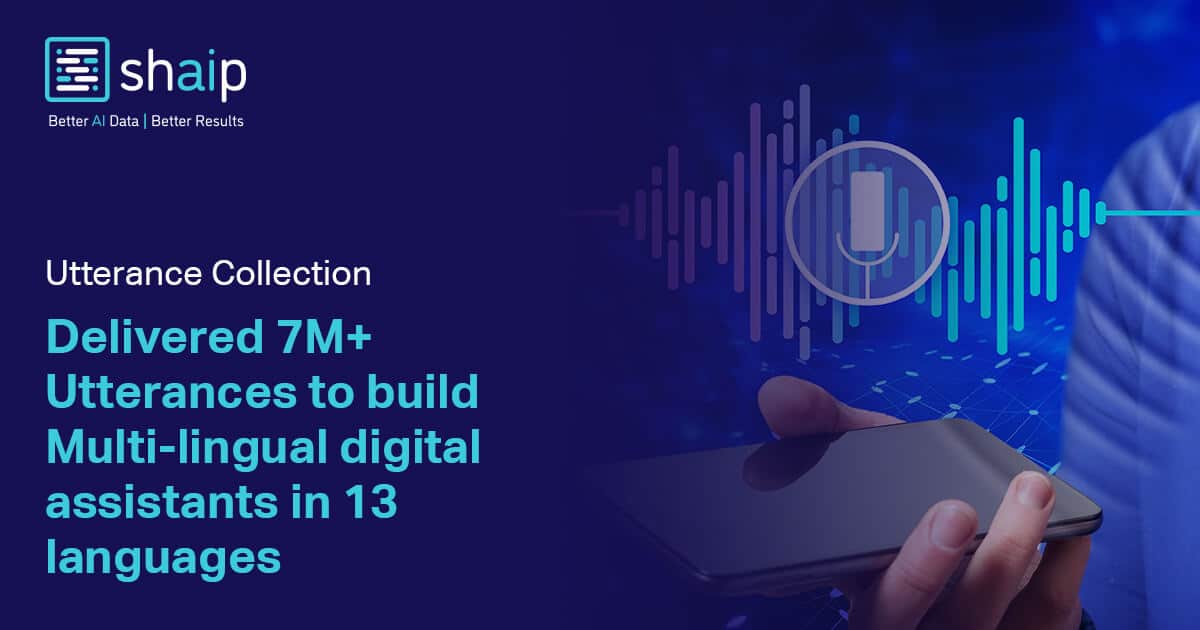
The need for Utterance training arises because not all customers use the exact words or phrases while interacting or asking questions to their voice assistants in a scripted format.
Empowering teams to build world-leading AI products.





A wake word is a specific word or phrase — such as “Alexa,” “Okay Google,” or a custom branded phrase — that activates a voice-enabled device and switches it from passive to active listening. The device continuously listens locally for the wake word and only begins processing a request once the wake word is detected.
Wake word training data is the labeled set of spoken recordings used to teach a model to recognize its activation phrase. Effective wake word training data spans many speakers, accents, ages, devices, and noise conditions so the model triggers reliably while rejecting similar-sounding speech.
A wake word works by running a small, always-listening detection model that scans incoming audio for the target phrase. When the model matches the wake word with sufficient confidence, the device activates and begins processing the user’s request using speech recognition and natural language processing.
A strong custom wake word uses diverse phonemes, contains at least three to four syllables, and avoids common everyday words to reduce false activations. Adding a prefix like “Hey” or “OK” improves distinctiveness. Shaip helps select and validate wake words during project setup.
Yes. On-device wake word detection runs the activation model locally, so audio is not recorded or sent to the cloud. This lowers latency, protects privacy, and keeps detection working offline. Shaip collects training data specifically suited to on-device and embedded deployment.
Shaip collects wake word training data in 100+ languages and a wide range of regional accents, sourced from a global workforce across 100+ countries. This breadth reduces accuracy gaps for non-native speakers and supports global product launches.
Shaip applies multiple quality-control passes — transcription review, acceptance criteria, and workforce monitoring — so datasets meet target accuracy before delivery. Diverse, high-quality data reduces both false-accept and false-reject rates in the deployed model.
A wake word activates the device; an utterance is the spoken request that follows. Wake word detection is a narrow always-on task, while utterance understanding involves interpreting varied natural-language phrasing. Shaip provides training data for both wake word detection and utterance collection.
An utterance is a phrase a user speaks to make a request to voice-command software. The software identifies the user’s intent from the utterance and responds accordingly. Unlike a complete sentence, an utterance is a unit of speech that may not convey a full thought and often contains pauses. Examples: “Show me the latest movie — the one released last week,” or “Is the store on 22nd Street open now?”
An invocation name is the keyword used to trigger a specific “skill” within voice software. It can include names of people or places and be combined with an action, command, or question. Every custom skill needs an invocation name to start it.
Wake words are also called trigger words, hot words, activation words, invocation words, wake phrases, and utterances.
Alexa uses several built-in microphones to detect its wake word while filtering out background noise. To prevent false positives and negatives, it only begins active listening after detecting “Alexa.”
We use cookies to improve your experience on our site. By using our site, you consent to cookies.
Manage your cookie preferences below:
Essential cookies enable basic functions and are necessary for the proper function of the website.
Google Tag Manager simplifies the management of marketing tags on your website without code changes.
Statistics cookies collect information anonymously. This information helps us understand how visitors use our website.
Google Analytics is a powerful tool that tracks and analyzes website traffic for informed marketing decisions.
Service URL: policies.google.com (opens in a new window)
Marketing cookies are used to follow visitors to websites. The intention is to show ads that are relevant and engaging to the individual user.
Google Ads is an online advertising platform that enables businesses to create targeted ads displayed on Google search results and partner sites.
Service URL: policies.google.com (opens in a new window)
HubSpot is an all-in-one marketing, sales, and customer service platform that streamlines business growth.
Service URL: legal.hubspot.com (opens in a new window)
You can find more information in our Cookie Policy and Privacy Policy.