
The EU AI Act is Europe’s big rulebook for artificial intelligence. Like most big rulebooks, it doesn’t switch on all at once — different rules start on different dates, the way a new building opens one floor at a time while work continues upstairs. For a long time, the date everyone watched was 2 August 2026. Then, in late 2025, the EU proposed a set of changes — nicknamed the “Digital Omnibus” — that moved several of those dates. This guide explains what changed, in everyday terms, and what it means for three groups: the data that powers AI, the companies that build or use it, and the everyday customers on the receiving end.
The short version
- The toughest AI rules were pushed back — from August 2026 to December 2027 and August 2028.
- But nothing is final yet, so August 2026 still officially counts until the change is signed off.
- Rules about being honest with users (like labelling chatbots) mostly stayed on the original timetable.
- For data: the expectation to keep clean, well-documented training data did not get easier.
- For companies: you have more time, but the work to prepare is the same.
- For customers: stronger protections are coming, just a little later than planned.
First, what is the EU AI Act in plain terms?
The EU AI Act sorts AI systems by how risky they are and sets tougher rules for riskier uses. Think of it like food safety labels: a packet of biscuits and a life-saving medicine are both “products,” but the medicine faces far stricter checks because the stakes are higher. AI works the same way under this law. A spam filter is low-stakes. An AI that screens job applicants or helps diagnose illness is high-stakes — and those “high-risk” systems carry the heaviest obligations.
High-risk AI system (in plain terms): An AI used somewhere a mistake could seriously affect someone’s life — hiring, credit, healthcare, education, policing. These face the strictest rules.
So is August 2026 still the deadline?
For now, yes — officially. The change that pushes the deadlines back has been agreed in principle, but it hasn’t been formally signed into law yet. Until it’s published as official EU law, the original 2 August 2026 date still stands on paper. The EU plans to finalise the change before then, but until the ink is dry, the safest assumption is that the old date applies. In short: the extension is very likely, but not guaranteed.
What actually changed? (The deadline reshuffle)
The “Digital Omnibus”: A 2026 package of tweaks to the EU AI Act. It doesn’t tear up the law — it mostly buys companies more time on the hardest parts and clarifies a few confusing points. It also adds new bans on AI tools that create abusive fake images of real people.
Here’s the before-and-after, in one view:
What it means for the data
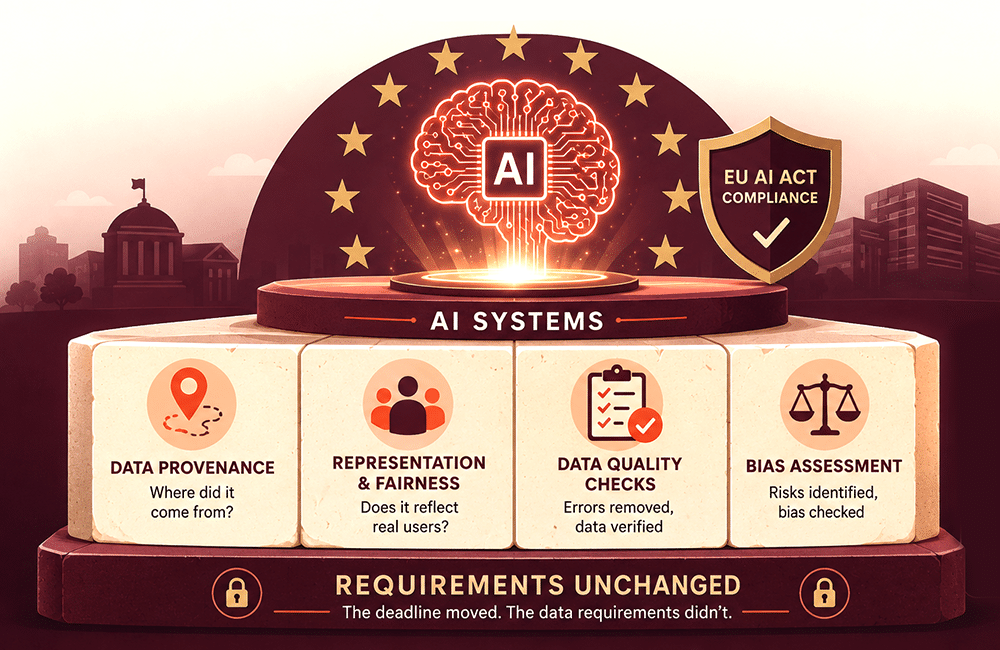
This is the part that did not get easier. AI learns from data, and the law expects that data to be well-chosen, fair, and properly documented — you should be able to show where it came from, that it represents the real people the AI will affect, and that it was checked for obvious mistakes and bias. None of that changed in the reshuffle. The deadline moved; the homework didn’t. If anything, the extra time is meant to be used getting this data foundation right, because it’s the part most organisations are weakest on.
What it means for companies
More breathing room, same to-do list. Picture a mid-size company that heard “the deadline moved” and quietly shelved its AI preparation. Months later, a big customer asks for proof of how its AI was built and trained — and the company has nothing on file. It then scrambles for months to reconstruct records it could have kept all along. The lesson: treat the delay as runway, not a day off. A simple starting checklist:
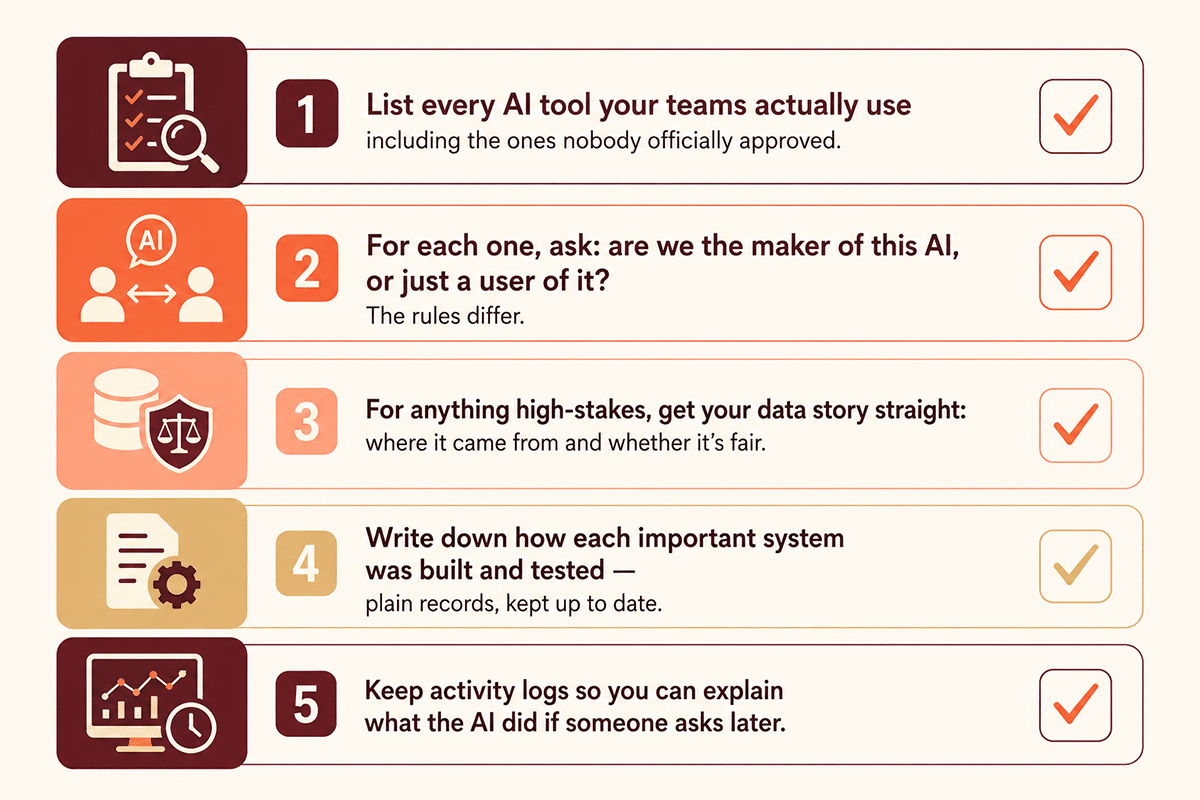
- List every AI tool your teams actually use — including the ones nobody officially approved.
- For each one, ask: are we the maker of this AI, or just a user of it? The rules differ.
- For anything high-stakes, get your data story straight: where it came from and whether it’s fair.
- Write down how each important system was built and tested — plain records, kept up to date.
- Keep activity logs so you can explain what the AI did if someone asks later.
Maker vs. user (why it matters): If you build or heavily change an AI system, you carry the heavier “maker” duties. If you only use a ready-made one, you have lighter “user” duties — but you still can’t simply rely on the maker’s paperwork to cover you.
What it means for end customers

Where Shaip fits in
The hardest part of these rules — for almost everyone — is the data. That’s exactly what we do. Shaip’s data annotation services prepare the training data behind AI systems with clear records of where it came from and how it was checked — the kind of proof these rules expect. For sensitive areas like medicine, Shaip’s healthcare AI data solutions focus on data that fairly represents real, diverse patients. Put simply: we help companies build AI on a foundation they can stand behind when regulators — or customers — ask questions.
The bottom line
The EU moved its toughest AI deadlines to 2027 and 2028, kept the honesty rules largely on schedule, and left the August 2026 date technically alive until the change is official. The expectations around fair, well-documented data didn’t soften at all. Companies that use the extra time to get their data and records in order will be ready when the rules bite — and the customers those systems affect will be better protected for it.