
Ask a humanoid robot to “pick up the red mug on the left and place it in the sink,” and a remarkable amount has to happen at once. The robot must see the mug, parse the instruction, plan a motion, feel the grip pressure, and understand that “the sink” is the wet basin three feet away—not the drawer beside it. No single data stream teaches all of that. Building capable embodied AI is less like training one sense and more like teaching a person to cook: you need sight, hearing, touch, balance, and a feel for the room, all working together. That combined fuel is multimodal data for humanoid robots, and it is the foundation every modern robotics program is racing to get right.
Key Takeaways
- Multimodal data for humanoid robots combines vision, language, action, telemetry, and context into one synchronized training signal.
- Vision-Language-Action (VLA) models convert what a robot sees and hears directly into motor commands.
- Telemetry gives robots a proprioceptive sense—joint angles, force, torque, and balance data over time.
- Teleoperation and egocentric demonstration are the dominant methods for collecting humanoid training data.
- The multimodal AI training data segment is forecast to grow at a 31.1% CAGR through 2029 (Marketsand Markets, 2024).
What is multimodal data for humanoid robots?
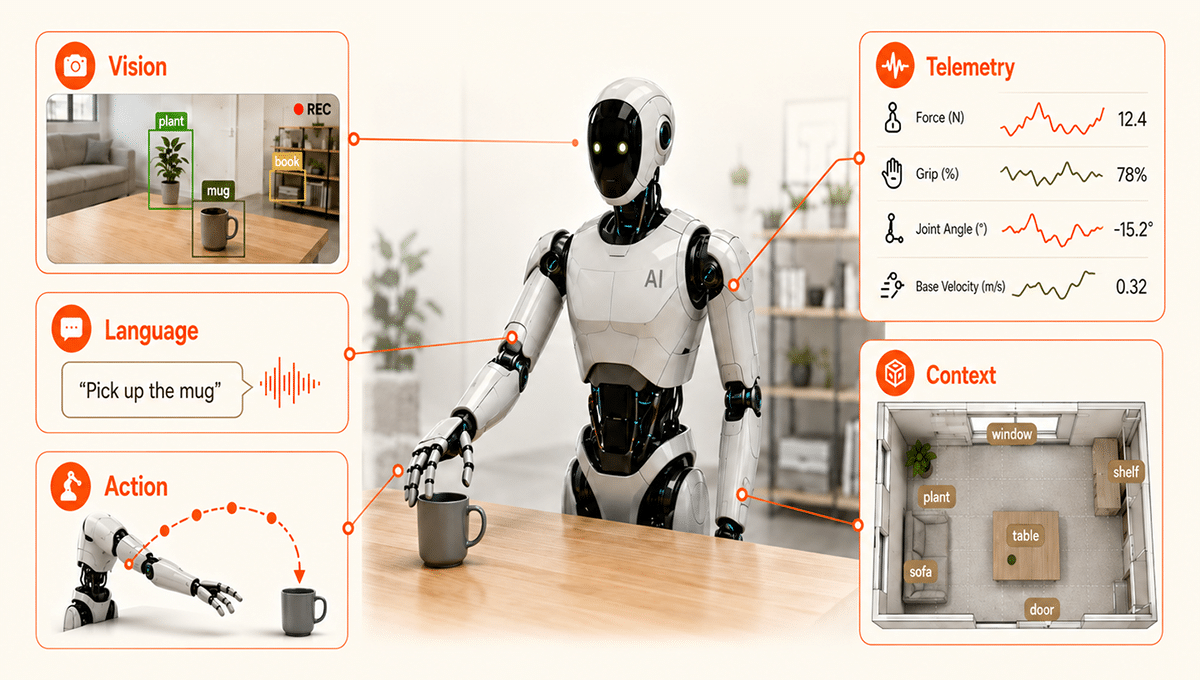
Multimodal data for humanoid robots is synchronized data drawn from several sensory streams—vision, language, action, telemetry, and context—used together to train embodied AI systems. Each stream captures one slice of an interaction, and only their alignment in time produces a usable training example.
Multimodal data: Synchronized information from multiple sensory channels, captured and timestamped together so a model can learn how they relate. A robot that learns from vision alone struggles the moment lighting changes or an object is partly hidden. One that also has force and motion data can keep working when its eyes fall short.
Why can’t humanoid robots learn from a single data type?
Humanoid robots cannot learn reliably from a single data type because real-world tasks are inherently multimodal, and any one sensor has blind spots. Conventional single-modal control is brittle and easily disrupted by environmental change, whereas multimodal sensing improves flexibility and accuracy under unknown conditions.
Vision fails in glare or occlusion. Language alone has no grounding in the physical scene. Action data without telemetry can’t explain why a grasp slipped. Combining streams covers these gaps—mmWave radar, for instance, performs in low-visibility conditions where cameras struggle, which is why production humanoids increasingly fuse it with vision and depth (Texas Instruments, 2026). Reliability comes from redundancy across modalities, not perfection in one.
The five modalities of humanoid robot data
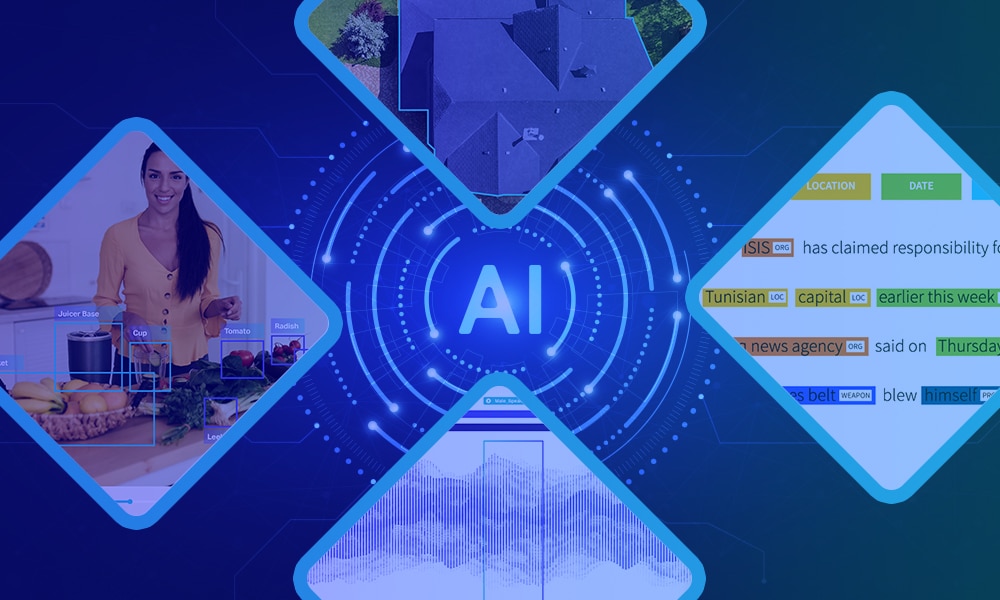
The five core modalities of humanoid robot data are vision, language, action, telemetry, and context. Each plays a distinct role, comes from a different source, and presents its own annotation challenge.
Vision — what humanoid robots see

Vision data gives a humanoid robot its spatial understanding of the world—objects, depth, surfaces, and motion. It typically comes from RGB cameras, depth sensors, and stereo rigs, and forms the largest single labeling category in robotics programs.
Bounding box: A rectangular outline marking an object’s location in an image. Beyond boxes, humanoid vision needs 3D segmentation, pose estimation, and depth labels so the robot can judge how far a handle sits and at what angle to grip it. Image and video annotation accounted for over 41% of all annotation requests in 2024 (Market.us, 2025), reflecting how vision-heavy embodied AI remains.
Language — turning instructions into intent

Language data lets a humanoid robot understand what a person wants and connect those words to objects and actions in the real scene. It spans spoken commands, written prompts, and multi-turn dialogue, and its hardest job is grounding—linking “the red mug” to the actual pixels and coordinates of that mug.
Grounding: The process of mapping words in an instruction to specific objects, locations, or actions in the physical environment. Without grounding, a robot can transcribe a sentence perfectly and still have no idea what to do with it.
Action — vision-language-action and motor commands

Action data records the motor commands and trajectories a robot executes, and it is the bridge that turns perception into movement. This is the heart of Vision-Language-Action (VLA) models.
Vision-Language-Action (VLA) model: An AI model that converts visual input and language instructions directly into robot motor commands. In a VLA system, an action decoder maps internal tokens to the degrees of freedom of the robot’s end effector—positional shifts, rotations, and gripper state. Humanoid VLA research increasingly emphasizes whole-body control and trajectory prediction, not just single-arm manipulation. Training these models well depends on tightly paired vision, language, and action examples, captured under controlled, repeatable conditions.
Telemetry — the robot’s proprioceptive sense

Telemetry is the stream of time-series sensor readings—joint angles, force, torque, and inertial data—that gives a robot its sense of its own body in motion. It is the proprioception layer: the difference between a robot that looks like it’s gripping and one that knows how hard.
Telemetry: Continuous time-series data from onboard sensors such as IMUs, force-torque sensors, and joint encoders, streamed during operation. Contact-rich tasks especially need this; datasets that add tactile and force signals consistently outperform vision-only collections for manipulation, because vision alone can’t register slip or pressure. High-quality humanoid pipelines now synchronize these streams at sub-millisecond precision across 30Hz episodes—a level of alignment that only purpose-built capture rigs achieve.
Context — why situational data changes everything

Context data captures the surrounding situation—environment, task state, and interaction history—that tells a robot what its other signals actually mean. The same arm motion means “hand over a tool” in one setting and “push away” in another; context disambiguates.
Picture a mid-size electronics assembler deploying a humanoid on its line. In testing, the robot performed flawlessly. On the floor, it kept failing one handoff—until the team realized its training data lacked the context of a moving conveyor and a coworker reaching in. Once contextual demonstrations were added, success rates recovered. Context is rarely a separate sensor; it emerges from labeling the relationships between modalities, which is the most demanding part of multimodal data annotation.
How is multimodal humanoid robot data collected?

Multimodal humanoid robot data is collected primarily through teleoperation and demonstration, where humans guide the robot while every sensor records in sync. The process generally follows these steps:
- Set up synchronized capture. Align cameras, microphones, motion-capture, and onboard telemetry to a shared clock so every stream timestamps together.
- Run teleoperated demonstrations. A human operator controls the robot—often via VR headset and hand controllers—to perform target tasks naturally.
- Capture egocentric and third-person video. Record both the robot’s point of view and external angles for richer grounding.
- Log action and telemetry continuously. Stream end-effector commands, joint states, and force readings throughout each episode.
- Validate and segment episodes. Review for sync errors, drop corrupted runs, and split continuous capture into labeled task units.
Teleoperation: Human-guided remote control of a robot, used to capture demonstration data for imitation learning. Recent large humanoid datasets span hundreds of tasks across locomotion, dexterous manipulation, and human-robot interaction—all captured this way. Shaip’s managed crowd captures teleoperated demonstration data across diverse real-world environments, which is what gives downstream models their robustness to lighting, layout, and human variation.
What makes Multimodal Data Annotation for robotics hard?
Multimodal data annotation for robotics is hard because every modality must be labeled and perfectly aligned in time with the others. A vision label that drifts 100 milliseconds from its matching force reading can teach a model the wrong cause-and-effect.
The core difficulties are temporal synchronization across streams, 3D and depth-aware labeling, grounding language to scene elements, and filtering noisy telemetry without losing real signal. Manual workflows still dominate—roughly 78% of labeling in 2025 (Mordor Intelligence, 2026)—precisely because edge cases in embodied data resist full automation. Shaip’s annotation pipelines align time-series telemetry with video frames for VLA model training, treating synchronization as a first-class quality metric rather than an afterthought.
How should you build a Multimodal Data strategy?
A strong multimodal data strategy matches data investment to your robot’s deployment reality, balancing scale, diversity, and quality. Use this framework:
- Start with the task, not the sensor. Map which modalities your actual tasks demand—contact-rich work needs telemetry; navigation needs richer vision and context.
- Prioritize synchronization early. Retrofitting time-alignment is far costlier than building it in.
- Balance breadth and depth. Aggregated cross-platform corpora aid generalization; single-platform data fine-tunes for your specific robot.
- Budget for human-in-the-loop QA. Hybrid pipelines cut annotation time by about 40% while preserving accuracy (Market.us, 2025).
The trade-off is real: broad, diverse data generalizes but dilutes platform-specific precision, while narrow data executes reliably but transfers poorly. Most programs need both, sequenced deliberately.
[Also Read: Robot training data strategy]
Security & Compliance for Humanoid Robot Data

Responsible programs align with recognized standards—ISO 27001 for information security management, SOC 2 for service-provider controls, and GDPR or comparable regimes for personal and biometric data. Consent for demonstrators, data residency, and audit-ready labeling records are no longer optional; the EU AI Act increasingly rewards vendors who can produce traceable, compliant datasets. Treat compliance as a design input, not a final checkbox.
Conclusion
Multimodal data for humanoid robots is the difference between a machine that performs in a demo and one that works on a real floor. Vision tells it what’s there, language tells it what to do, action turns intent into motion, telemetry gives it bodily awareness, and context ties it all to the moment. The hard part was never any single stream—it’s capturing them together, in sync, and labeling the relationships between them. As humanoids move from research labs into warehouses, clinics, and homes, the teams that win will be the ones who treat data not as exhaust, but as the engineered foundation it is.
Building that foundation is exactly what Shaip’s Physical AI data services are built for—purpose-collected, synchronized multimodal datasets spanning vision, language, action, telemetry, and context, gathered through teleoperated demonstration across 60+ countries and annotated under compliance-ready controls. Whether you need targeted fine-tuning data for a single task or a full multimodal collection program for a humanoid deployment, our team can scope it to your robot and timeline. Set up a call to discuss your project details and turn your data strategy into a deployment-ready pipeline.