When most people think of large language models (LLMs), they imagine chatbots that answer questions or write text instantly. But beneath the surface lies a deeper challenge: reasoning. Can these models truly “think,” or are they simply parroting patterns from vast amounts of data? Understanding this distinction is critical — for businesses building AI solutions, researchers pushing boundaries, and everyday users wondering how much they can trust AI outputs.
This post explores how reasoning in LLMs works, why it matters, and where the technology is headed — with examples, analogies, and lessons from cutting-edge research.
What Does “Reasoning” Mean in Large Language Models (LLMs)?
Reasoning in LLMs refers to the ability to connect facts, follow steps, and arrive at conclusions that go beyond memorized patterns.
Think of it like this:
Pattern-matching is like recognizing your friend’s voice in a crowd.
Reasoning is like solving a riddle where you must connect clues step by step.
Early LLMs excelled at pattern recognition but struggled when multiple logical steps were required. That’s where innovations like chain-of-thought prompting come in.
Chain of Thought Prompting
Chain-of-thought (CoT) prompting encourages an LLM to show its work. Instead of jumping to an answer, the model generates intermediate reasoning steps.
For example:
Question: If I have 3 apples and buy 2 more, how many do I have?
With CoT: “You start with 3, add 2, that equals 5.”
The difference may seem trivial, but in complex tasks — math word problems, coding, or medical reasoning — this technique drastically improves accuracy.
Supercharging Reasoning: Techniques & Advances
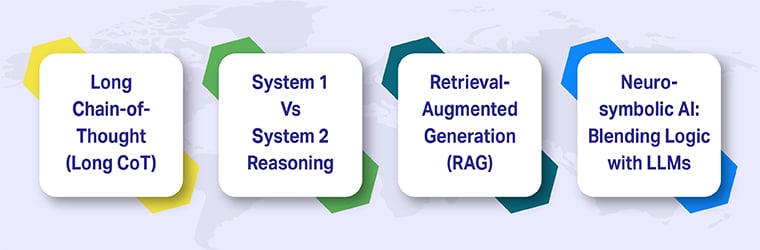
Researchers and industry labs are rapidly developing strategies to expand LLM reasoning capabilities. Let’s explore four important areas.
Long Chain-of-Thought (Long CoT)
While CoT helps, some problems require dozens of reasoning steps. A 2025 survey (“Towards Reasoning Era: Long CoT”) highlights how extended reasoning chains allow models to solve multi-step puzzles and even perform algebraic derivations.
Analogy: Imagine solving a maze. Short CoT is leaving breadcrumbs at a few turns; Long CoT is mapping the entire path with detailed notes.
System 1 vs System 2 Reasoning
Psychologists describe human thinking as two systems:
System 1: Fast, intuitive, automatic (like recognizing a face).
System 2: Slow, deliberate, logical (like solving a math equation).
Recent surveys frame LLM reasoning in this same dual-process lens. Many current models lean heavily on System 1, producing quick but shallow answers. Next-generation approaches, including test-time compute scaling, aim to simulate System 2 reasoning.
Here’s a simplified comparison:
Feature
System 1 Fast
System 2 Deliberate
Speed
Instant
Slower
Accuracy
Variable
Higher on logic tasks
Effort
Low
High
Example in LLMs
Quick autocomplete
Multi-step CoT reasoning
Retrieval-Augmented Generation (RAG)
Sometimes LLMs “hallucinate” because they rely only on pre-training data. Retrieval augmented generation (RAG) solves this by letting the model pull fresh facts from external knowledge bases.
Example: Instead of guessing the latest GDP figures, a RAG-enabled model retrieves them from a trusted database.
Analogy: It’s like phoning a librarian instead of trying to recall every book you’ve read.
👉 Learn how reasoning pipelines benefit from grounded data in our LLM reasoning annotation services.
Neurosymbolic AI: Blending Logic with LLMs
To overcome reasoning gaps, researchers are blending neural networks (LLMs) with symbolic logic systems. This “neurosymbolic AI” combines flexible language skills with strict logical rules.
Amazon’s “Rufus” assistant, for example, integrates symbolic reasoning to improve factual accuracy. This hybrid approach helps mitigate hallucinations and increases trust in outputs.
Real-World Applications
Reasoning-enabled LLMs aren’t just academic — they’re powering breakthroughs across industries:
Healthcare
Assisting in diagnosis by combining symptoms, patient history, and medical guidelines.
Finance
Evaluating risk by analyzing multiple market signals step-by-step.
Education
Personalized tutoring that explains math problems with reasoning steps.
Customer Support
Complex troubleshooting that requires if-then logic chains.
At Shaip, we provide high-quality annotated data pipelines that help LLMs learn to reason more reliably. Our clients in healthcare, finance, and technology leverage this to improve accuracy, trust, and compliance in AI systems.
Limits & Considerations
Even with progress, LLM reasoning is not flawless. Key limitations include:
Hallucinations
Models can still produce plausible-sounding but false answers.
Latency
More reasoning steps = slower responses.
Cost
Long CoT consumes more compute and energy.
Overthinking
Sometimes reasoning chains become unnecessarily complex.
That’s why it’s important to combine reasoning innovations with responsible risk management.
Conclusion
Reasoning is the next frontier for large language models. From chain-of-thought prompting to neurosymbolic AI, innovations are pushing LLMs closer to human-like problem-solving. But trade-offs remain — and responsible development requires balancing power with transparency and trust.
At Shaip, we believe better data fuels better reasoning. By supporting enterprises with annotation, curation, and risk management, we help transform today’s models into tomorrow’s trusted reasoning systems.
What is chain-of-thought prompting?
It’s a technique where LLMs generate intermediate reasoning steps before the final answer, improving accuracy (Wei et al., 2022).
How do LLMs perform System 2 reasoning?
By extending reasoning steps, scaling compute at inference, and combining logic-based modules for deliberate thinking.
What is retrieval-augmented generation (RAG)?
A method that grounds LLMs in external knowledge bases, improving factual reliability and reasoning.
How do neurosymbolic models help reasoning?
They integrate strict logic rules with flexible neural reasoning, reducing hallucinations and improving trust.
What are the limitations of current LLM reasoning?
They include hallucinations, slow performance on long tasks, higher compute costs, and occasional over-complication.
Enjoyed this article? Follow Shaip on LinkedIn for more updates.
Contains information related to marketing campaigns of the user. These are shared with Google AdWords / Google Ads when the Google Ads and Google Analytics accounts are linked together.
90 days
__utma
ID used to identify users and sessions
2 years after last activity
__utmt
Used to monitor number of Google Analytics server requests
10 minutes
__utmb
Used to distinguish new sessions and visits. This cookie is set when the GA.js javascript library is loaded and there is no existing __utmb cookie. The cookie is updated every time data is sent to the Google Analytics server.
30 minutes after last activity
__utmc
Used only with old Urchin versions of Google Analytics and not with GA.js. Was used to distinguish between new sessions and visits at the end of a session.
End of session (browser)
__utmz
Contains information about the traffic source or campaign that directed user to the website. The cookie is set when the GA.js javascript is loaded and updated when data is sent to the Google Anaytics server
6 months after last activity
__utmv
Contains custom information set by the web developer via the _setCustomVar method in Google Analytics. This cookie is updated every time new data is sent to the Google Analytics server.
2 years after last activity
__utmx
Used to determine whether a user is included in an A / B or Multivariate test.
18 months
_ga
ID used to identify users
2 years
_gali
Used by Google Analytics to determine which links on a page are being clicked
30 seconds
_ga_
ID used to identify users
2 years
_gid
ID used to identify users for 24 hours after last activity
24 hours
_gat
Used to monitor number of Google Analytics server requests when using Google Tag Manager
1 minute
Marketing cookies are used to follow visitors to websites. The intention is to show ads that are relevant and engaging to the individual user.
Google Ads is an online advertising platform that enables businesses to create targeted ads displayed on Google search results and partner sites.
Targeting cookie. Used to create a user profile and display relevant and personalised Google Ads to the user.
2 years
__Secure-1PSID
Targeting cookie. Used to create a user profile and display relevant and personalised Google Ads to the user.
2 years
__Secure-3PAPISID
Profiles the interests of website visitors to serve relevant and personalised ads through retargeting.
2 years
AEC
AEC cookies ensure that requests within a browsing session are made by the user, and not by other sites. These cookies prevent malicious sites from acting on behalf of a user without that user's knowledge.
6 months
ADS_VISITOR_ID
Cookie required to use the options and on-site web services
2 months
__Secure-3PSIDCC
Targeting cookie. Used to create a user profile and display relevant and personalised Google Ads to the user.
2 years
__Secure-3PSIDTS
Targeting cookie. Used to create a user profile and display relevant and personalised Google Ads to the user.
2 years
__Secure-1PSIDTS
Targeting cookie. Used to create a user profile and display relevant and personalised Google Ads to the user.
2 years
__Secure-1PAPISID
Targeting cookie. Used to create a user profile and display relevant and personalised Google Ads to the user.
2 years
__Secure-3PSID
Targeting cookie. Used to profile the interests of website visitors and display relevant and personalised Google ads.
2 years
Conversion
Google uses cookies for advertising, including serving and rendering ads, personalizing ads (depending on your ad settings at g.co/adsettings), limiting the number of times an ad is shown to a user, muting ads you have chosen to stop seeing, and measuring the effectiveness of ads.
90 days
_gcl_aw
Google uses cookies for advertising, including serving and rendering ads, personalizing ads (depending on your ad settings at g.co/adsettings), limiting the number of times an ad is shown to a user, muting ads you have chosen to stop seeing, and measuring the effectiveness of ads.
90 Days
_gcl_gs
Google uses cookies for advertising, including serving and rendering ads, personalizing ads (depending on your ad settings at g.co/adsettings), limiting the number of times an ad is shown to a user, muting ads you have chosen to stop seeing, and measuring the effectiveness of ads.
90 Days
_gcl_gb
Google uses cookies for advertising, including serving and rendering ads, personalizing ads (depending on your ad settings at g.co/adsettings), limiting the number of times an ad is shown to a user, muting ads you have chosen to stop seeing, and measuring the effectiveness of ads.
90 Days
_gac_gb_
Google uses cookies for advertising, including serving and rendering ads, personalizing ads (depending on your ad settings at g.co/adsettings), limiting the number of times an ad is shown to a user, muting ads you have chosen to stop seeing, and measuring the effectiveness of ads.
90 Days
FPGCLGB
Google uses cookies for advertising, including serving and rendering ads, personalizing ads (depending on your ad settings at g.co/adsettings), limiting the number of times an ad is shown to a user, muting ads you have chosen to stop seeing, and measuring the effectiveness of ads.
90 Days
FPGCLAW
Google uses cookies for advertising, including serving and rendering ads, personalizing ads (depending on your ad settings at g.co/adsettings), limiting the number of times an ad is shown to a user, muting ads you have chosen to stop seeing, and measuring the effectiveness of ads.
90 Days
HubSpot is an all-in-one marketing, sales, and customer service platform that streamlines business growth.
This cookie is used to recognize visitors who chat with you via the chatflows tool. If the visitor leaves your site before they're added as a contact, they will have this cookie associated with their browser.
13 months
__hs_do_not_track
This cookie can be set to prevent the tracking code from sending any information to HubSpot.
13 months
__hs_cookie_cat_pref
This cookie is used to record the categories a visitor consented to.
6 months
__hs_initial_opt_in
This cookie is used to prevent the banner from always displaying when visitors are browsing in strict mode.
7 days
__hs_gpc_banner_dismiss
This cookie is used when the Global Privacy Control banner is dismissed.
180 days
hs_ab_test
This cookie is used to consistently serve visitors the same version of an A/B test page they’ve seen before.
session
__hs_notify_banner_dismiss
This cookie is used when the website uses a Notify consent banner type.
180 days
hs-messages-is-open
This cookie is used to determine and save whether the chat widget is open for future visits.
30 minutes
hs-messages-hide-welcome-message
This cookie is used to prevent the chat widget welcome message from appearing again for one day after it is dismissed.
1 day
__hsmem
This cookie is set when visitors log in to a HubSpot-hosted site.
1 year
hs-membership-csrf
This cookie is used to ensure that content membership logins cannot be forged.
session
hs_langswitcher_choice
This cookie is used to save the visitor's selected language choice when viewing pages in multiple languages.
2 years
__hstc
The main cookie for tracking visitors.
13 months
hubspotutk
This cookie keeps track of a visitor's identity. It is passed to HubSpot on form submission and used when deduplicating contacts.
13 months
__hssc
This cookie keeps track of sessions.
30 minutes
__hssrc
Whenever HubSpot changes the session cookie, this cookie is also set to determine if the visitor has restarted their browser.
session
hubspotapi-prefs
This is used with the hubspotapi cookie to remember whether the user checked the 'remember me' box (controls the expiration of the main cookie's authentication).
1 Year
hubspotapi-csrf
This is used for CSRF prevention - preventing third party websites from accessing your data. Expires after a year.
1 year
__hs_opt_out
This cookie is used by the opt-in privacy policy to remember not to ask the visitor to accept cookies again.
13 months
hubspotapi
This cookie allows the user to access the app with the correct permissions.