
You call your bank at 9pm to dispute a charge. A voice picks up, understands the problem on the first try, pulls up the transaction, confirms your identity, and resolves it — no hold music, no transfer, no “press 4 to return to the main menu.” That interaction feels like a triumph of AI.

It is. But not in the way most people assume. The model is largely commodity now. What made that call work was thousands of hours of recorded speech from people who talk like you, labeled by annotators who agreed on what “dispute a charge” means, screened for the accents and phrasings the system will actually hear, and governed so that nobody’s voice ended up in a training set without consent.
That is the real story of conversational AI in 2026. The market is heading toward $82.46B at roughly 21% CAGR, 78% of organizations now use AI in at least one business function, and 75% are set to deploy large language models for customer support. The technology is settled. The differentiator has moved down the stack, to the data. Here’s how the whole thing fits together.
What Conversational AI Actually Is
Conversational AI is the family of systems — chatbots, virtual agents, voice assistants — that combine speech recognition, natural language understanding, and speech generation to hold a natural, back-and-forth conversation, and that get better each time they’re used.
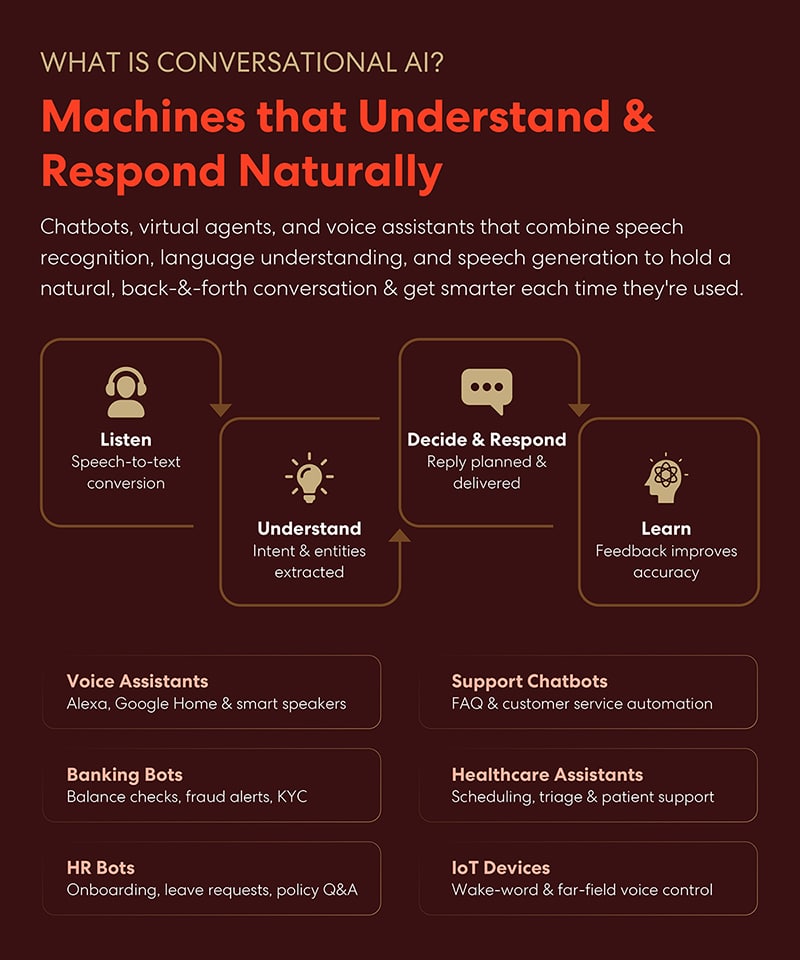
Underneath the variety, they all run the same four-step loop.
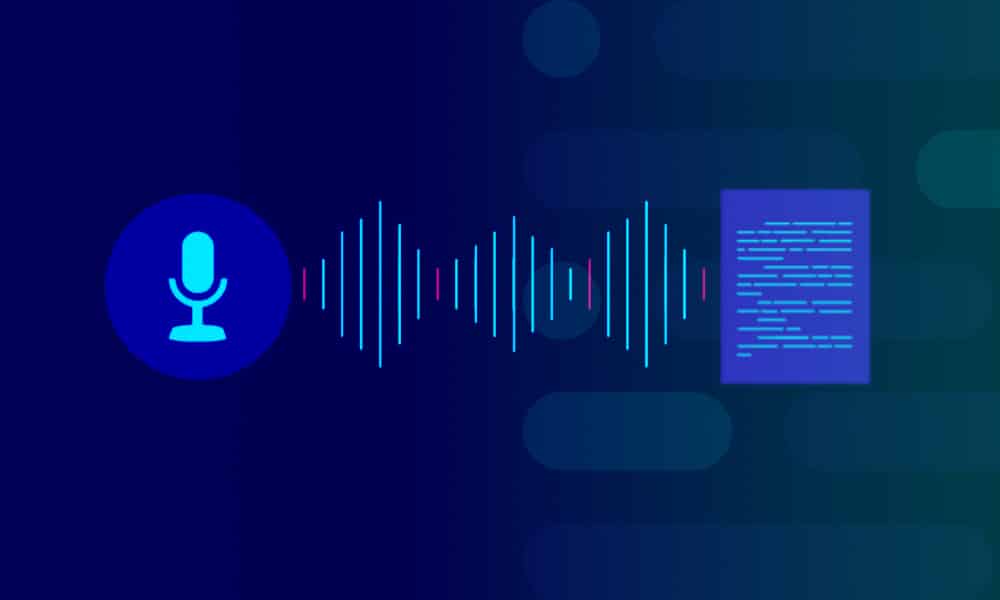
- The system listens, converting speech to text.
- It understands, extracting intent and entities — what the user wants, and the specific details attached to that want.
- It decides and responds, planning a reply and delivering it.
- And it learns, using feedback signals to improve accuracy on the next turn and the next user.
Listen → understand → decide → learn. Every product below is a different domain wrapped around that same loop.
- Voice assistants like Alexa and Google Home handle open-ended household requests through smart speakers.
- Support chatbots automate FAQ handling and customer service triage.
- Banking bots run balance checks, fraud alerts, and KYC verification.
- Healthcare assistants manage scheduling, symptom triage, and patient support.
- HR bots field onboarding questions, leave requests, and policy Q&A.
- And IoT devices rely on wake-word detection and far-field voice control, where the microphone is across the room and the user isn’t looking at a screen.
Same pipeline, radically different failure conditions. A retail chatbot that misreads intent costs a conversion. A healthcare triage assistant that misreads intent is a patient-safety event. That difference is settled in the data, not the architecture.
How Raw Speech Becomes Training Data
Getting from a recording to a model-ready dataset takes two distinct passes: choosing how the speech is gathered, then labeling it so a model can learn from it. Teams that treat these as one step tend to end up with a large dataset that teaches the wrong things.
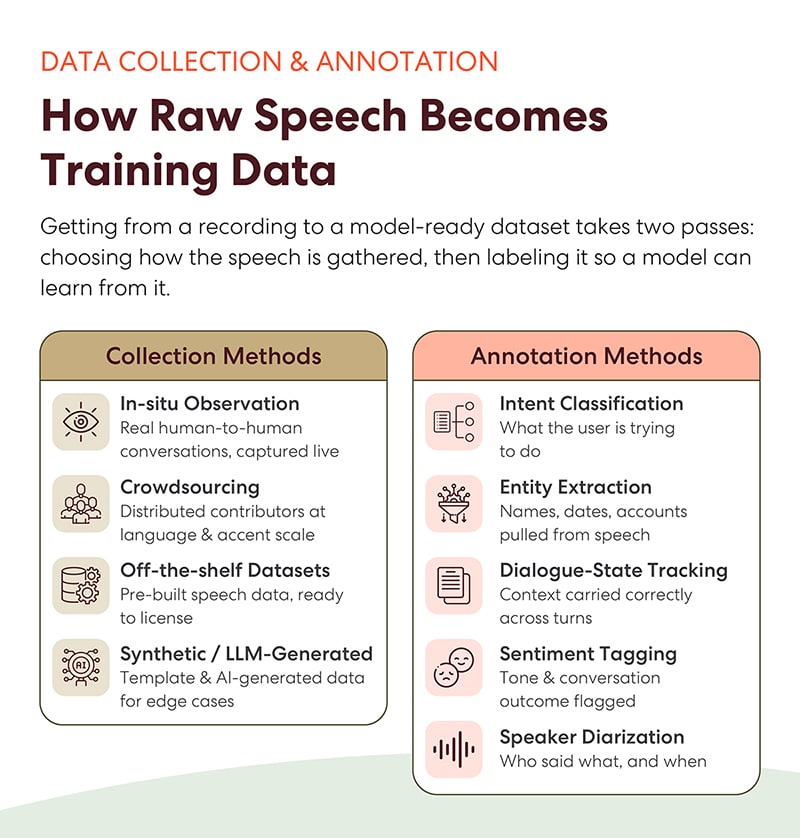
On the collection side, four methods cover most needs.
- In-situ observation captures real human-to-human conversations live — the most faithful signal available, and the hardest to obtain at scale.
- Crowdsourcing distributes recording to contributors selected by language and accent, which is how coverage gets built deliberately rather than accidentally.
- Off-the-shelf datasets provide pre-built, pre-cleared speech data ready to license, cutting months off a timeline when the domain is a reasonable match.
- And synthetic or LLM-generated data fills specific gaps — template-based and AI-generated utterances for edge cases too rare to wait for.
On the annotation side, five labeling layers turn audio into supervision.
- Intent classification tags what the user is trying to do.
- Entity extraction pulls the names, dates, and account numbers out of the speech.
- Dialogue-state tracking carries context across turns, so the system knows that “the second one” refers to something mentioned four turns ago.
- Sentiment tagging flags tone and conversation outcome.
- And speaker diarization establishes who said what, and when — non-negotiable for any multi-party recording, which is to say for most real call data.
Collect → transcribe → label intents and entities → track state → diarize → validate. Skip a layer and you get a model that transcribes fluently and understands nothing.
What “Good Data” Is Actually Measured By
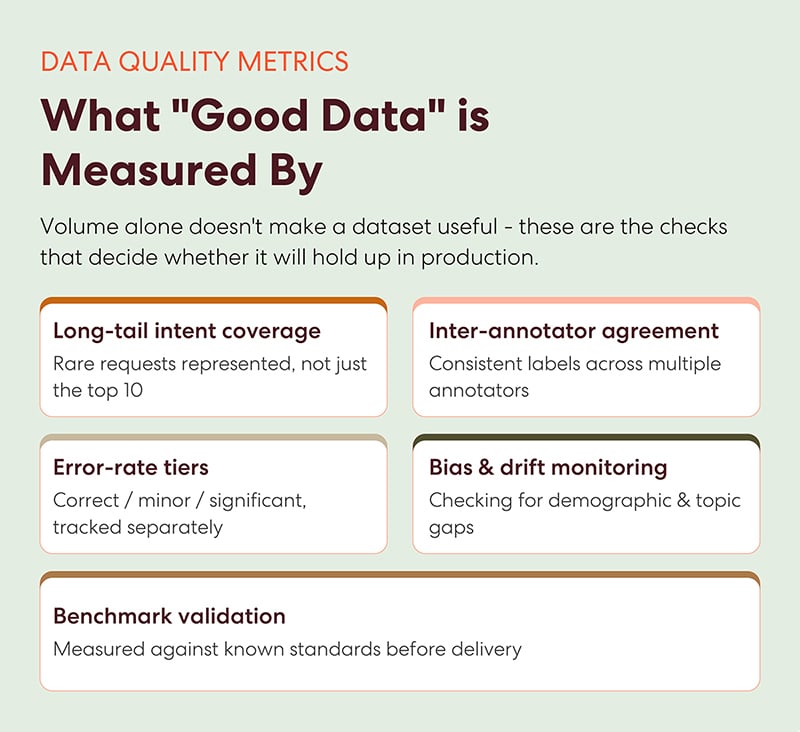
Volume alone doesn’t make a dataset useful. Five checks decide whether it will hold up in production, and they’re worth asking any vendor about directly.
- Long-tail intent coverage asks whether rare requests are represented, not just the top ten. Most datasets are dominated by the handful of intents users hit constantly — and most production failures happen in the tail.
- Inter-annotator agreement measures whether multiple annotators label the same utterance the same way; low agreement means your labels encode confusion rather than ground truth.
- Error-rate tiers separate correct from minor from significant errors and track them independently, because a 3% error rate made up of catastrophic misclassifications is not the same product as a 3% rate of trivial ones.
- Bias and drift monitoring checks for demographic and topic gaps, and watches them over time as language and user behavior shift.
- And benchmark validation measures the dataset against known standards before delivery, so quality is established before it becomes your problem.
These five are the difference between a dataset you can deploy on and a dataset you have to re-do.
Trust Is Built into the Data Layer, Not Bolted On
Speech data carries a person’s voice and words — two of the most identifying things about them. Governance has to be designed in from collection onward, because there is no way to retroactively add consent to a recording you already trained on.
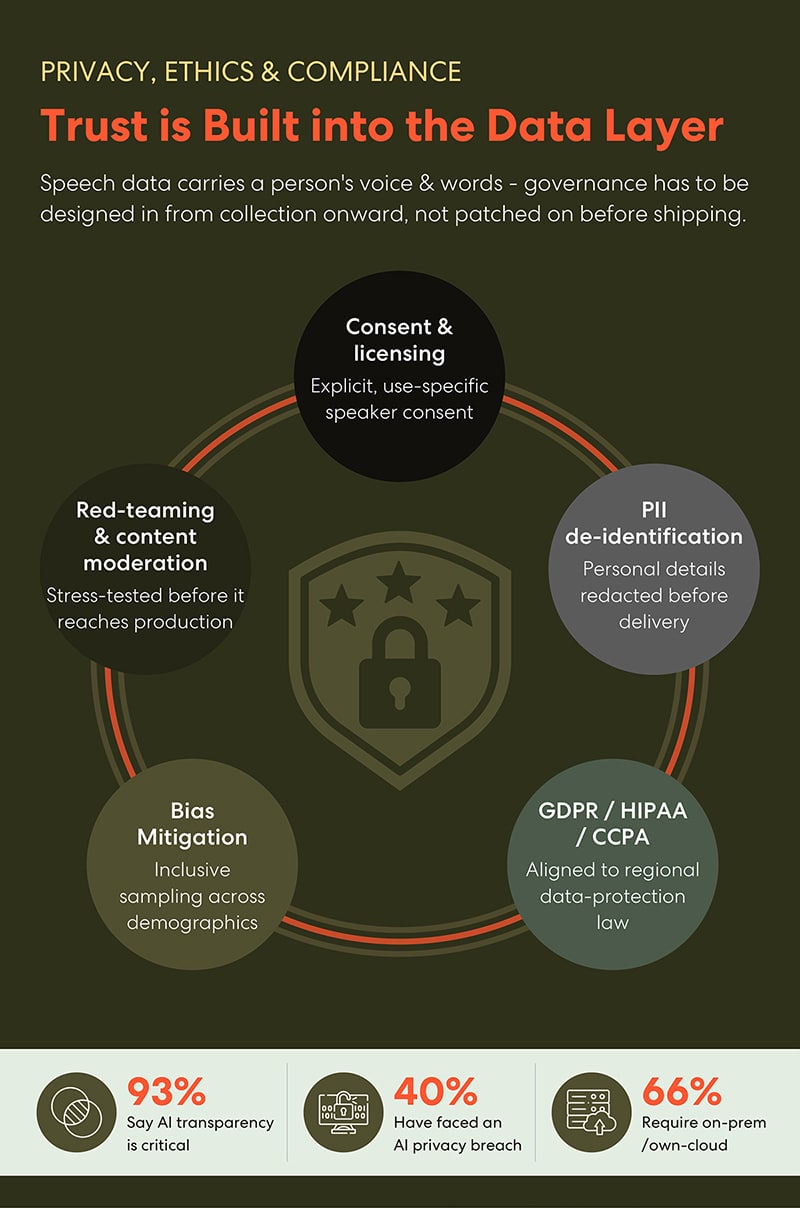
Five controls define a defensible data layer.
- Consent and licensing means explicit, use-specific speaker consent — not a blanket terms-of-service clause.
- PII de-identification redacts personal details before delivery, not after an incident.
- GDPR, HIPAA, and CCPA alignment maps the pipeline to the regional data-protection law that actually applies to the deployment.
- Bias mitigation builds inclusive sampling across demographics into the collection plan, where it costs nothing, rather than into remediation, where it costs everything.
- And red-teaming and content moderation stress-tests the system before it reaches production users.
The market has priced this in. 93% of organizations say AI transparency is critical, 40% have already faced an AI privacy breach, and 66% now require on-premise or own-cloud deployment. Buyers are asking where the data came from — and increasingly, they want the answer in a contract.
Where Conversational AI Shows Up
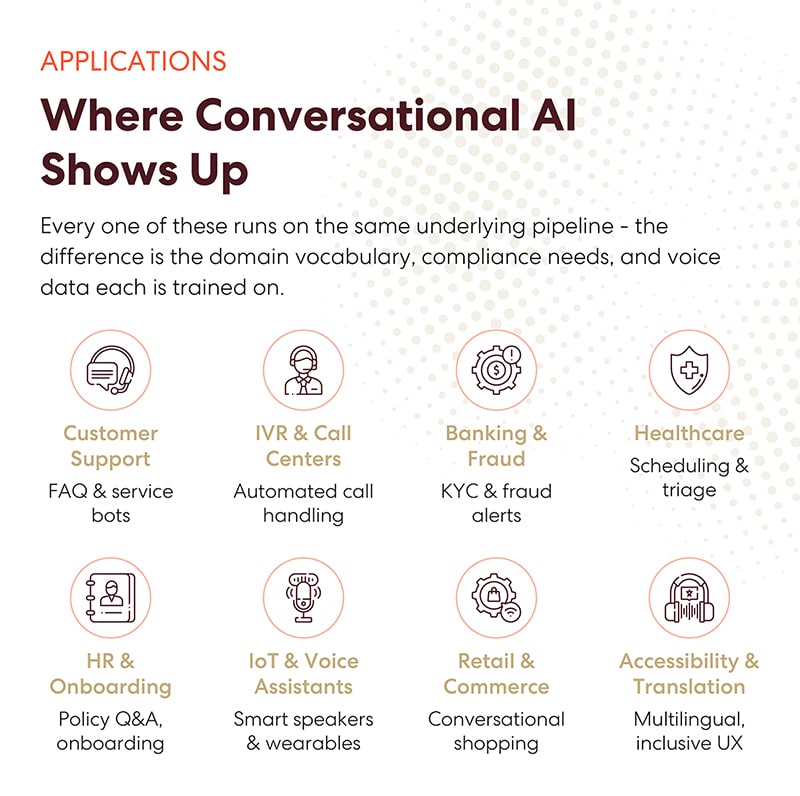
Eight application areas account for most enterprise deployment.
- Customer support runs FAQ and service bots.
- IVR and call centers automate call handling and routing.
- Banking and fraud covers KYC verification and fraud alerting.
- Healthcare handles scheduling and triage.
- HR and onboarding manages policy Q&A and new-hire workflows.
- IoT and voice assistants power smart speakers and wearables.
- Retail and commerce enables conversational shopping.
- And accessibility and translation delivers multilingual, inclusive user experience to people the standard interface leaves out.
Every one of these runs on the same underlying pipeline. The difference is the domain vocabulary, the compliance requirements, and the voice data each one is trained on. That last variable is the one teams underinvest in and the one that determines whether the deployment works outside the demo.
Better Conversational AI Starts with Better Data
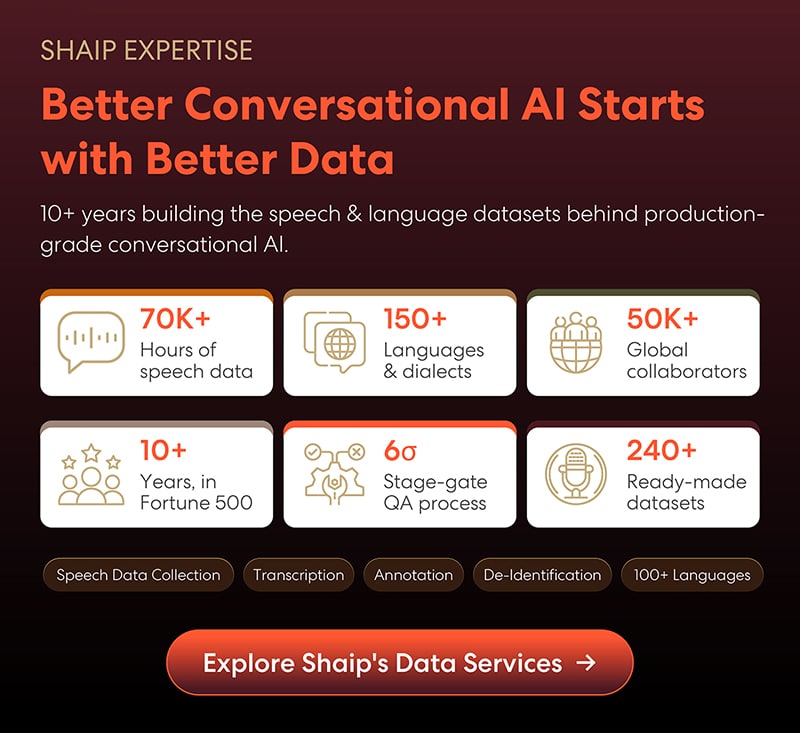
Closing the gap between a working prototype and a production-grade assistant is a data-operations problem, and it’s the one Shaip has spent over a decade on:
- 70K+ hours of speech data,
- 150+ languages and dialects,
- 50K+ global collaborators,
- 10+ years serving Fortune 500 AI teams,
- a six-sigma stage-gate QA process,
- 240+ ready-made datasets available off the shelf when timelines don’t allow for collection from scratch.
Across speech data collection, transcription, annotation, and de-identification, the goal is the same: training data that reflects the people your product will actually talk to, with the consent trail and quality metrics to prove it.
The Bottom Line
Conversational AI has stopped being a technology question. The loop is well understood, the models are widely available, and the applications are line items in budgets across every industry. What remains genuinely hard is the data layer — long-tail coverage, label agreement, demographic balance, consent, and de-identification.
That’s also where the advantage sits. Two teams using the same model will ship products of very different quality, and the gap will trace back to what their systems were trained on. If you’re building conversational AI, the most consequential decisions you’ll make aren’t about architecture. They’re about whose voices are in your dataset, how well they’re labeled, and whether you had the right to use them.