

Every computer vision team eventually hits the same wall: the data you need most is the data you can’t get. The near-miss at the intersection. The defect that shows up once in ten thousand units. The scenario too dangerous, too rare, or too private to capture on camera.
This is where synthetic data earns its place — computer-generated images and scenes that fill the gaps real-world collection can’t reach. But synthetic data is a tool, not a shortcut, and teams that treat it as a free lunch tend to discover its failure modes in production. Here’s a clear-eyed look at when it helps, when it backfires, and how to use it well.

Use Synthetic Data When You Need
Five situations consistently justify reaching for synthetic data.

Rare edge cases. Near-misses, unusual object interactions, uncommon scenarios — the events that matter most for safety and robustness are precisely the ones your real dataset barely contains. Synthetic generation lets you manufacture a thousand variations of an event you’ve only seen twice.
Controlled coverage. Real-world collection gives you the lighting, backgrounds, occlusion levels, and camera angles you happened to capture. Synthetic pipelines let you sweep those variables systematically — every sun angle, every partial occlusion, every lens height — so coverage becomes a design decision instead of an accident.
Fast iteration. When you’re bootstrapping a model before full-scale collection, synthetic data gets a first version training in days rather than months. You learn what the model struggles with before you spend the collection budget.
Privacy and compliance constraints. In sensitive environments where real capture is restricted — hospitals, schools, workplaces with strict privacy rules — synthetic scenes provide training signal without a single real face or identity in the pipeline.
Class balance support. When some classes are badly underrepresented, models train unstably and ignore the minority. Synthetic examples can boost underrepresented classes to restore training stability.
The Watch-Outs: Synthetic Can Backfire If
Now the honest part. Synthetic data fails in predictable ways, and every one of them is avoidable if you know to look.
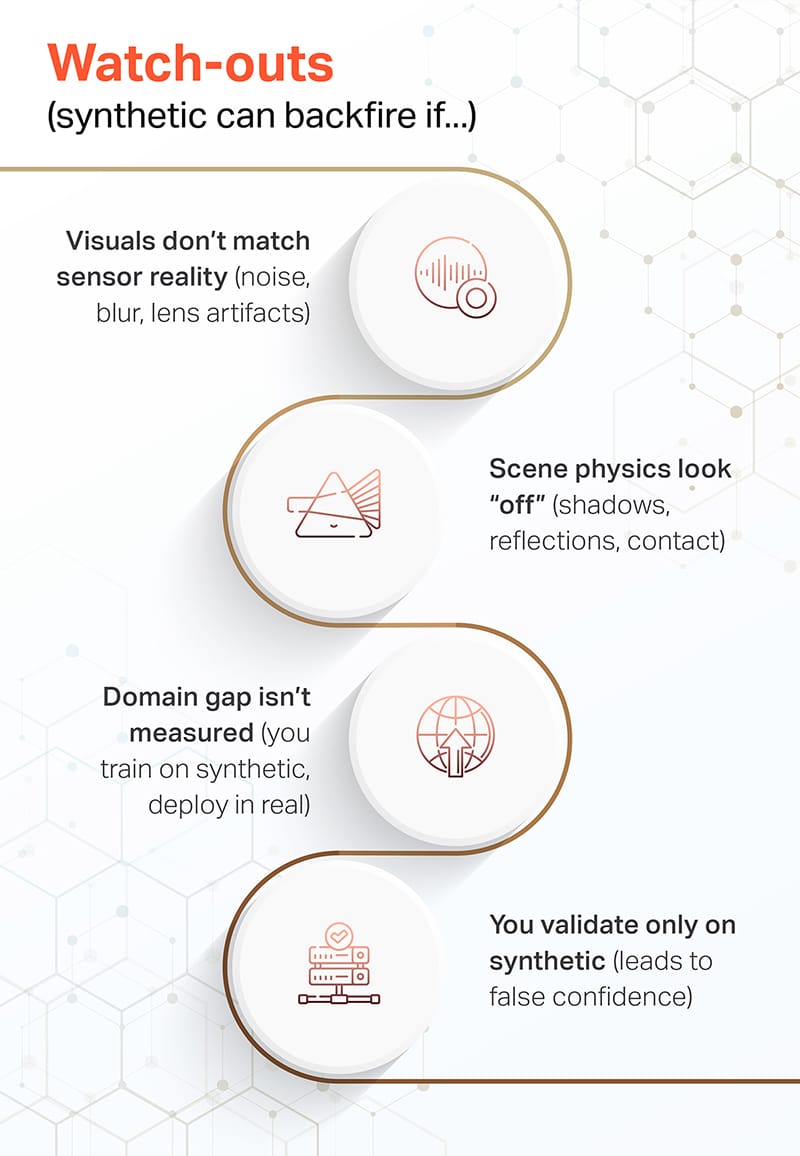
Visuals don’t match sensor reality. Your deployment camera has noise, blur, and lens artifacts. If your synthetic images are cleaner than anything your sensor will ever produce, the model learns a world that doesn’t exist.
Scene physics look “off.” Shadows that fall the wrong way, reflections that don’t behave, objects that don’t quite make contact with surfaces. Humans shrug these off; models absorb them as ground truth.
The domain gap isn’t measured. The classic failure: train on synthetic, deploy in real, and never quantify the difference between the two. If you aren’t measuring the domain gap, you’re guessing.
You validate only on synthetic. This is the most dangerous one, because it produces false confidence — a model that scores brilliantly on synthetic test sets and falls apart on real inputs. Synthetic validation tells you the model learned your simulator, not your world.
The Best-Practice Approach
Teams that succeed with synthetic data follow the same five-step loop.
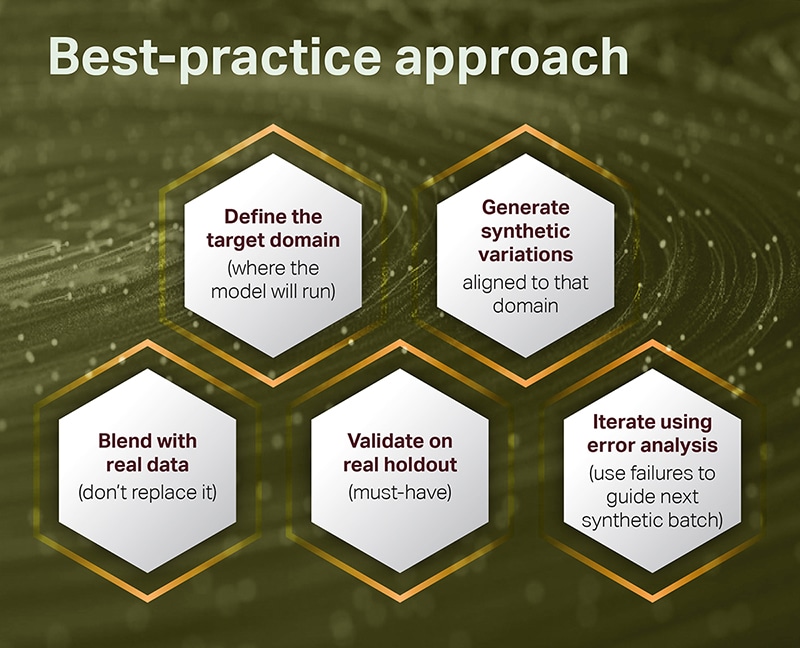
First, define the target domain — the actual conditions where the model will run, down to the sensor, environment, and lighting. Second, generate synthetic variations aligned to that domain, not generic pretty renders. Third, blend with real data — synthetic complements real capture; it doesn’t replace it. Fourth, validate on a real holdout set. This one is a must-have, full stop: your benchmark must be real data the model has never seen. And fifth, iterate using error analysis — let the model’s real-world failures guide what the next synthetic batch should contain.
Define → generate → blend → validate on real → iterate. The loop matters more than any single step.
Should You Use Synthetic Data? A Quick Decision Framework
Four questions settle most debates.
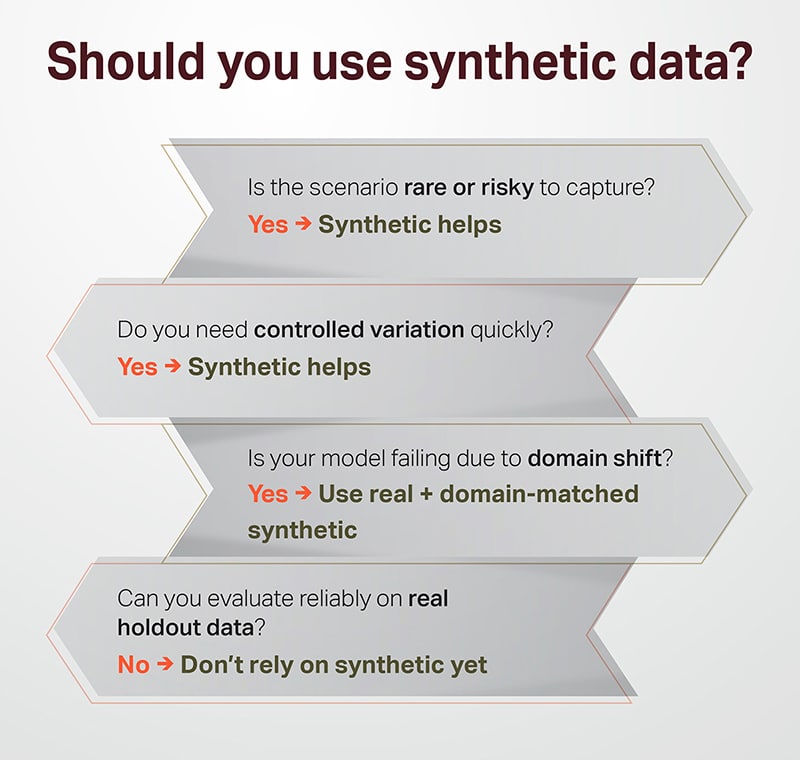
Is the scenario rare or risky to capture? If yes, synthetic helps. Do you need controlled variation quickly? If yes, synthetic helps. Is your model failing due to domain shift? If yes, use real data plus domain-matched synthetic — synthetic alone won’t close a gap it can’t see. And finally: can you evaluate reliably on real holdout data? If no, don’t rely on synthetic yet — build your real evaluation set first, because without it you can’t tell whether synthetic is helping or quietly hurting.
The Bottom Line
Synthetic data is one of the most powerful tools in the computer vision toolkit — for edge cases, coverage, speed, privacy, and balance. It’s also one of the easiest to misuse, because its failure modes hide behind good-looking metrics until deployment day.
The teams getting it right treat it as an engineering discipline: real data as the foundation, synthetic as targeted reinforcement, and real-world validation as the non-negotiable referee. That’s the approach Shaip takes with CV teams — planning the right mix of real and synthetic data, with measurable QA and deployment-focused validation, so the model that works in training is the same one that works in the field.