
Your voice model works beautifully in the demo. Then it meets a real user — someone with a Scottish accent, ordering in Hinglish, from a moving car — and the transcript falls apart.
This is the uncomfortable truth of voice AI in 2026: models don’t fail because the architecture is wrong. They fail because the dataset never spoke the world’s languages. Your voice model won’t scale unless your training data does — and that makes multilingual speech data one of the most strategic assets in AI today.

Why Most Voice AI Models Fail in Real-World Settings
Five challenges account for the vast majority of real-world voice AI failures — and notably, roughly 7 in 10 speech models fall short due to linguistic diversity gaps in their training data.
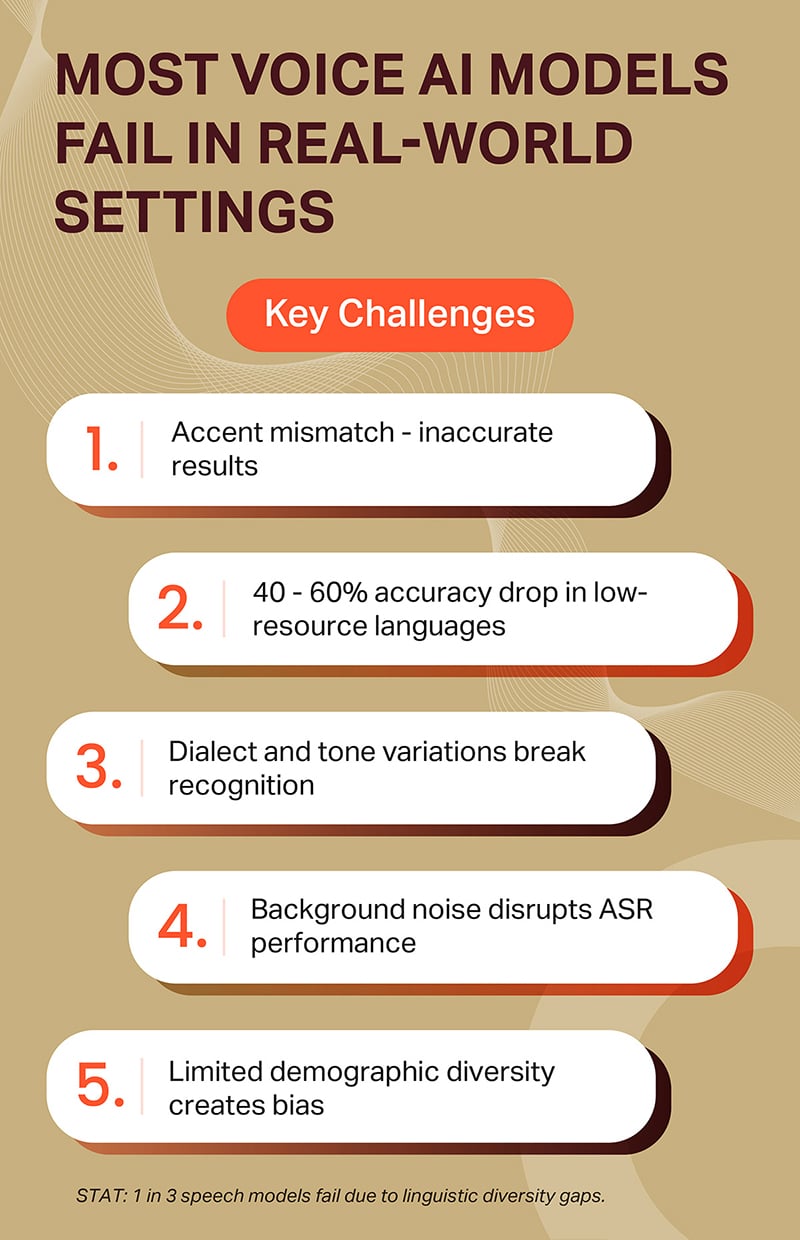
Accent mismatch comes first: a model trained mostly on American English produces inaccurate results the moment it hears the same words with different vowels.
Low-resource languages suffer worse — accuracy drops of 40–60% are typical when a model meets a language that was thin in its training data.
Dialect and tone variations break recognition even within a single language; “English” is not one thing, and neither is Arabic, Spanish, or Mandarin.
Background noise — traffic, kitchens, call-center chatter — disrupts ASR performance in exactly the environments where voice interfaces are most useful.
And limited demographic diversity in training data creates bias: models that hear young urban speakers well and older or rural speakers poorly.
None of these are model problems. All of them are data problems.
AI Must Understand Real People in Real Conditions
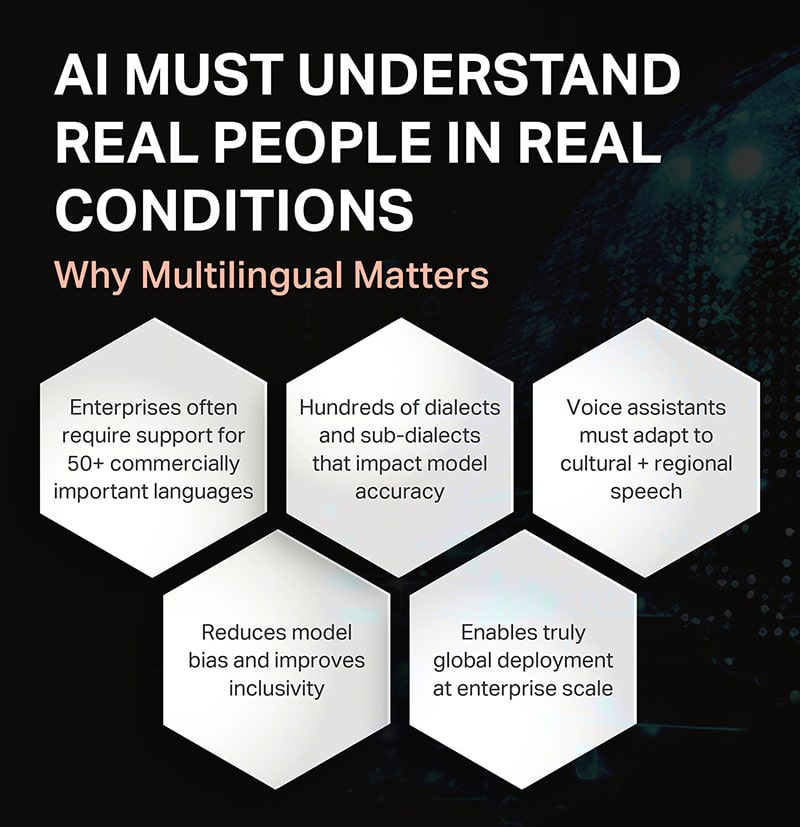
Why does multilingual data matter so much at the enterprise level? Because the scale of the problem is bigger than most teams assume.
Enterprises routinely require support for 50+ commercially important languages — and beneath those languages sit hundreds of dialects and sub-dialects that directly impact model accuracy. Voice assistants must adapt to cultural and regional speech, not just vocabulary: pacing, politeness forms, code-switching. Getting this right reduces model bias and improves inclusivity — the users most often failed by voice AI are the ones already underserved. And ultimately, diverse speech data is what enables truly global deployment at enterprise scale: one product that works in Mumbai, Mexico City, and Manchester alike.
Multilingual Speech Dataset DNA: What a Powerful Dataset Covers
So what does world-class speech data actually look like? Six dimensions — think of them as the dataset’s DNA.
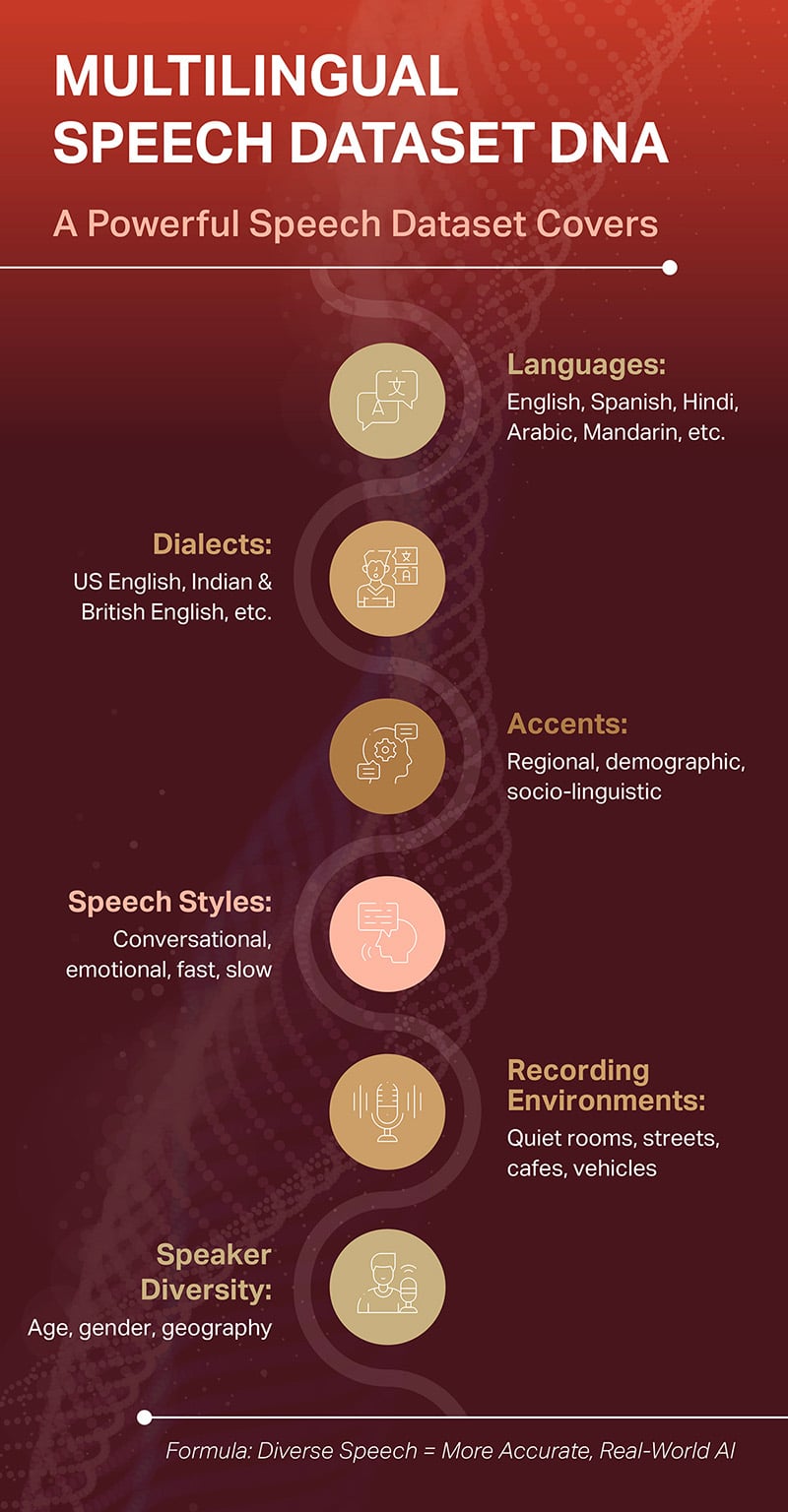
Languages: broad coverage across English, Spanish, Hindi, Arabic, Mandarin, and beyond.
Dialects: distinct variants like US, Indian, and British English treated as what they are — different speech patterns, not one bucket.
Accents: regional, demographic, and socio-linguistic variation within each dialect.
Speech styles: conversational, emotional, fast, slow — because nobody talks to a voice assistant the way they read a script.
Recording environments: quiet rooms, streets, cafés, vehicles — the acoustic conditions of real life.
Speaker diversity: balanced coverage across age, gender, and geography.
The formula is simple: diverse speech = more accurate, real-world AI. Every dimension you skip becomes a user segment your product fails.
Where Multilingual Speech AI Delivers: Enterprise Use Cases
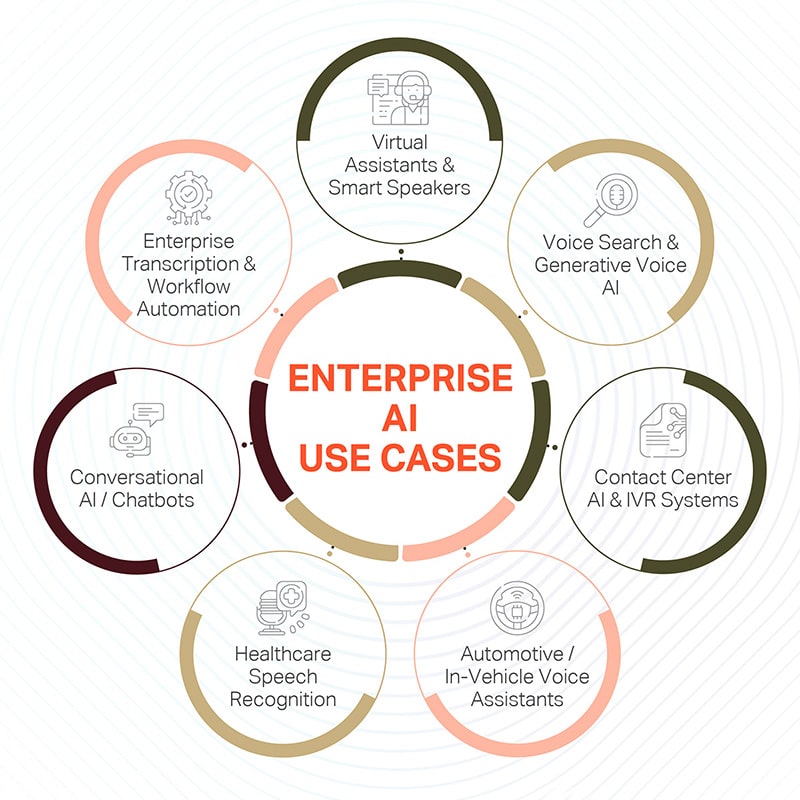
The applications span nearly every industry touchpoint where humans talk to machines: virtual assistants and smart speakers; voice search; enterprise transcription and workflow automation; conversational AI and chatbots; contact center AI and IVR systems; healthcare speech recognition, where accuracy directly affects care; and automotive in-vehicle voice assistants, where noise and accents collide in one hard environment.
In every one of these, the ceiling on user experience isn’t the model — it’s how much of the world’s speech the model has actually heard.
How Shaip Enables World-Class Speech AI
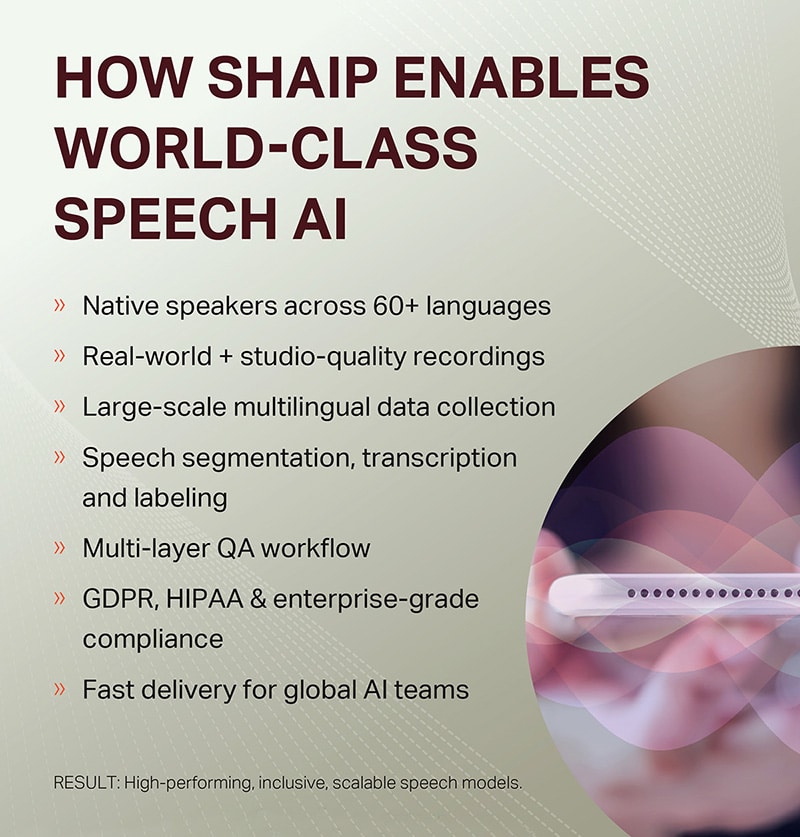
Closing linguistic diversity gaps takes more than scraping audio — it takes deliberate, quality-controlled data operations. This is where Shaip comes in: native speakers across 60+ languages; real-world and studio-quality recordings; large-scale multilingual data collection; speech segmentation, transcription, and labeling; a multi-layer QA workflow; GDPR, HIPAA, and enterprise-grade compliance; and fast delivery for global AI teams.
The result is training data that reflects the people your product will actually serve — not just the ones easiest to record.
The Bottom Line
Voice AI has crossed the threshold from novelty to infrastructure, but its biggest failures still trace back to a single root cause: datasets that don’t sound like the world. Accents, dialects, noise, and demographic diversity aren’t edge cases — they’re the deployment environment.
Build voice AI that understands the world, and start where the failures start: the data.