
Pose estimation is the computer-vision task of locating body keypoints — joints and facial landmarks — and connecting them into a skeleton that describes how a person or object is positioned and moving. For physical AI, that skeletal motion data is the bridge that turns observed human movement into actions a robot can imitate and execute.
That last sentence is where the industry’s attention has quietly moved. For a decade, pose estimation lived in fitness apps and sports broadcasts — useful, but bounded. Now the same keypoints and skeletons have become a core training signal behind humanoid robots, autonomous systems, and vision-language-action models. When a robot learns to pour, stack, sort, or hand something to a person, much of what it learned came from watching how humans did it first — and that watching is pose data.
What Pose Estimation Actually Captures
At its core, pose estimation detects a set of keypoints — anatomical landmarks such as shoulders, elbows, wrists, hips, knees, and ankles, plus facial points like eyes, nose, and ears — and links them into a skeleton that represents posture and motion. Track that skeleton across frames and you have a compact, machine-readable description of how a body moves through time.
The field splits along a few familiar lines. Human pose estimation focuses on people; the same techniques extend to animals and objects. Detection can be 2D (locating keypoints as x, y pixel coordinates) or 3D (adding depth, z, for a true spatial skeleton). There are further model-layer choices — single- versus multi-person detection, for instance — but those are architecture decisions for the model team, not properties of the training data. What decides whether a pose model succeeds isn’t the detection strategy; it’s the accuracy, consistency, and coverage of the keypoints it learned from. That is a data problem, and it’s the part teams underestimate.
Why Pose Data Is the Missing Link for Physical AI
A physical AI system has to close a loop a chatbot never does: perceive the world, decide, and then act on it physically. Perception has matured — robots can see. The hard part is grounding what they see in coordinated, physically correct action, and pose and motion data is what grounds it.
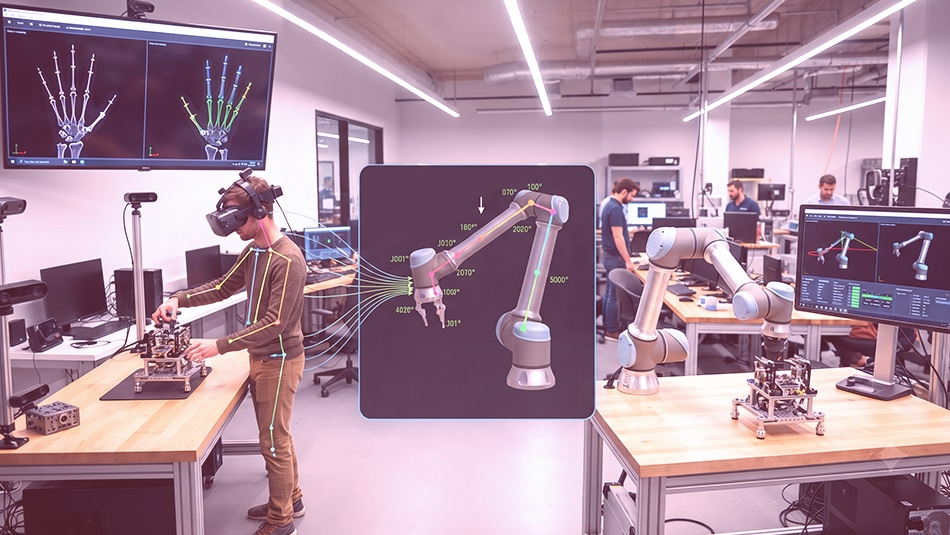
Consider how modern robot-learning pipelines acquire skills. Real robot demonstrations, captured through teleoperation, are precise but slow and costly to collect. So teams increasingly pretrain on something far more abundant: video of humans performing tasks. Recent robotics research has shown that policies pretrained on large-scale egocentric human video can generalize better than those trained on robot data alone, because human video carries the diversity, physics, and task structure that lab-collected robot data can’t match at scale.
But raw human video isn’t directly usable by a robot. A robot doesn’t have a body identical to yours; it has its own joints, end-effectors, and degrees of freedom. Pose estimation is the translation layer. By reducing a human demonstration to a structured skeleton — and, critically, a hand skeleton — that motion can be retargeted onto a robot’s kinematics and turned into action trajectories a policy can train on. This is exactly the input that vision-language-action (VLA) models are hungry for.
Pose data shows up across the physical-AI stack in three recurring forms: operator pose captured during teleoperation, worker pose for collaborative robots that must share space safely with people, and human-demonstration pose harvested from first-person egocentric video and retargeted into robot action. In every case, the quality of the skeleton sets the ceiling on the quality of movement the robot can learn.
From Motion Capture to Robot Motion
The bridge from human movement to robot motion often runs through parametric 3D body-model techniques that fit a full body — and hands — to estimated keypoints, producing physically coherent motion from ordinary video. That is markerless motion capture, in effect. For robotics, the fitted body becomes a source of clean action trajectories: reach, grasp, lift, place, release, each phase segmented and timed. The better the underlying pose annotation, the cleaner the retargeted trajectory.
2D vs 3D Pose — Which One Your Robot Actually Needs
This is the question robotics teams ask most, and the honest answer is: it depends on what the robot has to do with the pose.
2D pose estimation gives you keypoints on the image plane. It’s enough for form checking, gesture recognition, and activity classification, and it’s cheaper to capture and faster to annotate. But it can’t tell you how far the hand is from the mug, or the true angle of a joint in space.
3D pose estimation adds the depth axis, producing a metric skeleton positioned in three dimensions. For manipulation — grasping, placing, contact-rich tasks — this is usually non-negotiable, because grasp points and joint angles need metric accuracy the moment a robot has to touch something. Three-dimensional pose is typically recovered with stereo or depth cameras, LiDAR, multi-camera rigs, or 2D-to-3D lifting, and it costs more in both capture and annotation.
The rule we give clients: if your system only has to understand movement, 2D may be sufficient; if it has to reproduce movement in the physical world, plan for 3D — and design your sensor stack and annotation schema around that from day one, not after the first failed grasp.
Hand Pose and Dexterity
If body pose gets a robot to the object, hand pose lets it succeed once it’s there. Dexterous manipulation depends on fine-grained tracking of finger joints, contact points, and grasp configuration — often twenty or more keypoints per hand. This is where much of physical AI is currently bottlenecked, and where the annotation standard is highest. Paired video-and-hand-pose data has proven powerful for teaching manipulation; producing it reliably, at volume, is a specialized discipline.
Where Pose Data Breaks
Pose models fail in predictable ways, and nearly all of them trace back to the training data rather than the architecture:
- Occlusion. Limbs hide behind torsos, hands disappear behind objects, subjects leave the frame. Whether you flag hidden keypoints honestly or guess at them shapes model reliability.
- Multi-person overlap. When bodies cross, keypoints get swapped or merged, so disciplined identity tracking matters.
- Viewpoint, lighting, and clothing variance. A model trained only on clean, front-facing, well-lit frames collapses in the real world.
- Depth ambiguity. For 3D pose, inferring depth from limited views is inherently hard and demands consistent annotation to avoid teaching wrong geometry.
- Dynamic motion. Fast movement brings blur and frame-to-frame drift; keypoints must stay stable across time, not just correct in single frames.
- Anatomical consistency. A wrist marked at the wrist in one frame and mid-forearm in the next quietly poisons the dataset.
The throughline: a pose model inherits every inconsistency in its keypoints, and in physical AI those inconsistencies become wrong — sometimes unsafe — movements. The discipline of the annotation pipeline matters as much as the raw volume of data.
Inside a Real Pose Pipeline: Shaip’s 150,000-Frame Keypoint Project
For one computer-vision client, Shaip annotated 150,000 frames of image and video against a custom 36-keypoint schema — facial landmarks plus a full-body skeleton — built to support both pose estimation and facial-motion analysis in a single pass. The work spanned diverse poses, angles, lighting, and clothing, with occlusion handled honestly (hidden landmarks flagged, never guessed) and every frame passing structured QA to a calibrated accuracy benchmark. The result was a production-ready pipeline behind the client’s pose, motion, fitness, and healthcare-movement models. Full details are in our human body keypoint annotation case study.
The takeaway: that project trained a human-movement model, but the discipline it required — a dense custom schema, honest occlusion handling, and pose diversity at scale — is the same discipline a humanoid or collaborative-robot policy demands. The application changes; the standard for the data does not.
Pose Estimation Use Cases: Real-World Applications
Pose and motion data now trains systems well beyond robotics, and each field sets its own keypoint schema and accuracy bar. For physical AI teams, the useful insight is that these are overlapping sources of the same asset — high-fidelity human-motion data that can be redirected toward embodied intelligence.
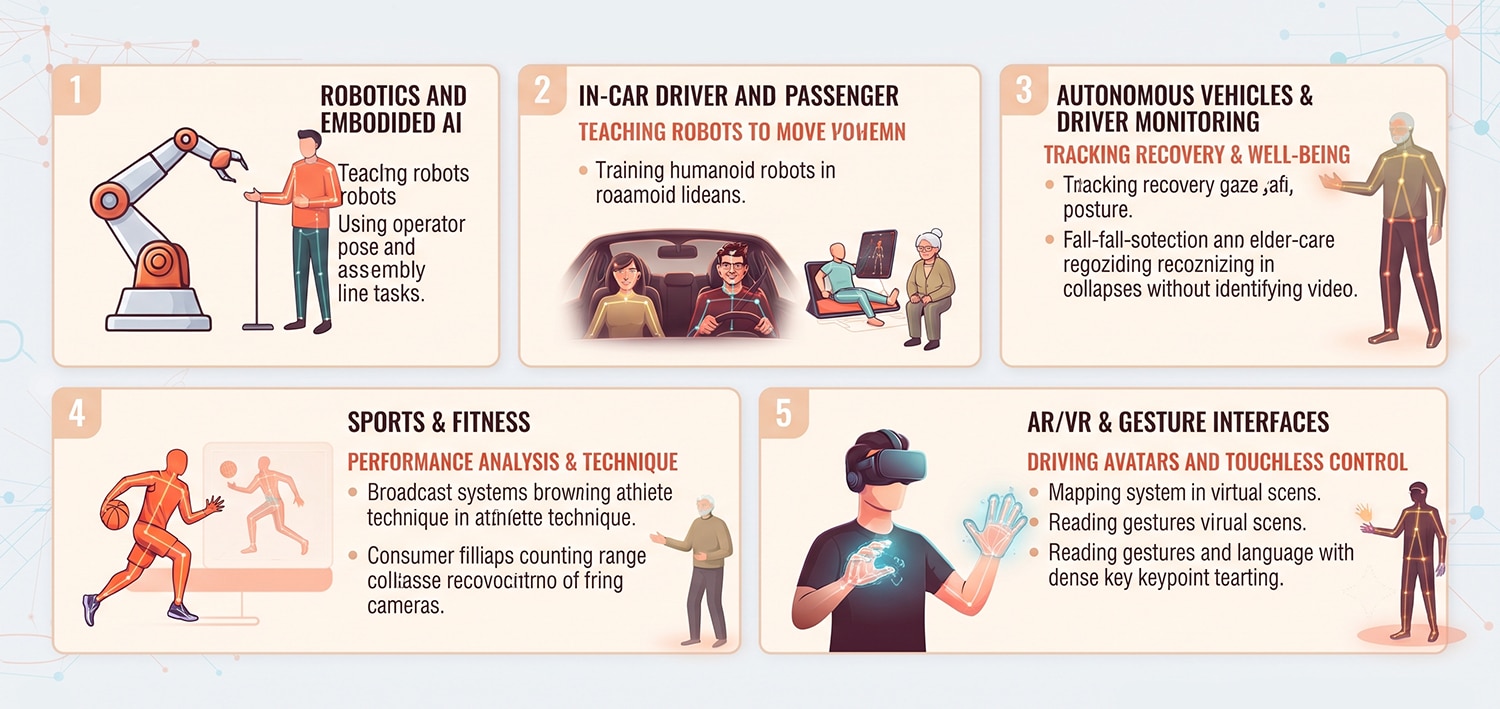
Robotics and embodied AI — the primary frontier. Pose data teaches robots to move by learning from human demonstration. A warehouse humanoid learning to lift totes and place them on a conveyor is trained partly on pose-tracked video of people doing the same task, with operator pose from teleoperation sessions supplying the precise action trajectories. On assembly lines, collaborative robots use real-time worker pose to keep a safe distance and hand off parts without collisions — the kind of tote-handling and line-side tasks now being piloted across logistics and automotive plants.
Autonomous vehicles and driver monitoring. Inside the cabin, pose estimation tracks a driver’s head position, gaze, and upper-body posture to detect drowsiness or distraction. Driver-monitoring systems shipping in new vehicles to meet Euro NCAP’s 2026 safety-rating requirements depend on exactly this facial-landmark and keypoint data.
Healthcare and rehabilitation. Pose estimation measures how a body actually moves, which clinicians use to track recovery. A physiotherapy app can watch a patient exercise through a phone camera, count range of motion, and flag incorrect form; a fall-detection system in an elder-care setting can recognize a collapse from skeletal motion alone, without storing identifying video.
Sports and fitness. Skeletal tracking turns ordinary video into performance data. Broadcast systems overlay real-time skeletons on athletes to break down technique, while consumer fitness apps count repetitions and correct form using nothing more than a phone camera.
AR/VR and gesture interfaces. Body and hand pose drive avatars and enable touchless control. A headset that maps your hands into a virtual scene, or an interface that reads gestures and sign language, relies on dense hand-keypoint tracking under heavy self-occlusion.
Choosing a Pose and Keypoint Data Partner
If you’re evaluating who should build your pose data, the questions that separate vendors are operational, not cosmetic: