Hand-Pose Annotation for Dexterous Robot Manipulation
Hand pose annotation is the process of labeling how a hand and its fingers move across every frame of a video, so that robots can learn dexterous, human-like manipulation. Today’s robots can walk, roll, and grip a box. What they still struggle with is the small stuff — buttoning a shirt, threading a cable, picking up a single grape without crushing it. At Shaip, we see this every day: the hard part of physical AI isn’t teaching a robot to move, it’s teaching its hands to behave. And that comes down to the quality of the hand-pose data behind it.
This post goes deep on hands specifically. If you want the wider picture first, start with our guide to robot training data and manipulation datasets — this is the dexterity chapter of that story.
Why is dexterity the real bottleneck in robot manipulation?
Dexterity is the bottleneck because coarse movement is largely solved and fine finger control is not. A robot can be taught to reach and close a gripper. Teaching it to roll a pen between two fingers, or re-grip a screwdriver mid-task, is a different challenge — and it depends entirely on data that captures how fingers actually move.
Here’s the simple way we explain it to clients:
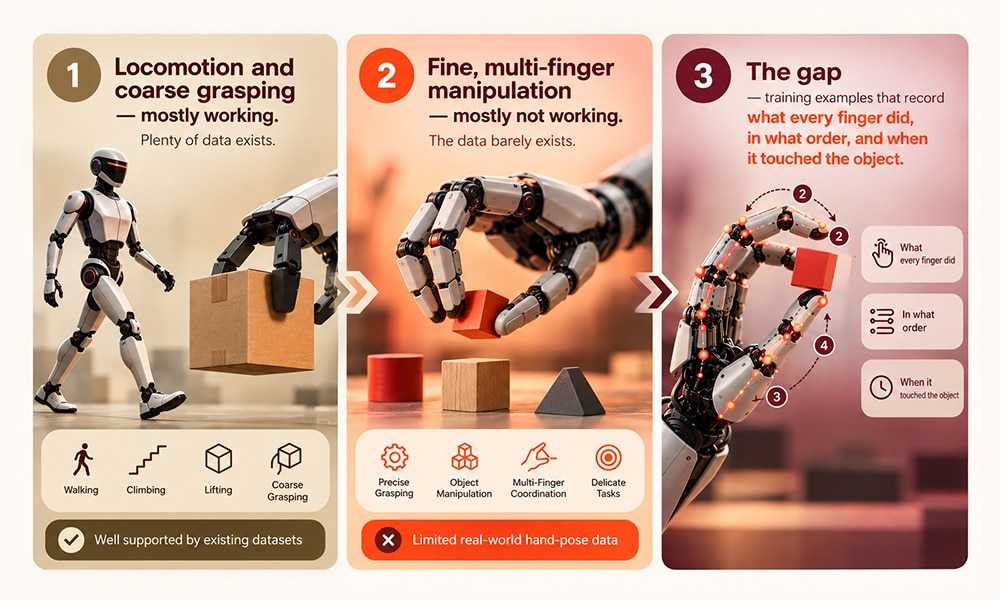
Locomotion and coarse grasping — mostly working. Plenty of data exists.
Fine, multi-finger manipulation — mostly not working. The data barely exists.
The gap — training examples that record what every finger did, in what order, and when it touched the object.
That last line is exactly what hand pose annotation produces. Without it, a robot can recognize a shoelace but has no idea how to tie one.
What is hand pose annotation, exactly?
Hand pose annotation is a form of keypoint annotation in which the joints of the hand — the knuckles, finger segments, fingertips, and wrist — are marked and tracked through every frame of a clip. It turns ordinary video of a hand into a clean, structured record of movement that a model can learn from.
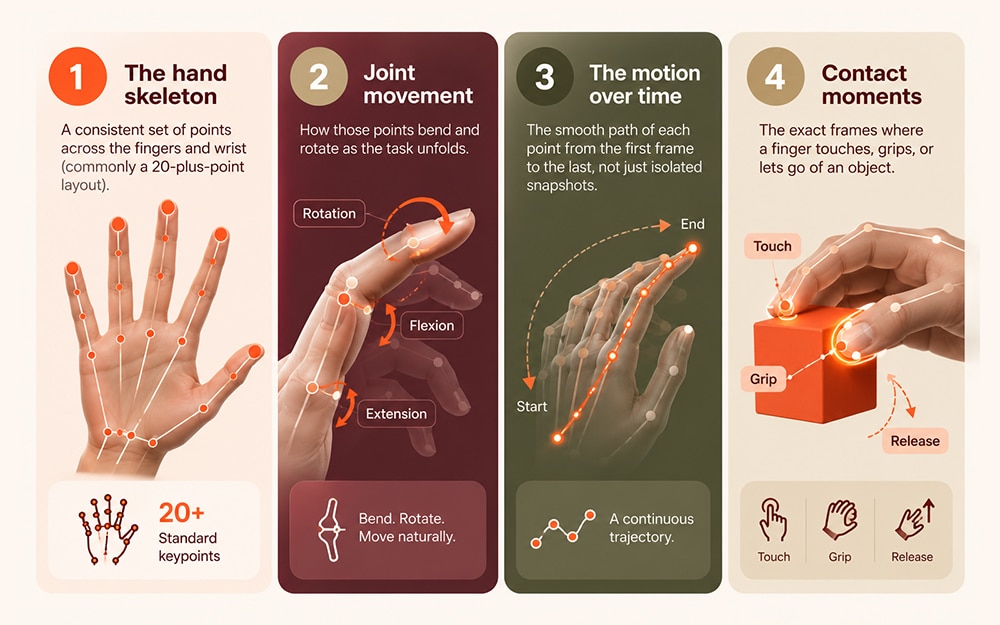
In practice, our teams label four things on every hand:
The hand skeleton — a consistent set of points across the fingers and wrist (commonly a 20-plus-point layout).
Joint movement — how those points bend and rotate as the task unfolds.
The motion over time — the smooth path of each point from the first frame to the last, not just isolated snapshots.
Contact moments — the exact frames where a finger touches, grips, or lets go of an object.
That fourth item is where dexterity lives. Anyone can mark where a hand is; the value is in capturing the how and the when.
How is dexterity annotation different from standard keypoint annotation?
Dexterity annotation is keypoint annotation held to a much higher bar. Standard keypoint work answers “where is the hand?” Dexterity annotation answers “what did every finger do, in what order, and when did it make contact?” — which is the only version a manipulation model can actually train on.
The difference is clearest side by side:
What we’re labeling
Standard keypoint annotation
Dexterity-grade hand-pose annotation
Detail
Hand position, per frame
Full finger movement, every frame
Depth
Flat, 2D
3D — how joints move in space
Time
Frame-by-frame, independent
One smooth, continuous motion
Contact
Rarely labeled
Grip, touch, and release marked
Occlusion
Often skipped
Carefully inferred and filled in
What it’s good for
Gestures, hand tracking
Teaching robots to manipulate
The right-hand column is what we build at Shaip, because it’s the only column a dexterous robot can learn from.
How does hand-pose annotation turn human video into robot skill?
Hand pose annotation is the bridge between cheap human video and expensive robot demonstrations. Retargeting is the step that maps a person’s labeled hand movements onto a robot’s hand, so a human demonstration becomes something a robot can copy. Filming people is easy and scalable; capturing real robot demonstrations is slow and costly — so the smart path is to teach robots from us.
The flow we run for clients looks like this:
Record — capture first-person (“what my hands see”) video of a person doing a task.
Annotate — label the hand pose across every frame to recover the full finger motion.
Retarget — map that motion onto the robot’s hand so it can reproduce the action.
A useful example: to teach a kitchen robot to crack an egg, you don’t need a thousand robots practicing. You need clean, well-labeled video of people cracking eggs — the annotation is what makes that footage teachable.
Where is dexterous manipulation data actually used?
Dexterity data matters anywhere a machine has to handle the physical world with care. This is the section most overviews skip, so it’s worth being concrete. Hand-pose and dexterity annotation feeds:
Humanoid and home robots — folding laundry, loading a dishwasher, handling everyday objects that come in every shape.
Warehouse and retail automation — picking a fragile item off a shelf without damaging it, or sorting mixed products by feel.
Healthcare and assistive robotics — rehabilitation devices and assistive arms that must move gently around people.
Manufacturing and repair — tool use, cable routing, and small-part assembly where a coarse grip simply won’t do.
AR/VR and wearables — natural hand interaction, gesture control, and hand-tracking interfaces.
The common thread: each one fails without training data that captures fine finger movement. That’s the need Shaip’s motion, pose, and dexterity work is built to meet.
How big does dexterity data need to be — and how good?
Scale matters, but quality matters more. To put the scale in perspective, one landmark research dataset published in 2025 gathered 829 hours of first-person manipulation video with paired hand tracking across 194 everyday tasks — described by its authors as the largest dexterous-manipulation dataset of its kind (Apple Machine Learning Research, 2025). That’s the direction the field is heading: large, richly labeled, task-diverse.
But volume alone doesn’t train a good robot. In our experience at Shaip, most dexterity failures trace back to label quality, not dataset size. The hard problems are practical:
Hidden fingers — hands constantly cover themselves and the objects they hold.
Look-alike fingers — it’s easy to mislabel one finger as its neighbor.
Fast motion — quick movements blur the very frames that matter most.
Consistency over time — one shaky joint label can ruin an entire motion sequence.
This is why every dexterity project at Shaip runs through trained, human-in-the-loop teams and a multi-stage quality process — first-pass validation, calibration against a gold-standard set, and a final release review — with inter-annotator agreement and task-specific acceptance thresholds set per project. Clean data is cheaper than a robot that learned the wrong motion.
How Shaip helps
At Shaip, we handle the full journey — from collecting first-person and human-demonstration video, to precise hand-pose and dexterity labeling, to retargeting-ready data your team can train on. It’s all delivered under enterprise-grade security (ISO 27001 and SOC 2 Type II) by a managed, vetted workforce.
Hand pose annotation is the labeling of a hand’s joints — knuckles, finger segments, fingertips, and wrist — across every frame of a video. It creates structured data that teaches robots and AI models how a hand moves and handles objects over time.
How is dexterity annotation different from standard keypoint annotation?
Standard keypoint annotation marks where a hand is, frame by frame, in 2D. Dexterity annotation adds depth, smooth motion over time, and labeled contact moments — producing data a robot can actually use to learn fine, multi-finger manipulation.
What is retargeting in hand-pose data?
Retargeting maps a person’s labeled hand movements onto a robot’s hand, so a human demonstration becomes an action the robot can reproduce. It’s how abundant human video is turned into scarce, valuable robot training data.
Why does dexterity limit what robots can do?
Dexterity limits robots because coarse tasks like walking and simple gripping are largely solved, while fine finger control — re-gripping a tool, handling a delicate object — lacks the training data that captures how fingers move. Hand pose annotation supplies that missing signal.
What industries use dexterity data?
Humanoid and home robotics, warehouse and retail automation, healthcare and assistive robots, manufacturing and repair, and AR/VR hand interaction all rely on dexterity data to handle real-world objects safely and precisely.
Does dataset size or label quality matter more?
Both matter, but label quality usually decides the outcome. Large datasets help, yet most dexterity failures trace back to inconsistent or inaccurate hand labels — which is why Shaip pairs scale with strict, human-in-the-loop quality control.
Can Shaip collect and label first-person hand video?
Yes. Shaip collects and annotates first-person and human-demonstration video, producing accurate, retargeting-ready hand-pose data under ISO 27001 and SOC 2 Type II controls.
Enjoyed this article? Follow Shaip on LinkedIn for more updates.
Contains information related to marketing campaigns of the user. These are shared with Google AdWords / Google Ads when the Google Ads and Google Analytics accounts are linked together.
90 days
__utma
ID used to identify users and sessions
2 years after last activity
__utmt
Used to monitor number of Google Analytics server requests
10 minutes
__utmb
Used to distinguish new sessions and visits. This cookie is set when the GA.js javascript library is loaded and there is no existing __utmb cookie. The cookie is updated every time data is sent to the Google Analytics server.
30 minutes after last activity
__utmc
Used only with old Urchin versions of Google Analytics and not with GA.js. Was used to distinguish between new sessions and visits at the end of a session.
End of session (browser)
__utmz
Contains information about the traffic source or campaign that directed user to the website. The cookie is set when the GA.js javascript is loaded and updated when data is sent to the Google Anaytics server
6 months after last activity
__utmv
Contains custom information set by the web developer via the _setCustomVar method in Google Analytics. This cookie is updated every time new data is sent to the Google Analytics server.
2 years after last activity
__utmx
Used to determine whether a user is included in an A / B or Multivariate test.
18 months
_ga
ID used to identify users
2 years
_gali
Used by Google Analytics to determine which links on a page are being clicked
30 seconds
_ga_
ID used to identify users
2 years
_gid
ID used to identify users for 24 hours after last activity
24 hours
_gat
Used to monitor number of Google Analytics server requests when using Google Tag Manager
1 minute
Marketing cookies are used to follow visitors to websites. The intention is to show ads that are relevant and engaging to the individual user.
Google Ads is an online advertising platform that enables businesses to create targeted ads displayed on Google search results and partner sites.
Targeting cookie. Used to create a user profile and display relevant and personalised Google Ads to the user.
2 years
__Secure-1PSID
Targeting cookie. Used to create a user profile and display relevant and personalised Google Ads to the user.
2 years
__Secure-3PAPISID
Profiles the interests of website visitors to serve relevant and personalised ads through retargeting.
2 years
AEC
AEC cookies ensure that requests within a browsing session are made by the user, and not by other sites. These cookies prevent malicious sites from acting on behalf of a user without that user's knowledge.
6 months
ADS_VISITOR_ID
Cookie required to use the options and on-site web services
2 months
__Secure-3PSIDCC
Targeting cookie. Used to create a user profile and display relevant and personalised Google Ads to the user.
2 years
__Secure-3PSIDTS
Targeting cookie. Used to create a user profile and display relevant and personalised Google Ads to the user.
2 years
__Secure-1PSIDTS
Targeting cookie. Used to create a user profile and display relevant and personalised Google Ads to the user.
2 years
__Secure-1PAPISID
Targeting cookie. Used to create a user profile and display relevant and personalised Google Ads to the user.
2 years
__Secure-3PSID
Targeting cookie. Used to profile the interests of website visitors and display relevant and personalised Google ads.
2 years
Conversion
Google uses cookies for advertising, including serving and rendering ads, personalizing ads (depending on your ad settings at g.co/adsettings), limiting the number of times an ad is shown to a user, muting ads you have chosen to stop seeing, and measuring the effectiveness of ads.
90 days
_gcl_aw
Google uses cookies for advertising, including serving and rendering ads, personalizing ads (depending on your ad settings at g.co/adsettings), limiting the number of times an ad is shown to a user, muting ads you have chosen to stop seeing, and measuring the effectiveness of ads.
90 Days
_gcl_gs
Google uses cookies for advertising, including serving and rendering ads, personalizing ads (depending on your ad settings at g.co/adsettings), limiting the number of times an ad is shown to a user, muting ads you have chosen to stop seeing, and measuring the effectiveness of ads.
90 Days
_gcl_gb
Google uses cookies for advertising, including serving and rendering ads, personalizing ads (depending on your ad settings at g.co/adsettings), limiting the number of times an ad is shown to a user, muting ads you have chosen to stop seeing, and measuring the effectiveness of ads.
90 Days
_gac_gb_
Google uses cookies for advertising, including serving and rendering ads, personalizing ads (depending on your ad settings at g.co/adsettings), limiting the number of times an ad is shown to a user, muting ads you have chosen to stop seeing, and measuring the effectiveness of ads.
90 Days
FPGCLGB
Google uses cookies for advertising, including serving and rendering ads, personalizing ads (depending on your ad settings at g.co/adsettings), limiting the number of times an ad is shown to a user, muting ads you have chosen to stop seeing, and measuring the effectiveness of ads.
90 Days
FPGCLAW
Google uses cookies for advertising, including serving and rendering ads, personalizing ads (depending on your ad settings at g.co/adsettings), limiting the number of times an ad is shown to a user, muting ads you have chosen to stop seeing, and measuring the effectiveness of ads.
90 Days
HubSpot is an all-in-one marketing, sales, and customer service platform that streamlines business growth.
This cookie is used to recognize visitors who chat with you via the chatflows tool. If the visitor leaves your site before they're added as a contact, they will have this cookie associated with their browser.
13 months
__hs_do_not_track
This cookie can be set to prevent the tracking code from sending any information to HubSpot.
13 months
__hs_cookie_cat_pref
This cookie is used to record the categories a visitor consented to.
6 months
__hs_initial_opt_in
This cookie is used to prevent the banner from always displaying when visitors are browsing in strict mode.
7 days
__hs_gpc_banner_dismiss
This cookie is used when the Global Privacy Control banner is dismissed.
180 days
hs_ab_test
This cookie is used to consistently serve visitors the same version of an A/B test page they’ve seen before.
session
__hs_notify_banner_dismiss
This cookie is used when the website uses a Notify consent banner type.
180 days
hs-messages-is-open
This cookie is used to determine and save whether the chat widget is open for future visits.
30 minutes
hs-messages-hide-welcome-message
This cookie is used to prevent the chat widget welcome message from appearing again for one day after it is dismissed.
1 day
__hsmem
This cookie is set when visitors log in to a HubSpot-hosted site.
1 year
hs-membership-csrf
This cookie is used to ensure that content membership logins cannot be forged.
session
hs_langswitcher_choice
This cookie is used to save the visitor's selected language choice when viewing pages in multiple languages.
2 years
__hstc
The main cookie for tracking visitors.
13 months
hubspotutk
This cookie keeps track of a visitor's identity. It is passed to HubSpot on form submission and used when deduplicating contacts.
13 months
__hssc
This cookie keeps track of sessions.
30 minutes
__hssrc
Whenever HubSpot changes the session cookie, this cookie is also set to determine if the visitor has restarted their browser.
session
hubspotapi-prefs
This is used with the hubspotapi cookie to remember whether the user checked the 'remember me' box (controls the expiration of the main cookie's authentication).
1 Year
hubspotapi-csrf
This is used for CSRF prevention - preventing third party websites from accessing your data. Expires after a year.
1 year
__hs_opt_out
This cookie is used by the opt-in privacy policy to remember not to ask the visitor to accept cookies again.
13 months
hubspotapi
This cookie allows the user to access the app with the correct permissions.