
For 21 years, the default answer to “we need humans to label this” was a crowd marketplace. That default ends on September 30, 2026, when Amazon Mechanical Turk closes for good. If your labeling queues, survey panels, or model-evaluation loops still run through it, you now need one of the Mechanical Turk alternatives below, and the choice you make will shape your data quality for years.
This guide doesn’t rank vendors. It sorts the alternatives by type, explains which type fits which workload, and gives you a migration checklist you can work through this week.
Key takeaway:
- MTurk stops accepting HIT submissions on September 30, 2026. Unsubmitted HITs expire automatically.
- You have until October 30, 2026 to approve or reject completed work and pay bonuses. Transaction history stays available until January 28, 2027.
- There are five kinds of MTurk alternatives: self-serve crowd marketplaces, research-participant panels, managed AI data services, expert networks, and in-house teams.
- For AI training data (labeling, collection, and LLM evaluation), a managed data partner with vetted contributors and layered QA fixes the quality problems that pushed many teams off MTurk in the first place.
- Don’t just port your old tasks. Use the migration to rewrite guidelines, add gold-standard checks, and set measurable quality thresholds.
What Is Happening to Amazon Mechanical Turk?
Amazon Mechanical Turk (MTurk) is a crowdsourcing marketplace where requesters post small “Human Intelligence Tasks” (HITs) that remote workers complete for per-task pay. Amazon closed it to new customers on July 30, 2026, then announced in late August that the whole service would permanently close on September 30, 2026.
Amazon’s only public explanation was that it “regularly evaluate[s] programs, tools, and services” and decided to close the service after an assessment. Press coverage of the closure put the workforce at more than 500,000 workers across 190 countries, which gives you a sense of how many pipelines are being disrupted at once.
The practical dates, from the official MTurk closure FAQ:
| Date | What happens |
| July 30, 2026 | No new requester or worker accounts |
| September 30, 2026 | HIT submission closes; unsubmitted HITs expire; MTurk is removed as a workforce option in the cloud provider’s own labeling and human-review services |
| October 30, 2026 | Last day to approve/reject submitted HITs (unreviewed work auto-approves) and to pay bonuses |
| January 28, 2027 | Transaction history no longer available |
Why Teams Were Already Looking for MTurk Alternatives
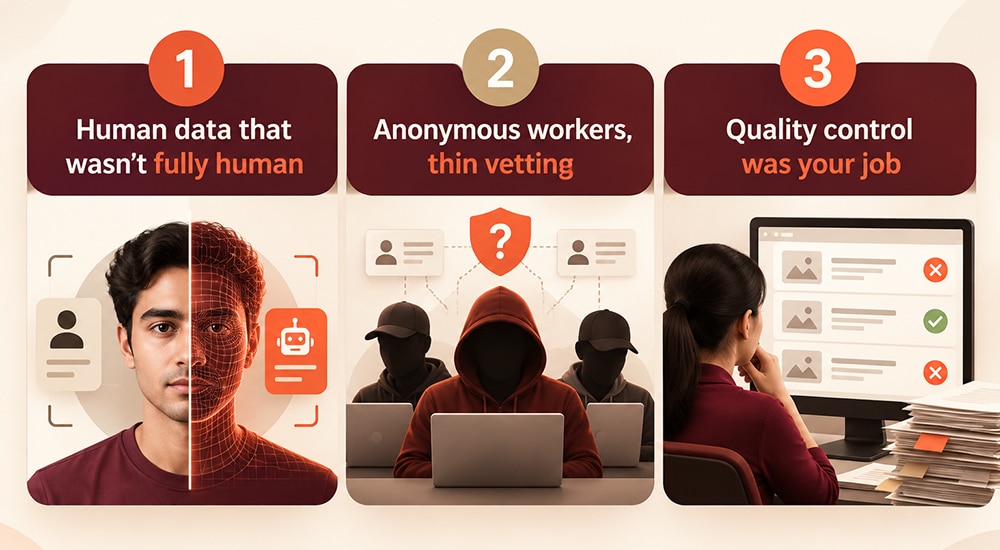
The shutdown forced the decision, but many AI teams had been drifting away for years. Three problems came up again and again.
- Human data that wasn’t fully human. In a 2023 study, EPFL researchers estimated that 33–46% of crowd workers used large language models to complete a text-summarization task on MTurk. When you pay for human judgment to train or evaluate a model, and part of what comes back is model output, you are training on the thing you were trying to measure.
- Anonymous workers, thin vetting. Open marketplaces let almost anyone accept a task. Qualification tests and approval-rate filters help, but they don’t tell you whether someone is a native speaker of the dialect you need, has clinical background for a medical label, or will behave the same way on task 500 as on task 5.
- Quality control was your job. The marketplace supplied people; everything else (guideline design, gold questions, adjudication, re-work) sat with the requester. Ask anyone who has run large HIT batches and you’ll hear the same story: the labeling was cheap, but the cleanup, re-labeling, and engineer time spent writing filters never showed up in the per-task price.
The throughline: MTurk was built for short, standardized micro-tasks. Modern AI data work (multimodal collection, domain-expert annotation, preference ranking, LLM red-teaming) needs more context, more accountability, and more QA than a micro-task marketplace was built to deliver.
The 5 Types of Mechanical Turk Alternatives in 2026
The best MTurk alternative depends on the work you ran there. Most former requesters fall into one of five paths, each with a different balance of control, cost, speed, and quality ownership.
Read the table by workload, not by price. If your MTurk usage was mostly short surveys, a participant panel is the like-for-like move. If it was training or evaluating models, the categories that matter are managed data services and, for small specialized slices, expert networks.
When a self-serve crowd marketplace still makes sense
If your tasks are truly atomic (yes/no image checks, simple categorization, duplicate detection) and you already have mature gold-question and consensus logic, a self-serve marketplace is the fastest path. Keep your checks tight: the contamination and vetting problems above don’t disappear by switching platforms.
When a research panel is the right fit
Academic and UX researchers who used MTurk for surveys should look at participant panels with identity checks and demographic filters. Many university review boards are already telling researchers to file protocol modifications that name the replacement platform, so budget time for that paperwork.
When you need a managed AI data partner
If the output of your human work becomes training data or evaluation data for a model, a managed partner is usually the right MTurk replacement. You hand over a spec and quality targets; the partner handles sourcing, vetting, workflow, QA, and delivery.
Moving labeling or evaluation off MTurk before the deadline? Shaip can scope a pilot batch against your existing guidelines.
MTurk Alternatives by Use Case: Labeling, Collection, and LLM Evaluation
For AI teams, the three MTurk workloads that matter most are data labeling, data collection, and LLM evaluation. Each has different requirements, so choose the alternative per workload rather than assuming one platform must replace everything.
Data labeling and annotation

MTurk handled simple bounding boxes and text classification reasonably well. It struggled with anything that needed precision or domain knowledge: polygon and semantic segmentation, LiDAR point clouds, medical named-entity recognition, speaker diarization, or multilingual sentiment.
What to look for in a replacement:
- Annotators trained on your guidelines, not workers who read them once
- Multi-pass QA: labeler → reviewer → auditor, with disagreement adjudication
- Gold-standard sets seeded into every batch, with accuracy tracked per annotator
- Modality coverage: text, audio, image, video, and 3D in one workflow
Shaip’s data annotation services cover text, audio, image, video, and LiDAR annotation, run through a Six Sigma stage-gate QA process with dedicated quality managers.
Data Collection

This is where MTurk was weakest. Micro-task workers could upload a photo or record a short phrase, but building a balanced, consented dataset (say, 2,000 hours of conversational speech across 12 dialects with balanced age and gender, or images of hand gestures under specific lighting conditions) needs recruitment, demographic tracking, consent management, and file-level validation that an open marketplace never offered.
A managed collection partner should give you:
- Demographic and geographic quotas that are actually enforced and reported
- Documented contributor consent that holds up under GDPR and similar regimes
- Metadata per file (speaker, device, environment, locale)
- Validation before delivery, not after you find the bad files in training
LLM evaluation, RLHF, and human feedback
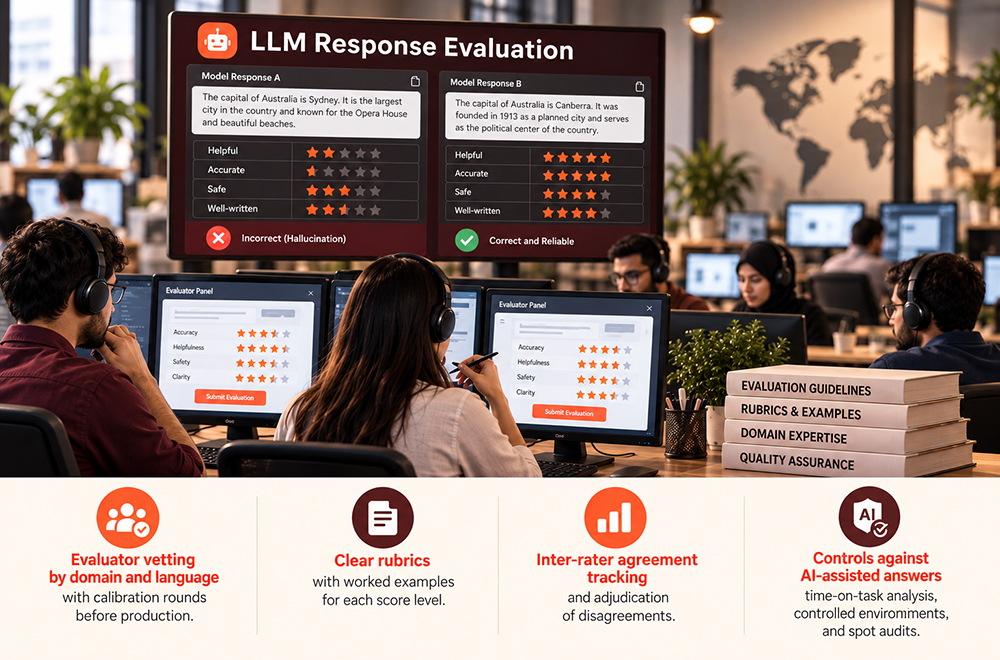
LLM evaluation is the use case where replacing MTurk with something better matters most. Preference ranking, response rating, hallucination checks, safety and toxicity review, and red-teaming only work if the human judgment is independent, consistent, and qualified. Evaluators who run the prompt through another model, or who lack the domain knowledge to spot a wrong answer, produce feedback that quietly degrades your model.
What good LLM evaluation looks like:
- Evaluator vetting by domain and language, with calibration rounds before production
- Clear rubrics with worked examples for each score level
- Inter-rater agreement tracking and adjudication of disagreements
- Controls against AI-assisted answers: time-on-task analysis, controlled environments, and spot audits
Shaip’s generative AI solutions include RLHF, supervised fine-tuning data, LLM output evaluation and comparison, and human feedback workflows for answer ranking and toxicity assessment.
How to Choose the Right MTurk Alternative: A Buyer’s Checklist

Choose an MTurk alternative by testing it against your hardest workload, not your easiest. Before you sign anything, ask every candidate these questions:
- Who are the workers, and how are they vetted? Ask about identity verification, skills testing, language testing, and domain credentials.
- How do you detect AI-generated work? A credible answer names specific controls. “We trust our workers” is not one.
- What does QA look like, step by step? Number of review passes, gold-set frequency, and what happens to work that fails.
- What quality level will you commit to? Get accuracy or agreement thresholds written into the SOW.
- Which compliance certifications do you hold? For regulated data, look for GDPR, HIPAA, SOC 2 Type II, and ISO 27001.
- Can you source the contributors I need? Specific languages, dialects, regions, demographics, or professional backgrounds.
- How fast can you run a pilot? A good partner can scope and deliver a paid pilot batch in days to a few weeks.
- What’s the total cost, including re-work? Compare cost per accepted unit, not cost per submitted task.
The rule we give clients: if a vendor can’t show you their QA metrics from a comparable project, treat their per-unit price as a guess.
When a Managed Data Partner Is Not the Right Fit
The honest answer is: it depends on your work. A managed service is probably overkill if:
- You run a few hundred survey responses a month for academic research. A participant panel is cheaper and purpose-built.
- Your tasks are truly trivial and tolerant of noise, and you already have strong automated filters.
- You need results in hours, not days, for a one-off experiment with no quality bar.
- Your data is so sensitive that no third party can touch it. In that case, build an in-house team and bring in outside help only for guideline design or QA audits.
For everything that ends up in a production model’s training or evaluation set, the math usually flips in favor of a managed partner.
How Shaip Helps Teams Replace Mechanical Turk
MTurk’s closure leaves AI teams with the same three workloads (labeling, collection, and evaluation) and no default place to send them. Shaip replaces the open-marketplace model with a managed one: you define the spec and quality bar, and we deliver data that meets it.
- Data annotation and labeling across text, audio, image, video, and LiDAR, with multi-stage QA and gold-set auditing.
- Custom data collection through a network of 500,000+ vetted crowd contributors and a 10,000+ in-house workforce, covering 150+ languages and dialects, with consent and demographic tracking built in.
- LLM evaluation and RLHF: preference ranking, response rating, hallucination and toxicity review, and prompt-response generation by vetted, domain-matched evaluators.
- Compliance that holds up: GDPR, HIPAA, SOC 2 Type II, ISO 27001, and ISO 9001:2015.
Need off-the-shelf data instead of a custom program? Shaip’s catalogs and AI data collection services cover both.
Talk to our team about a pilot batch that shows you the quality difference before you commit.