
Most teams don’t start looking into data annotation outsourcing because they want to. They start because an in-house pilot worked — forty thousand images, three interns, a spreadsheet of guidelines — and then someone asked for two million images by Q3, in four languages, with an audit trail.
That’s the moment the question changes. It stops being “can we label this ourselves?” and becomes “what are we actually buying when we buy annotation, and how do we tell a good vendor from an expensive one?”
This guide answers the second question. It covers what outsourced annotation costs and why published rate cards mislead, how to measure quality before you sign rather than after, what changed in 2026 on the compliance side, and how to design a pilot that predicts production instead of flattering it.
Key Takeaways
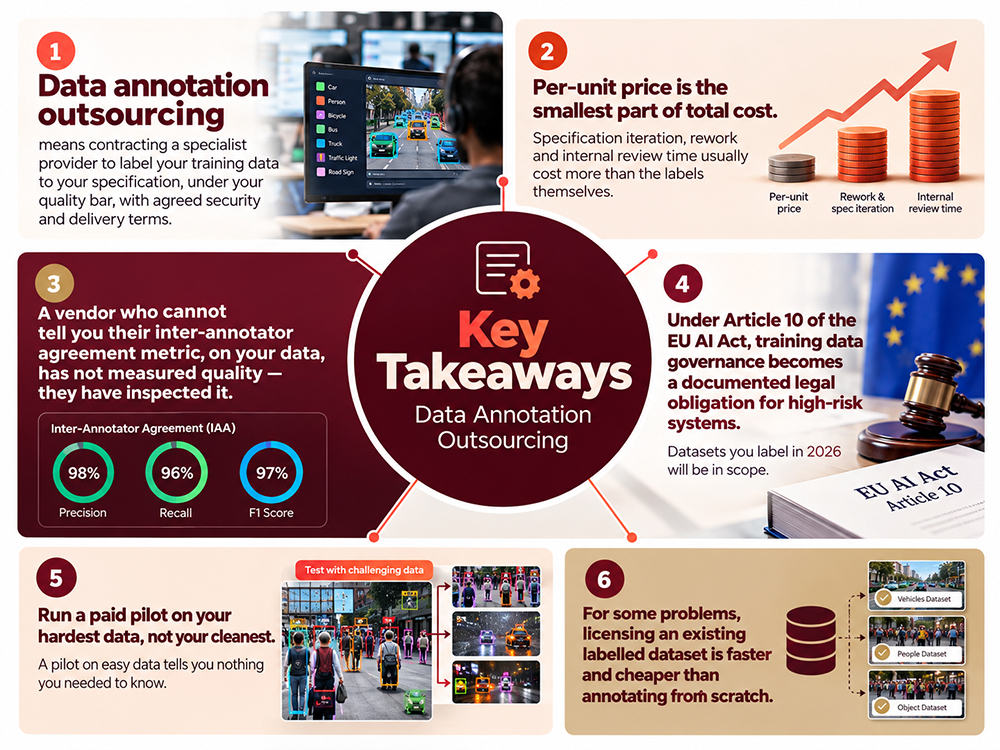
- Data annotation outsourcing means contracting a specialist provider to label your training data to your specification, under your quality bar, with agreed security and delivery terms.
- Per-unit price is the smallest part of total cost. Specification iteration, rework and internal review time usually cost more than the labels themselves.
- A vendor who cannot tell you their inter-annotator agreement metric, on your data, has not measured quality — they have inspected it.
- Under Article 10 of the EU AI Act, training data governance becomes a documented legal obligation for high-risk systems. Datasets you label in 2026 will be in scope.
- Run a paid pilot on your hardest data, not your cleanest. A pilot on easy data tells you nothing you needed to know.
- For some problems, licensing an existing labelled dataset is faster and cheaper than annotating from scratch.
What Is Data Annotation Outsourcing?
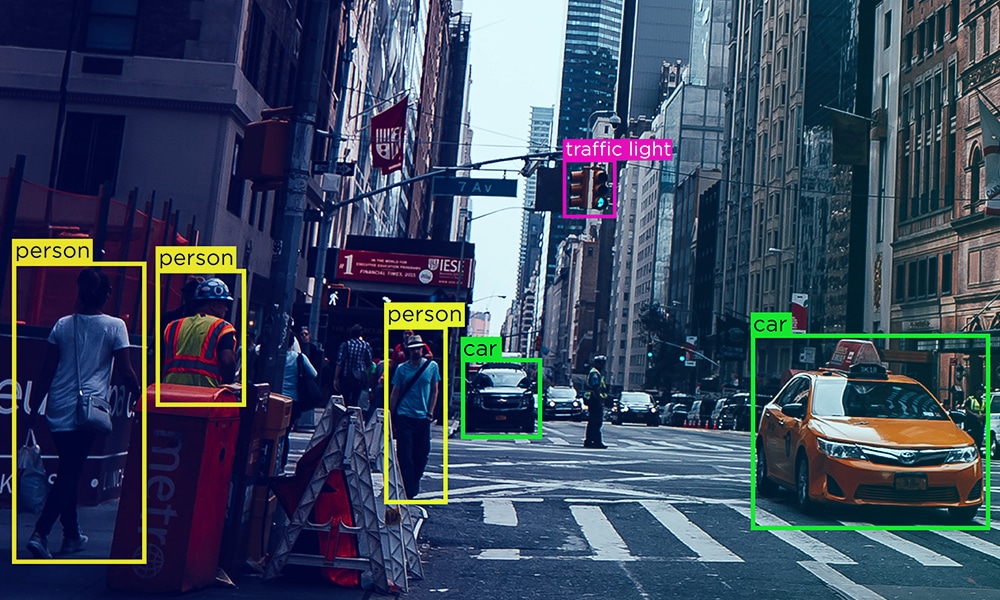
Data annotation outsourcing is the practice of contracting an external provider to label raw data — images, video, audio, text, LiDAR point clouds — into the structured training examples a machine learning model needs, according to a specification you define and a quality standard you agree in advance.
You will see it called data labeling outsourcing just as often; the terms are used interchangeably, with “annotation” more common for structured tasks like segmentation and “labeling” for classification.
The distinction that matters is between outsourcing the work and outsourcing the judgment. You can hand over the labour of drawing boxes. You cannot hand over the decision about what counts as a box. Teams that try to outsource the second thing are the ones who come back disappointed.
In practice the market offers three delivery shapes:
- Managed service: The provider supplies annotators, tooling, QA and project management. You supply data and specification. Priced per unit or per project.
- Dedicated team: A ring-fenced group works only on your account, typically billed per FTE per month. Slower to spin up, much better on tasks where accumulated domain knowledge matters.
- Crowdsourced marketplace: A distributed, anonymous workforce completes microtasks. Cheapest per unit, weakest on consistency, and generally unsuitable for regulated or confidential data.
The throughline: The delivery shape you need is set by how much tacit knowledge your task carries, not by your budget.
When Outsourcing Makes Sense — and When It Doesn’t
Outsource when the work is high-volume, the specification can be written down, and the bottleneck is throughput rather than understanding. Keep it in-house when the labelling task is still an open research question, when the data cannot leave your environment under any terms, or when the annotation is the product.
The honest answer on in-house versus outsourced data annotation is that most mature teams end up running both. A small internal group owns the specification, adjudicates edge cases and maintains the gold-standard set. An external partner carries volume. That split works because it puts the judgment where the domain knowledge is and the labour where the capacity is.
Read that table as a decision about where ambiguity lives. Whoever holds the ambiguous cases needs the domain knowledge — everything else is logistics.
What Data Annotation Outsourcing Actually Costs
The published rate cards you’ll find — a few cents per bounding box, a fraction of a cent per keypoint — are real, and they are also close to useless for budgeting. They price the easy case: a clean image, an unambiguous class list, a single object, sampling-based inspection. Your data is not that.
Six things move the real number:
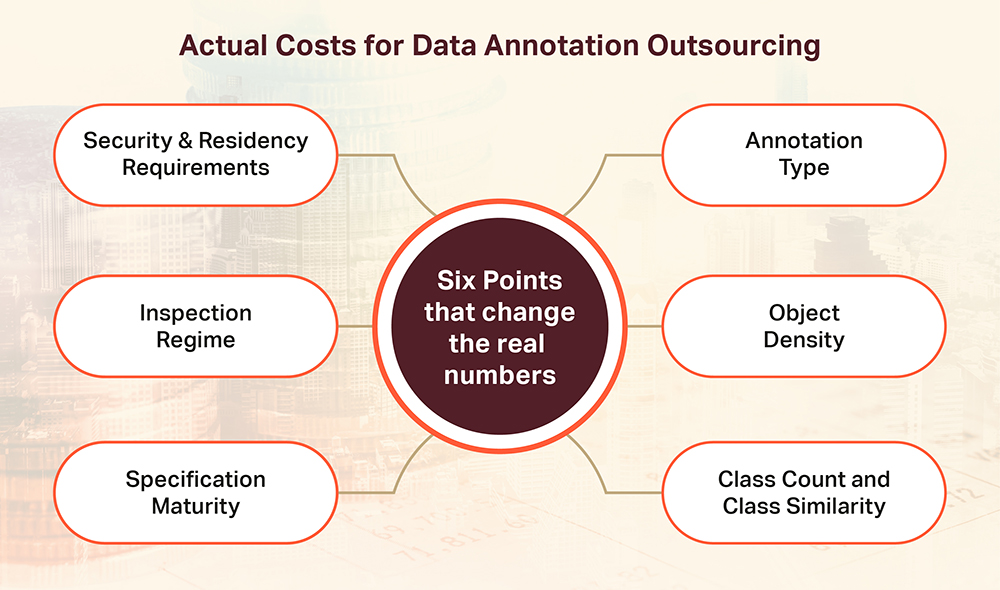
- Annotation type. Polygon segmentation costs multiples of a bounding box for the same image. 3D cuboids and point-cloud work cost more again.
- Object density. Thirty instances in one frame is not thirty times one instance — it is worse, because occlusion and ordering decisions multiply.
- Class count and class similarity. Eight visually distinct classes is a different job from forty classes where six pairs are near-identical.
- Specification maturity. Ambiguous guidelines are the single largest hidden cost in annotation. Every unresolved edge case becomes a question, a delay, and eventually a batch of rework.
- Inspection regime. Sampled QA is cheap and catches systematic errors. Full-volume review is expensive and catches everything else. You are choosing an error budget, not a service level.
- Security and residency requirements. On-premise delivery, restricted-access facilities, vetted and background-checked annotators, and data that may not cross a border all carry real cost.
And then the costs that never appear on an invoice: your ML engineers’ time writing and rewriting the specification, your reviewers’ time adjudicating disagreements, and the model-training cycles you burn on a dataset you later discover was wrong.
A useful budgeting rule: price the pilot on unit cost, but budget the programme on unit cost plus specification iteration plus an assumed rework rate. Teams that skip the last two terms are the ones who report that data annotation outsourcing “came in over budget” — it didn’t; they costed a third of it.
Trying to build a budget for a labelling programme and unsure what your real cost drivers are? Talk to our team — we’ll walk your data types and volumes through it with you.
How to Measure Annotation Quality before You Sign
This is where most buyer’s guides go quiet, and it is the section that decides whether the engagement works.
Ask a prospective data annotation service provider how they measure quality and you will usually hear an accuracy percentage — 98%, 99.5%, a number with a decimal point. Ask what the denominator is and the conversation gets interesting. Accuracy against what reference? Measured on what sample? Adjudicated by whom?
The metric that matters is agreement, not accuracy. Inter-annotator agreement (IAA) measures whether two qualified people, given your guidelines and your data, produce the same label. It is the only quality signal available before you have ground truth — and on subjective or domain-heavy tasks, it is the only one that ever exists.
A 2026 review of agreement metrics from the University of Sheffield makes the selection concrete: Cohen’s kappa applies to exactly two annotators and is sensitive to class imbalance; Fleiss’ kappa extends to three or more but requires equal ratings per item; Krippendorff’s alpha handles missing data and mixed data types; Gwet’s AC1 is more stable when one class dominates, which is the normal condition in defect detection, medical imaging and safety-critical vision. The same review makes two points buyers should hold onto: report confidence intervals rather than a single figure, and treat disagreement as a signal about your guidelines rather than as annotator noise.
That last point is the practical one. When agreement drops on a specific class, the usual cause is not a bad annotator. It is a specification that never resolved an edge case.
It is worth remembering how much label error survives in data everyone treats as clean. Northcutt, Athalye and Mueller’s 2021 study of ten widely used benchmark test sets found an average of at least 3.3% label errors, with the ImageNet validation set at 6% or more — and showed that correcting those labels was enough to flip the ranking between model architectures. If curated public benchmarks carry that error rate, an unmeasured commercial pipeline is not carrying less.
What to require from a vendor, in writing:
- The agreement metric they use, why they chose it for your task, and the score achieved on your pilot data.
- A gold-standard set — items with adjudicated correct answers — that you own and they are measured against.
- The escalation path for ambiguous cases, with a named adjudicator and a turnaround time.
- Per-class quality reporting, not a single blended number. Blended numbers hide the one class you care about.
- A defined rework process and who pays for it.
Five Failure Modes Buyers Hit Repeatedly
Ask anyone who has run an outsourced labelling programme and the same failures come up, in the same order:
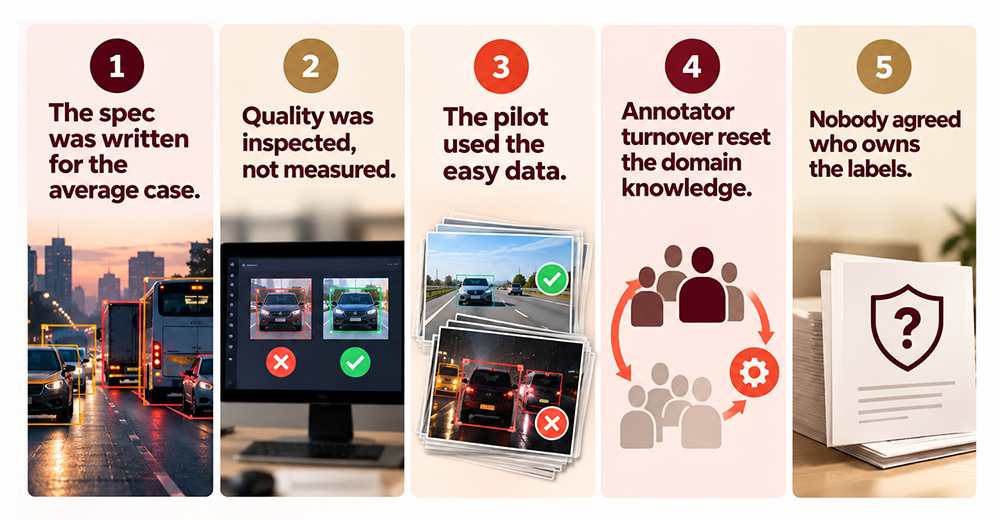
- The spec was written for the average case. It covered the clean frame and said nothing about the truck partially behind a bus at dusk. Annotators guessed, guessed inconsistently, and the inconsistency became the model’s blind spot.
- Quality was inspected, not measured. A reviewer looked at a sample and pronounced it fine. Nobody computed agreement, so nobody noticed one class degrading.
- The pilot used the easy data. Everyone wanted the pilot to pass, so the pilot got a clean, representative-looking batch. Production data then looked nothing like it.
- Annotator turnover reset the domain knowledge. The team that learned your edge cases over three months was rotated off, and quality fell back to month one with no contractual protection.
- Nobody agreed who owns the labels. The contract covered the service and was silent on the annotations, the derived data and what happens to both at exit.
A complaint that surfaces constantly in practitioner discussions is the third one — a pilot that passed cleanly, followed by a production batch that didn’t. In our delivery work the pattern is consistent enough to be a rule: a pilot batch that doesn’t include your ugliest data hasn’t tested anything.
Compliance and Data Governance
Buyers used to check security certificates. Now they have to check data governance too. Regulators increasingly want to see how training data was made, not just that it was stored safely.
The EU AI Act is the clearest example. It requires datasets behind high-risk AI systems to be relevant, representative and as free of errors as possible — with records of where the data came from and how it was prepared. Annotation and labelling are named directly. Similar expectations are emerging in other markets.
What that means for you: your annotation process becomes something you may have to show, not just something you bought. “Our vendor labelled it” won’t be enough.
So ask every provider for:
Then ask what each certificate actually covers. One that names a head office but not the site handling your data isn’t worth much.
How to Run a Pilot That Predicts Production
A pilot exists to surface disagreement cheaply. Design it that way.
- Pick the hardest 100–200 items you have. Occlusion, poor lighting, rare classes, ambiguous boundaries, the accented audio, the messy handwriting. Include a few items your own team argued about.
- Have two annotators label the same subset independently. Without overlap you cannot compute agreement, and without agreement you have no quality data — only opinions.
- Hold back a gold-standard set you adjudicated internally. Twenty to fifty items is enough. Don’t show it to the vendor.
- Measure per class, not overall. Report agreement and gold-set accuracy for each class separately.
- Count the questions. How many clarification requests did the vendor raise? A vendor who raises none on hard data is not reading the spec; a vendor who raises thoughtful ones is doing the job.
- Time the correction loop. How long between you flagging an error and the corrected batch arriving? That number, multiplied across production, is your real schedule risk.
- Pay for it. Free pilots get staffed with whoever is available. Paid pilots get staffed properly, and you learn what production will actually look like.
Set the pass threshold before you see the results. Deciding what “good enough” means after the numbers arrive is how weak pilots get approved.
The Vendor Evaluation Checklist
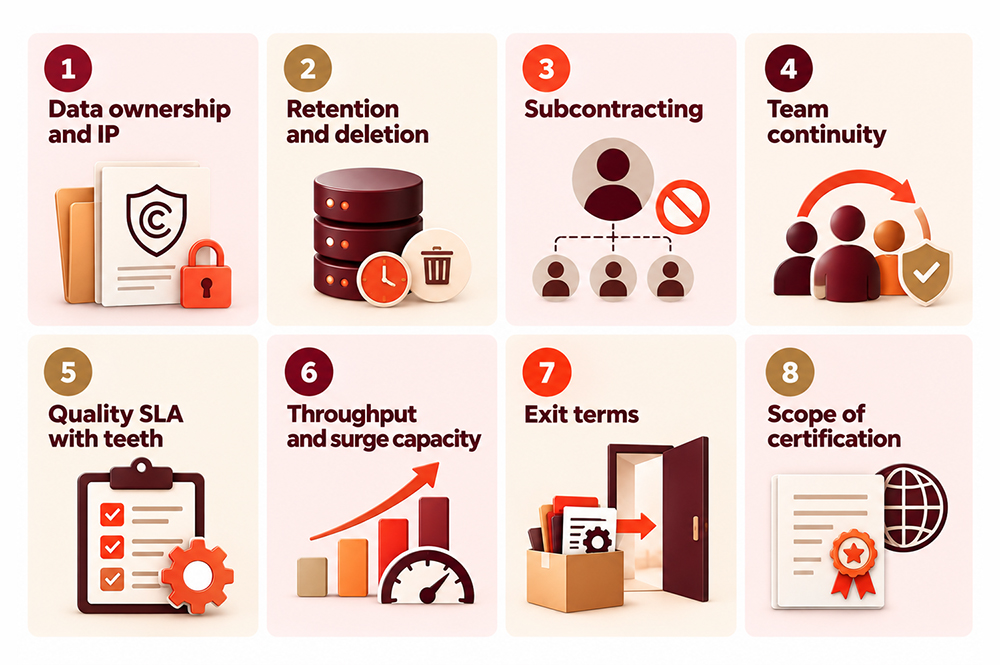
Beyond capability and price, these are the terms that determine whether year two goes well:
- Data ownership and IP. Written confirmation that you own the annotations, the derived datasets and the specification — and that none of it trains the vendor’s own models.
- Retention and deletion. Where your data lives, how long it is retained after delivery, and what evidence of deletion you receive.
- Subcontracting. Whether any part of the work is passed to a third party, and whether you have the right to know and to refuse.
- Team continuity. Named team, minimum tenure commitments, and a re-qualification process after any rotation.
- Quality SLA with teeth. A defined metric, a threshold, a measurement method, and a remedy — rework at the vendor’s cost, not a credit note.
- Throughput and surge capacity. Committed units per week and the notice period required to double it.
- Exit terms. Export format, handover of the gold set and guidelines, and transition assistance. Your specification is your asset; make sure you leave with it.
- Scope of certification. Which legal entity and which delivery site each certificate covers.
When Buying Labelled Data Beats Outsourcing Annotation
Not every labelling requirement should be met by labelling. If your need is a general capability — speech recognition across a set of languages, a common object detector, a baseline medical imaging model — an existing licensed dataset can reach usable quality in days rather than months, at a fraction of custom annotation cost.
Custom annotation earns its cost when the data is genuinely yours: your defect types, your clinical protocol, your cameras, your customers’ accents. A practical pattern is to license a broad base dataset for general competence, then spend the custom annotation budget only on the narrow, high-value slice where your model has to beat everyone else’s. Shaip’s off-the-shelf data catalogs exist for exactly that first half of the problem — licensed speech, medical, computer vision and Physical AI datasets with compliance documentation attached.
Ask any prospective partner which parts of your requirement they’d meet with existing data. A provider who answers honestly — including when the answer reduces their invoice — is showing you how the rest of the engagement will go.
How Shaip Can Help
The problems this guide describes — ambiguous specifications, quality that was inspected rather than measured, pilots that flattered the vendor, and provenance nobody documented — are delivery problems before they are commercial ones. Shaip’s data annotation services are built around that: text, audio, image, video and LiDAR annotation delivered by trained human annotators, with the specification, gold-standard sets and per-class quality reporting treated as part of the deliverable rather than as overhead.
For buyers evaluating outsourced data annotation services, three things tend to matter most. Sourcing reach: Shaip collects and annotates data across 60+ countries, which matters when representativeness is a regulatory requirement and not just a nice-to-have. Compliance posture: GDPR, HIPAA, SOC 2 Type II, ISO 27001 and ISO 9001:2015, with documentation you can hand to an auditor. And choice of route: custom annotation through the Shaip AI Data Platform where your data is genuinely specific, licensed datasets where it isn’t.
Scoping a data annotation outsourcing programme and want a second opinion on your specification, quality thresholds or pilot design before you commit? Talk to our team — bring your hardest data and we’ll tell you what it will actually take.