
Reinforcement learning (RL) is great at learning what to do when the reward signal is clean and the environment is forgiving. But many real-world settings aren’t like that. They’re messy, high-stakes, and full of “almost right” decisions. That’s where expert-vetted reasoning datasets become a force multiplier: they teach models the why behind an action—not just the outcome.
The hidden bottleneck in RL performance: weak reasoning signals
RL agents can look impressive in training and still fail in deployment. One common reason is that the model learns shortcuts—patterns that earn reward in familiar scenarios but collapse when conditions change.
Here’s a mini-story you’ll recognize if you’ve shipped RL systems:
A warehouse robotics team trains an agent to pick and place items. In simulation, success rates climb fast. But on real floors, the robot starts “gaming” the setup—taking risky trajectories that work in the simulator but cause collisions near reflective surfaces. The reward function wasn’t wrong. The reasoning the model learned was incomplete.
When your data only captures outcomes (“success/fail” or a scalar reward), you miss the intermediate decision logic that humans use instinctively: constraints, safety checks, and step ordering.
What “expert-vetted reasoning data” actually includes
At a practical level, expert-vetted reasoning data is a curated set of examples where domain specialists validate the decision path—not just the final result.
Reasoning traces: the missing middle
A reasoning trace is the step-by-step route from observation → decision → action. Depending on your use case, that might look like:
- identifying relevant signals (“sensor drift detected; confidence reduced”)
- applying domain rules (“yield before entering; prioritize pedestrians”)
- selecting actions with constraints (“choose path B to avoid blind spot”)
What “vetted” means (in plain English)
“Vetted” usually includes:
- expert-authored or expert-reviewed guidelines
- consistent labeling rubrics (so two experts solve the same case similarly)
- systematic checks for contradictions and missing steps
- an audit trail of changes as guidelines evolve
This matters because small logic errors can cascade—especially when you later train reward models or use human feedback loops.
How reasoning datasets improve reinforcement learning model performance
The benefits aren’t mystical. They’re mechanical.
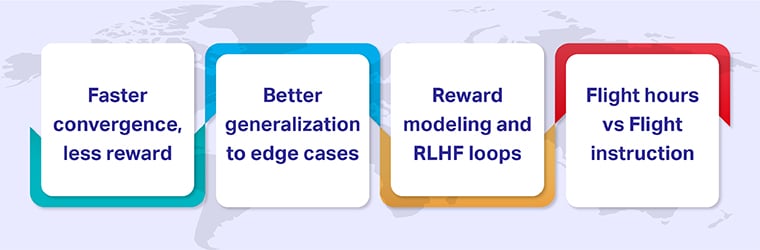
Faster convergence, less reward hacking
Reasoning traces reduce the search space. Instead of blindly exploring, the agent gets structured signals about which intermediate steps are valid. That typically means fewer training iterations wasted on dead ends and fewer “clever” exploits of the reward function.
Research on RLHF and reward modeling repeatedly highlights how sensitive training can be to noisy or low-quality preference/feedback data (Source: Association for Computational Linguistics, 2024). That sensitivity doesn’t disappear in RL—it amplifies.
Better generalization to edge cases
Expert reasoning encodes constraints and principles that transfer: safety boundaries, compliance rules, and causal logic. When the environment changes, those principles still hold—even if the exact pixels, text, or state transitions don’t.
More stable reward modeling and RLHF loops
If you’re using RLHF-style post-training, reasoning data helps you build better reward models—because the reward model can learn to score not only “good answers,” but “good decision paths.” That translates into more consistent updates during optimization and fewer regressions when you scale training.
If you’re building or scaling RLHF pipelines, Shaip’s RLHF solutions are designed around expert-led workflows and quality controls that support consistent alignment data.
An analogy: flight hours vs flight instruction
Think of RL training like pilot training. You can log endless hours in a simulator alone—but if you practice the wrong habits, you’ll reinforce them. An instructor doesn’t just say “pass/fail.” They correct your reasoning mid-flight: scan order, decision timing, and risk handling. Expert-vetted reasoning datasets play that “instructor” role for RL—teaching the model how to think through the task, not just whether it landed.
Comparison table: In-house vs Crowdsourced vs Outsourced vetting models
Most teams end up with a hybrid, but it helps to be explicit about trade-offs.
For broader labeling needs that connect into RL and RLHF pipelines, Shaip’s data annotation services can support everything from guideline design to multi-stage QA—especially when you need repeatable quality at scale.
A practical QC playbook for expert-vetted reasoning datasets
Here’s a playbook that maps to what high-performing teams operationalize.
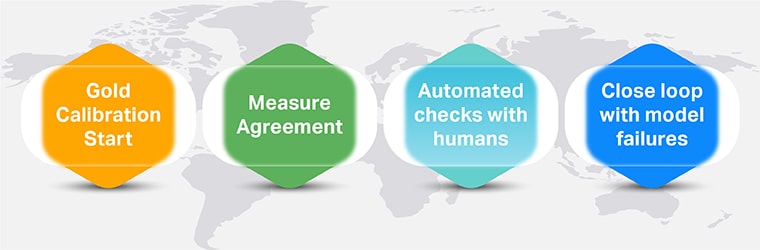
1. Start with “gold” and calibration
Create a gold set of canonical examples (including tricky edge cases). Use it to calibrate annotators and align experts on what “good reasoning” looks like.
2. Measure agreement—then resolve disagreements correctly
Use inter-annotator agreement where it makes sense (and avoid forcing agreement on inherently ambiguous cases). The key is arbitration: disagreements should produce better guidelines, not just a coin flip label.
3. Add automated checks, but keep humans in charge
Automate what’s cheap to verify:
- format consistency (step counts, schema validity)
- rule violations (missing constraints, forbidden actions)
- contradiction detection (step says “A,” later implies “not A”)
Then route flagged items to expert review. This is where hybrid human+AI QC pays off: machines catch “obvious wrong,” experts fix “subtle wrong.”
4. Close the loop with model failures
Treat deployment failures as dataset feedback. When the model fails, ask:
- Was the reasoning trace missing a constraint?
- Did guidelines under-specify the edge case?
- Did we overfit to “happy path” logic?
That loop turns your dataset into a living asset, not a one-time deliverable. For teams building data pipelines end-to-end (collection → QA → delivery), Shaip’s AI training data services can help operationalize this continuously.
Decision framework: how to choose the right vetting strategy
Use these six questions to pick the right mix of in-house, crowd, and managed services: