Buying a dataset takes a purchase order. Making it trainable takes a pipeline. The gap between those two states is where most LLM programmes lose their first month, and it is almost never discussed in the listing that sold the data.
An off-the-shelf corpus is a starting position, not a finished input. It arrives with duplicates, with overlap against the benchmarks you plan to evaluate on, with personal data you may not be licensed to process, and with a distribution shaped by whoever collected it rather than by the model you are building. None of that makes it bad data. It makes it raw material.
Gate one: Provenance and Licensing

The first question is not quality, it is whether you are permitted to train on the data for your intended use — and whether you can demonstrate it later. Commercial use, redistribution of derived weights, territorial limits and consent basis are separate permissions, and a dataset that clears one may fail another. Under the EU AI Act, obligations for general-purpose AI model providers have applied since 2 August 2025: Article 53(1)(a) requires technical documentation covering data sources, provenance and curation methodology, and Article 53(1)(d) requires a publicly available summary of training content following a template issued by the AI Office. Provenance stopped being a legal footnote and became an engineering artifact you have to produce on demand.
The practical rule we give clients: if you cannot name where every subset came from and under what consent, you do not yet have licensable LLM training data. You have a liability with good benchmarks.
Gate two: Deduplication
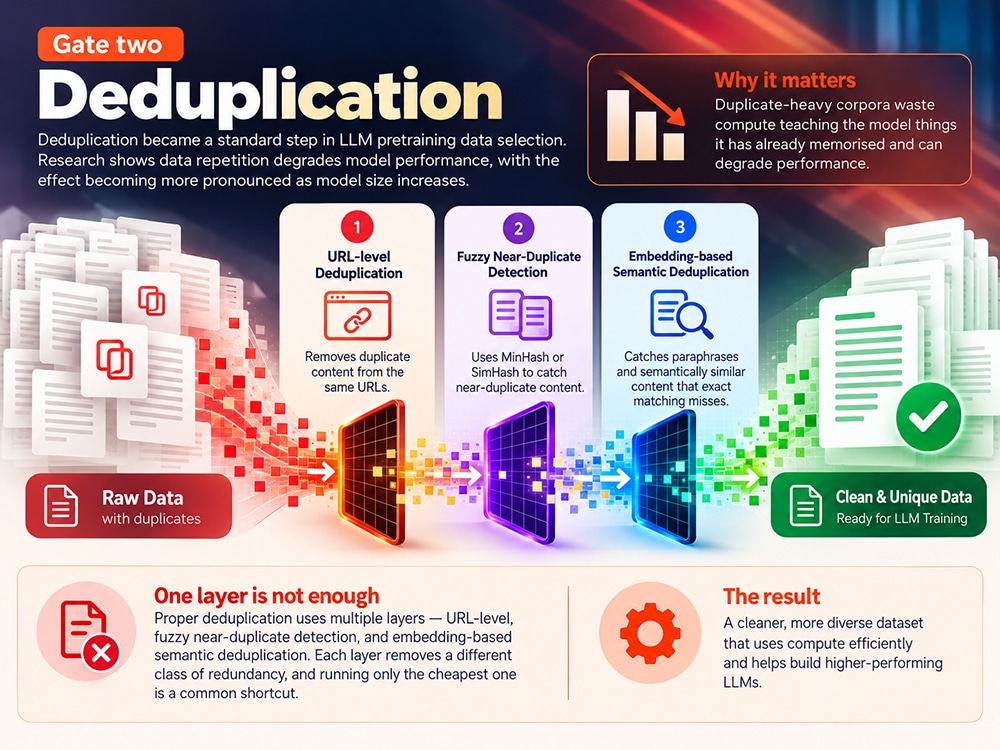
Deduplication became a standard step in LLM pretraining data selection following work published in 2022, and the reason is empirical rather than aesthetic: research the same year showed data repetition degrades model performance, with the effect becoming more pronounced as model size increases. Duplicate-heavy corpora waste compute teaching the model things it has already memorised.
Doing it properly means more than exact-match filtering. Mature pipelines layer URL-level deduplication, fuzzy near-duplicate detection using MinHash or SimHash, and embedding-based semantic deduplication that catches paraphrases exact matching misses. Each layer removes a different class of redundancy, and running only the cheapest one is the most common shortcut we see.
Gate three: Decontamination against your own eval set
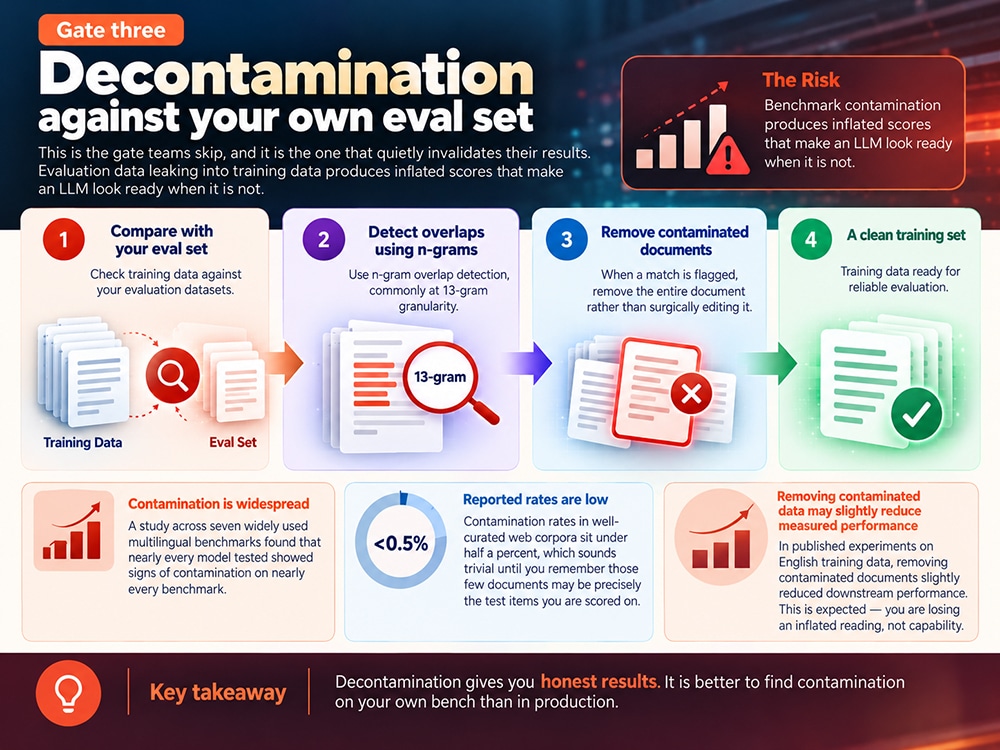
This is the gate teams skip, and it is the one that quietly invalidates their results. Benchmark contamination — evaluation data leaking into training data — produces inflated scores that make an LLM look ready when it is not. A contamination study across seven widely used multilingual benchmarks found that nearly every model tested showed signs of contamination on nearly every benchmark.
Decontamination is usually done with n-gram overlap detection, commonly at 13-gram granularity, removing the entire document when a match is flagged rather than surgically editing it. Reported contamination rates in well-curated web corpora sit under half a percent, which sounds trivial until you remember those few documents may be precisely the test items you are scored on.
Here is the honest part. In published decontamination experiments on English training data, removing contaminated documents slightly reduced measured downstream performance. That is the expected outcome. You are not losing capability, you are losing an inflated reading — and it is better to find that on your own bench than in production.
Gate four: Privacy Scrubbing
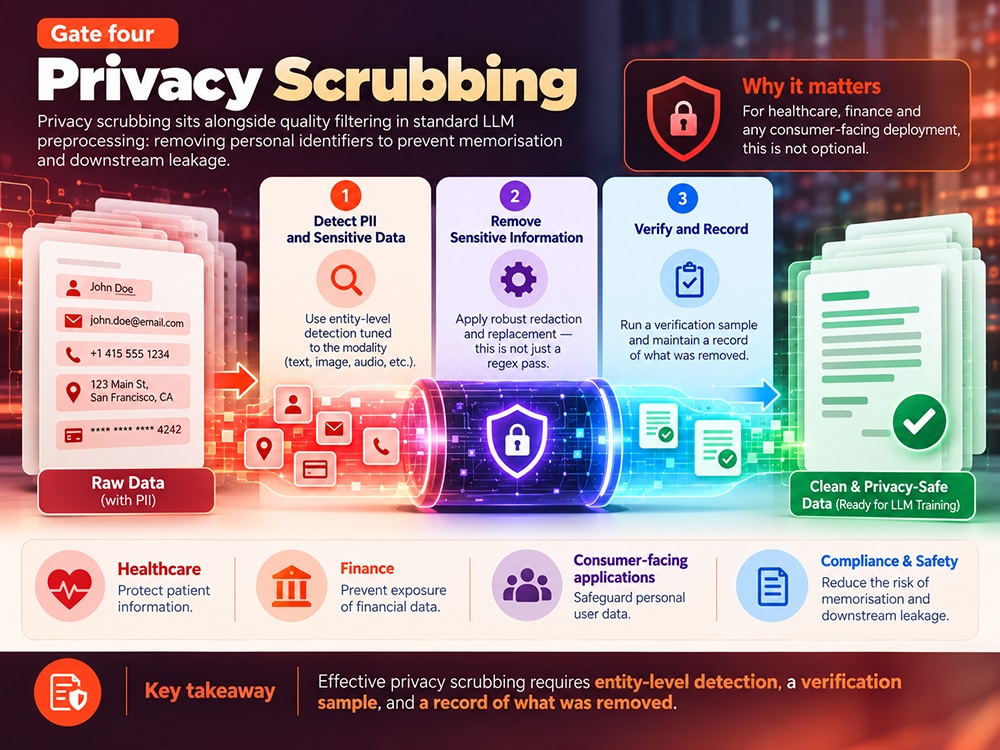
Privacy scrubbing sits alongside quality filtering in standard LLM preprocessing: removing personal identifiers to prevent memorisation and downstream leakage. For healthcare, finance and any consumer-facing deployment, this is not optional and it is not a regex pass. It requires entity-level detection tuned to the modality, a verification sample, and a record of what was removed.
Gate five: Distribution fit and the over-filtering trap
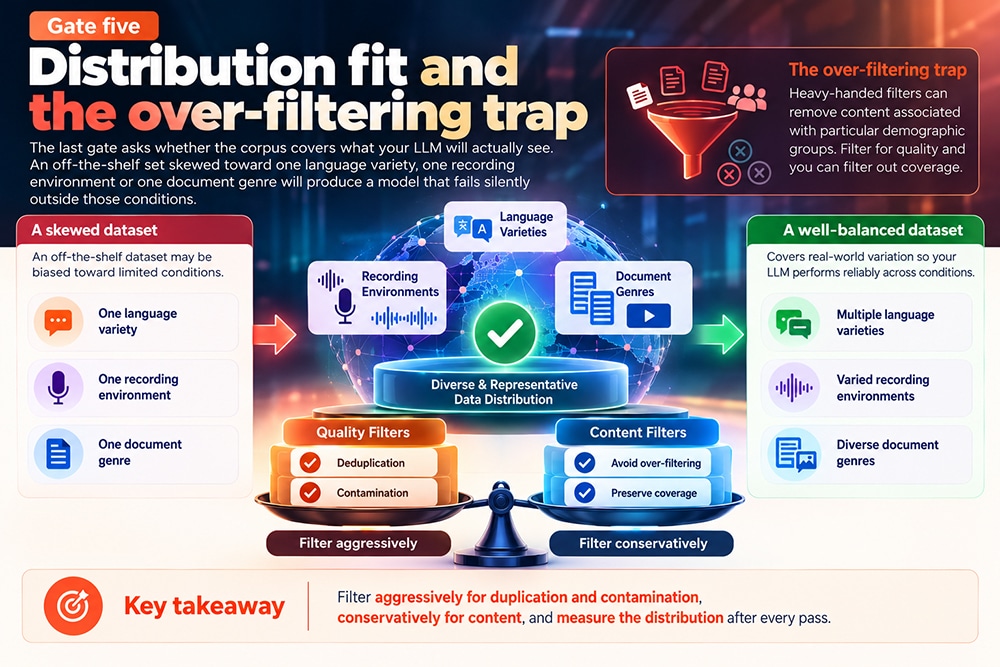
The last gate asks whether the corpus covers what your LLM will actually see. An off-the-shelf set skewed toward one language variety, one recording environment or one document genre will produce a model that fails silently outside those conditions.
The trade-off is real and cuts the other way too. At least one widely documented open-weight model family deliberately forgoes aggressive pretraining filtration, on the reasoning that heavy-handed filters can remove content associated with particular demographic groups. Filter for quality and you can filter out coverage. The rule that holds: filter aggressively for duplication and contamination, conservatively for content, and measure the distribution after every pass.
What this means for build-versus-buy
Off-the-shelf data is still usually the right first move. It is faster and cheaper than collection, and for an LLM pretraining corpus it is the only realistic option at volume. The mistake is budgeting for the purchase and not for the pipeline. Ask any team that has shipped a model and you will hear the same thing: the licence was the cheap part.
How Shaip Supports Production-Ready LLM Training Data
The gap this article describes — between a purchased corpus and a trainable one — is where Shaip’s data catalogs and licensing work sits. Our off-the-shelf catalogs across speech, medical, computer vision and Physical AI modalities ship with documented provenance and consent basis for every subset, because that record is the part you cannot reconstruct after purchase. Where a catalog does not cover a distribution gap, we collect against spec across 60+ countries to fill it. For teams building LLMs on top of that data, our generative AI practice covers fine-tuning, RLHF and multimodal dataset preparation, with de-identification workflows and a compliance posture spanning GDPR, HIPAA, SOC 2 Type II and ISO 27001.
Sitting on a licensed corpus and unsure whether it is clean enough to train on? Talk to our team.