
There is a line in the egocentric manipulation literature that frames the whole problem: before AlexNet must come ImageNet. Robotics has the architectures. What it does not have — at anything like the scale that transformed language and vision — is the dataset.
The reason is not lack of effort. It is that two questions remain genuinely unsettled: what data should be collected, and how it can be collected at the necessary scale. Every sourcing option currently available answers one of those well and the other badly.
The three sources, and what each actually costs

Teleoperation
A human operator drives the robot directly, so the recorded action labels correspond exactly to the target embodiment’s kinematics. Fidelity is unmatched. The constraint is structural: collection is bottlenecked by physical robot operation — one robot, one operator, real time, real wear. Community efforts have pooled hundreds of hours across institutions, and it remains unclear how to keep scaling this paradigm much beyond its present size.
In-the-wild internet video
Effectively unlimited and free of collection cost. The problem is that unstructured video lacks the precise annotation needed to learn dexterous manipulation. You can learn useful visual representations from it. You cannot read exact fingertip trajectories off it.
Egocentric human video with pose annotation
The middle path: first-person capture of humans performing tasks, with paired 3D hand pose. It is passively scalable in the way internet text and images are — collection does not require a robot, and wearable capture devices make volume achievable. Published work on egocentric mobile manipulation found policies co-trained on human data reached comparable or better task success than those trained on teleoperated mobile robot data, with performance continuing to scale as hours of human data increased.
The trade-off that gets missed
Robot-free collection is frequently presented as strictly cheaper. The evidence is more interesting than that.
If you define data efficiency as the human collection effort required to reach a target success rate, robot-free interfaces can be less efficient than teleoperation — published analysis reports some cases requiring more than five times the episodes for comparable success. Cheaper per episode does not mean cheaper per unit of capability.
The rule that follows: compare sources on cost per point of policy success, not cost per hour of footage. The two rankings are frequently different, and the second one is what gets budgeted.
What actually has to be in the data
Three things distinguish usable robot training data from video of someone doing a task.
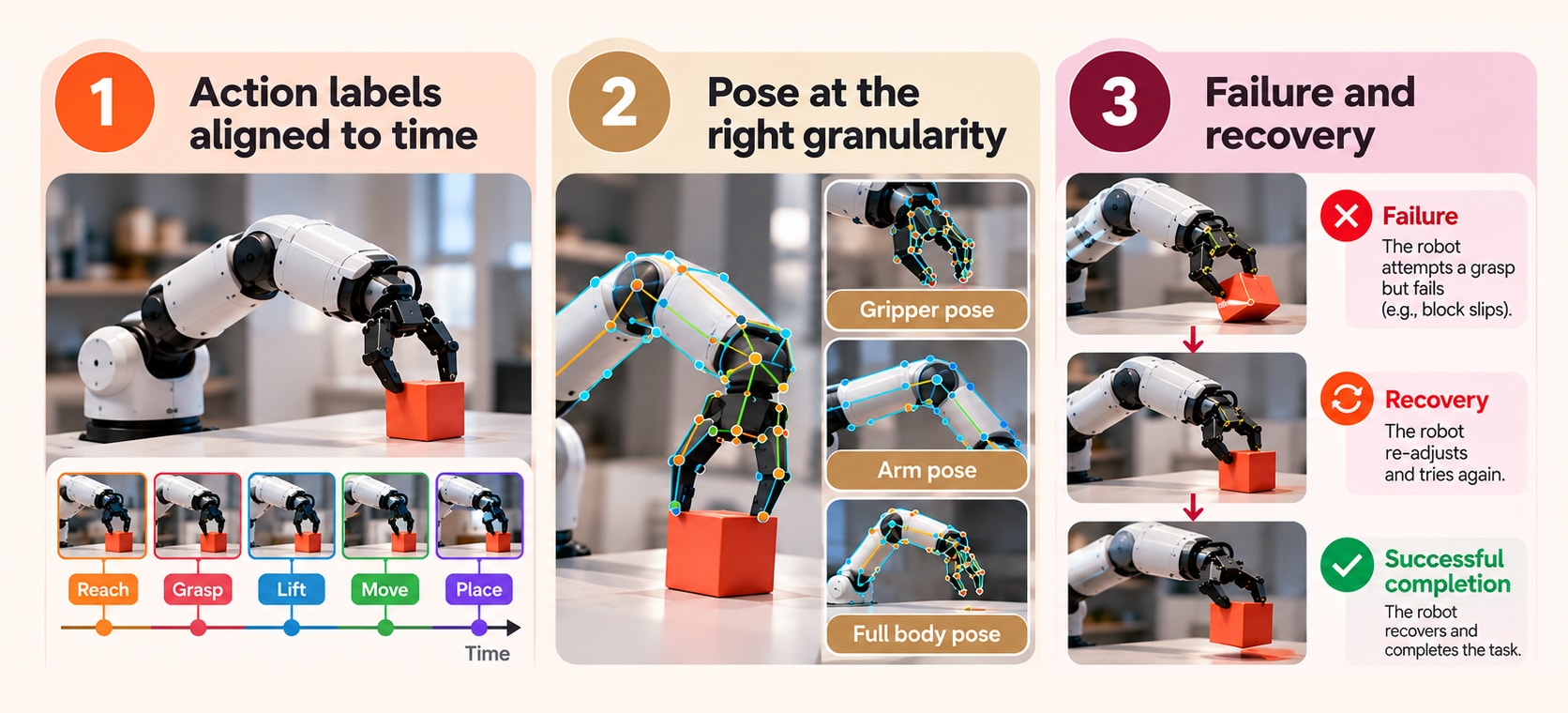
Action labels aligned to time
The observation and the action must be synchronised precisely. Misalignment of a few frames teaches a policy to act on stale observation — a failure that looks like imprecision and is actually a labelling artifact.
Pose at the right granularity
For dexterous manipulation, joint-level hand pose. For whole-body or locomotion work, full-body kinematics. Collecting at the wrong granularity produces a dataset you cannot use for the task you intended.
Failure and recovery
Datasets of perfectly executed demonstrations teach policies that have never seen a mistake and cannot recover from one. Deliberate inclusion of near-misses, slips and corrections is one of the highest-value things a collection spec can specify — and one of the most commonly omitted.
The embodiment problem
Data collected on one robot does not transfer cleanly to another with different kinematics. This is the persistent tax on robotics data: a corpus is partly embodiment-specific in a way that a text corpus never is.
Cross-embodiment pooling and human-video pretraining both exist to soften this, and both work partially. The realistic pattern is large-scale pretraining on heterogeneous human data followed by targeted fine-tuning on a smaller volume of data from the target embodiment. That sequencing matters for budget: the expensive, embodiment-specific collection should be the last and smallest phase, not the first and largest.
How to weight the stack
There is no universal ratio, but the decision variables are consistent: