Inter-annotator agreement is the number most teams check first, and it is the number most likely to mislead them. A 2026 survey of agreement metrics for annotation and evaluation makes the point directly: a homogeneous group of annotators can reach high agreement precisely because its members share the same interpretive frame — including where that frame is wrong. Agreement measures consensus. It does not measure correctness.
That gap is why expert data annotation has moved from a premium option to a default requirement on a growing share of projects. It is also why “just use experts for everything” is bad advice. The honest answer is: it depends on what a wrong label costs you.
What expert data annotation means
Expert data annotation is the labeling of training data by annotators who hold verified domain credentials or equivalent practical experience in the subject matter being labeled — clinicians for medical imaging, licensed practitioners for legal text, senior engineers for code. The distinction is not effort or training hours. It is whether the annotator can resolve genuine interpretive ambiguity using knowledge the guidelines cannot fully encode.
Where generic crowds still work
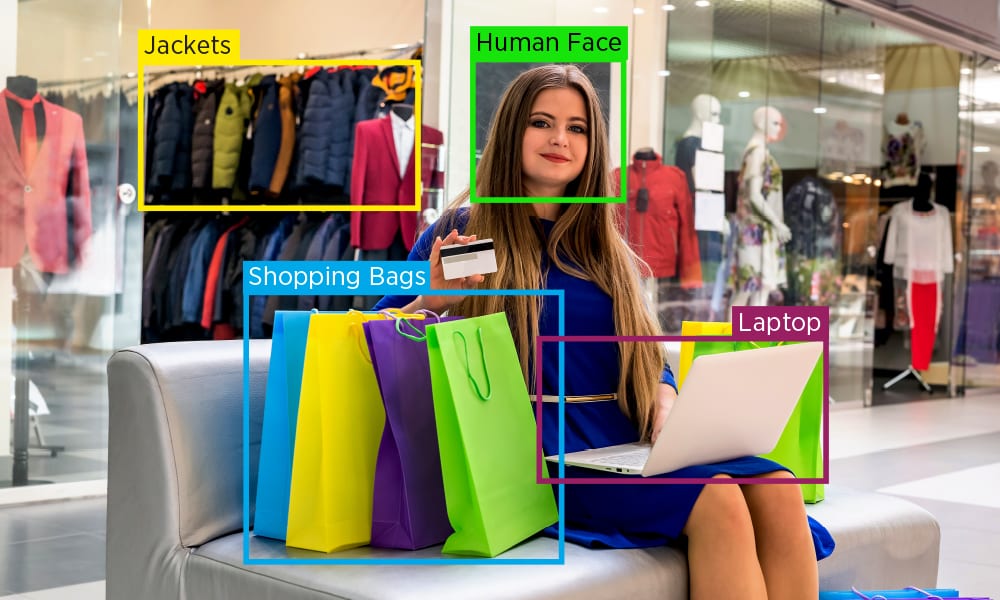
For tasks with objective criteria and clear boundaries, crowd annotation is efficient and accurate. Standard bounding boxes on everyday objects, binary sentiment classification, transcription of clear speech, basic entity tagging — these have defensible ground truth that a well-briefed non-specialist can reach.
The evidence goes further than “good enough.” A 2023 study on lung ultrasound segmentation collected 21,154 annotations from 214 non-expert annotators over two and a half days using a gamified workflow. Crowd consensus segmentations matched the reference standard more closely than individual experts did, on both count accuracy and spatial precision. Design the aggregation well and a crowd can outperform a single specialist.
A 2026 survey of inter-annotator agreement methods makes the complementary point: for general tasks such as sentiment analysis or entity tagging, aggregated non-expert labels achieve high reliability, and mixed-expertise pools are actively valuable for subjective phenomena where disagreement reflects real diversity of interpretation rather than error.
The four places crowds break
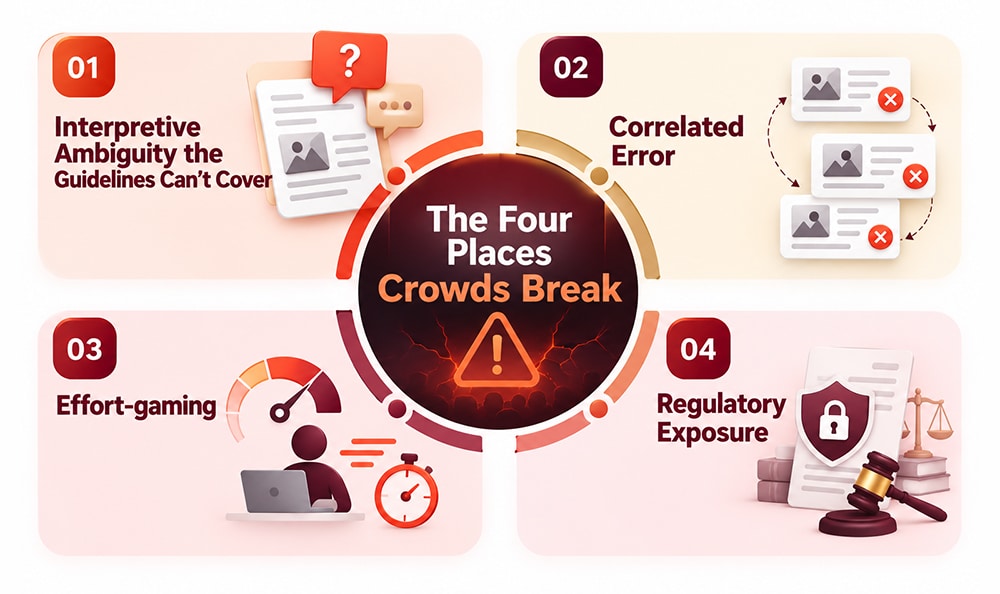
Interpretive ambiguity the guidelines can’t cover. When resolving an edge case requires knowing why the category exists, a non-specialist guesses plausibly. A 2019 biomedical information-extraction study found that a model trained on expert annotations of just 20% of the corpus outperformed a model trained on crowd annotations of all 5,000 abstracts — recall collapsed on the crowd-labeled set.
Correlated error. Individual mistakes average out across a pool. A shared misunderstanding does not — it produces a dataset that coheres neatly around the same error. Consensus metrics are blind to this by construction, which is why agreement scores should never be reported without a gold-standard check against expert-adjudicated items.
Effort-gaming. On open marketplaces, some annotators optimize for throughput rather than accuracy. A 2024 imaging-AI study comparing annotation providers cites reported rates of unusable annotations as high as 67.8% on one open crowd marketplace.
Regulatory exposure. In healthcare, finance, and safety-critical autonomy, you may need to show who labeled what and on what basis. An anonymous pool cannot produce that record.
The routing test
Ask one question per batch: if this label is wrong, what happens downstream?