
Automation won’t replace annotators. It will empower them.
Data annotation is evolving from “labeling work” into AI data operations: higher judgment, stronger governance, tighter evaluation loops, and more sophisticated human-in-the-loop systems. Automation will take repetitive steps off people’s plates — while humans become even more critical where nuance, safety, domain knowledge, and accountability matter most.
1. Data Annotation Is No Longer a “Back-Office Task”
For years, annotation was treated like a throughput problem: more volume, faster turnaround, lower cost. But GenAI and multimodal models have changed the game. Modern AI fails less often because it can’t “compute,” and more often because it was trained and evaluated on incomplete, inconsistent, or non-defensible supervision.
What’s emerging is a new reality:
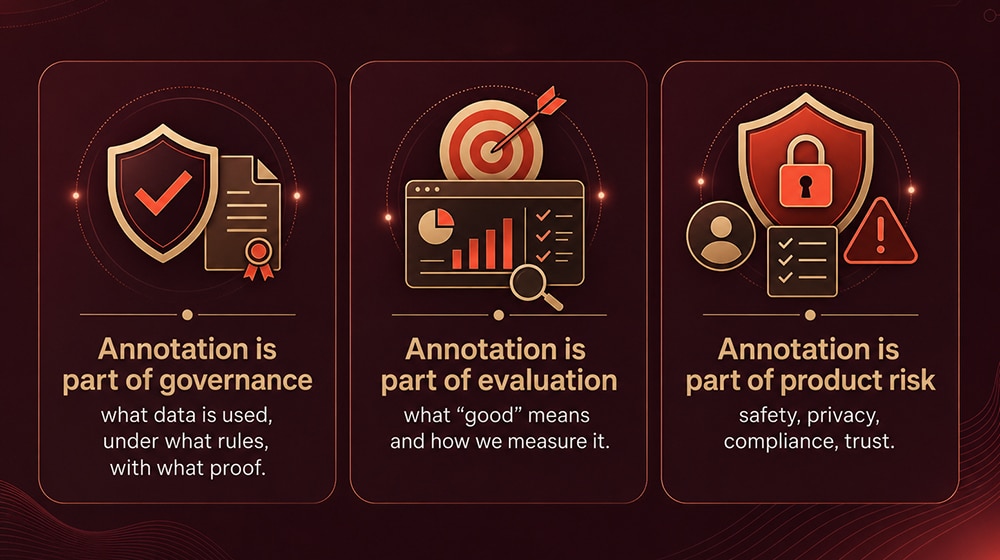
- Annotation is part of governance — what data is used, under what rules, with what proof.
- Annotation is part of evaluation — what “good” means and how we measure it.
- Annotation is part of product risk — safety, privacy, compliance, trust.
2. What Automation Will Actually Replace
If annotation now carries governance, evaluation, and product-risk weight, the obvious next question is where automation still fits. It does — just not where most teams expect.
Automation will absolutely change annotation — but mostly by removing the least valuable parts of the workflow.
Automation’s Real Impact
Automation replaces busywork, not judgment.
3. The Work Shifts “Up the Stack”: From Labels to Decisions
Strip out the busywork automation removes, and what’s left is the part of the job that actually decides model quality.
Here’s what humans increasingly do in high-performing AI programs:
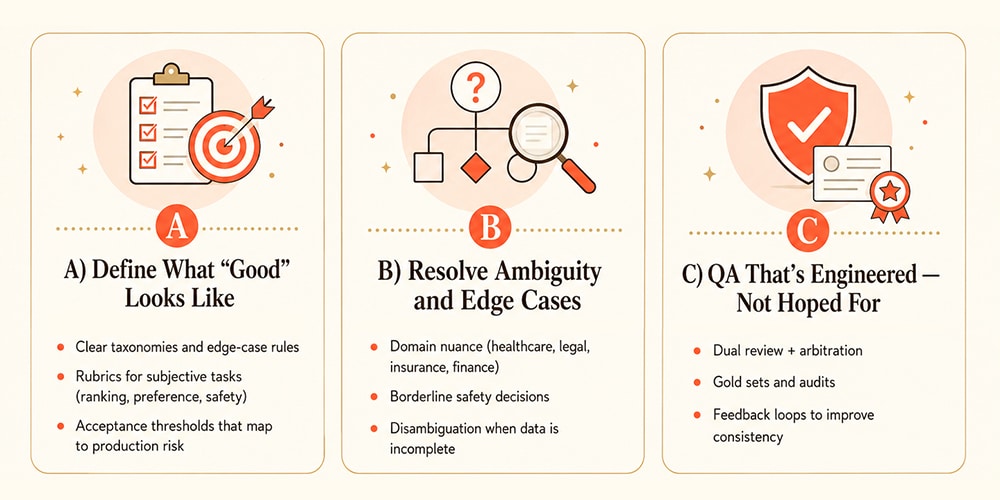
A) Define What “Good” Looks Like
If you can’t define “good,” you can’t label consistently, and you can’t evaluate improvements. That means:
- Clear taxonomies and edge-case rules
- Rubrics for subjective tasks (ranking, preference, safety)
- Acceptance thresholds that map to production risk
B) Resolve Ambiguity and Edge Cases
Production data is messy. Customers are messy. Reality is messy. Humans are still the best system for:
- Domain nuance (healthcare, legal, insurance, finance)
- Borderline safety decisions
- Disambiguation when data is incomplete
C) QA That’s Engineered — Not Hoped For
High-stakes annotation relies on systems like:
- Dual review + arbitration
- Gold sets and audits
- Feedback loops to improve consistency
This kind of rigor shows up in real deployments, where quality control often requires dual blind vote + arbitration to maintain accuracy at scale.
4. What “Modern Annotation” Looks Like in 2026+
Put governance, judgment-heavy review, and engineered QA together, and a clear pattern emerges for how teams are structuring their 2026 annotation programs.
Expect these shifts to become standard:
4 Trends Shaping Annotation in 2026+
5. The New Role of the Annotator: Operator of AI Quality
Every trend above points to the same underlying shift in who does the work and how.
The story isn’t “human vs. automation.” It’s: humans + automation → higher quality at scale.
Annotators evolve into:
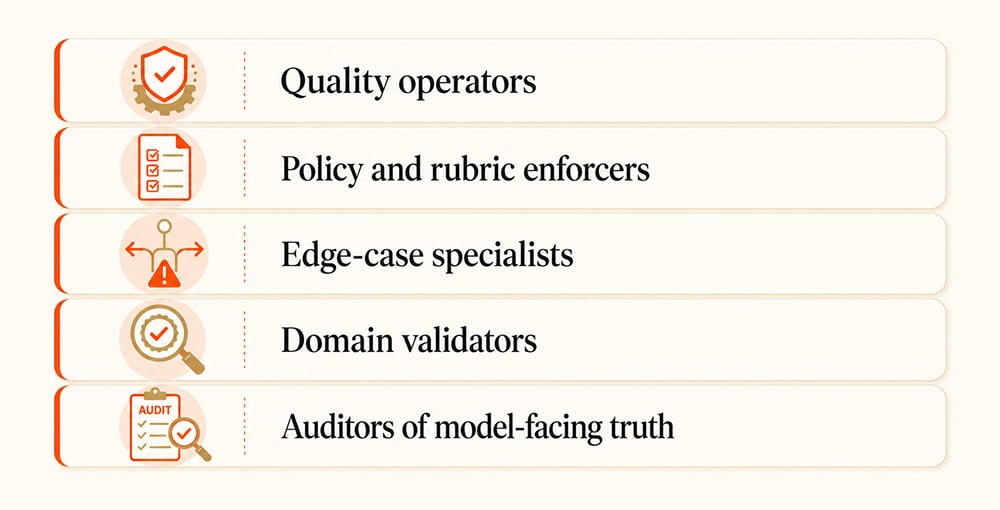
- Quality operators
- Policy and rubric enforcers
- Edge-case specialists
- Domain validators
- Auditors of model-facing truth
This is also why “gold standard annotation” and multi-layer QA are becoming the most valuable capabilities annotation partners can offer.
6. What to Do Now: Practical Checklist
None of this is theoretical — it’s a punch list teams can act on this quarter.
If you’re planning annotation for 2026+, start here:
2026 Readiness Checklist