
If you’ve ever watched model performance dip after a “simple” dataset refresh, you already know the uncomfortable truth: data quality doesn’t fail loudly—it fails gradually. A human-in-the-loop approach for AI data quality is how mature teams keep that drift under control while still moving fast.
This isn’t about adding people everywhere. It’s about placing humans at the highest-leverage points in the workflow—where judgment, context, and accountability matter most—and letting automation handle the repetitive checks.
Why data quality breaks at scale (and why “more QA” isn’t the fix)
Most teams respond to quality issues by stacking more QA at the end. That helps—briefly. But it’s like installing a bigger trash can instead of fixing the leak that’s causing the mess.
Human-in-the-loop (HITL) is a closed feedback loop across the dataset lifecycle:
- Design the task so quality is achievable
- Produce labels with the right contributors and tooling
- Validate with measurable checks (gold data, agreement, audits)
- Learn from failures and refine guidelines, routing, and sampling
The practical goal is simple: reduce the number of “judgment calls” that reach production unchecked.
Upstream controls: prevent bad data before it exists
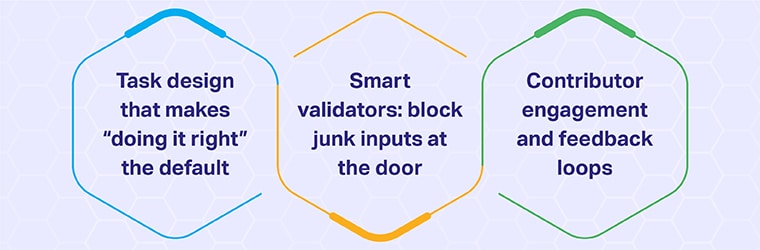
Task design that makes “doing it right” the default
High-quality labels start with high-quality task design. In practice, that means:
- Short, scannable instructions with decision rules
- Examples for “main cases” and edge cases
- Explicit definitions for ambiguous classes
- Clear escalation paths (“If unsure, choose X or flag for review”)
When instructions are vague, you don’t get “slightly noisy” labels—you get inconsistent datasets that are impossible to debug.
Smart validators: block junk inputs at the door
Smart validators are lightweight checks that prevent obvious low-quality submissions: formatting issues, duplicates, out-of-range values, gibberish text, and inconsistent metadata. They’re not a replacement for human review; they’re a quality gate that keeps reviewers focused on meaningful judgment instead of cleanup.
Contributor engagement and feedback loops
HITL works best when contributors aren’t treated like a black box. Short feedback loops—automatic hints, targeted coaching, and reviewer notes—improve consistency over time and reduce rework.
Midstream Acceleration: AI-assisted Pre-Annotation
Automation can speed up labeling dramatically—if you don’t confuse “fast” with “correct.”
A reliable workflow looks like this:
pre-annotate → human verify → escalate uncertain items → learn from errors
Where AI assistance helps most:
- Suggesting bounding boxes/segments for human correction
- Drafting text labels that humans confirm or edit
- Highlighting likely edge cases for priority review
Where humans are non-negotiable:
- Ambiguous, high-stakes judgments (policy, medical, legal, safety)
- Nuanced language and context
- Final approval for gold/benchmark sets
Some teams also use rubric-based evaluation to triage outputs (for example, scoring label explanations against a checklist). If you do this, treat it as decision support: keep human sampling, track false positives, and update rubrics when guidelines change.
Downstream QC playbook: measure, adjudicate, and improve
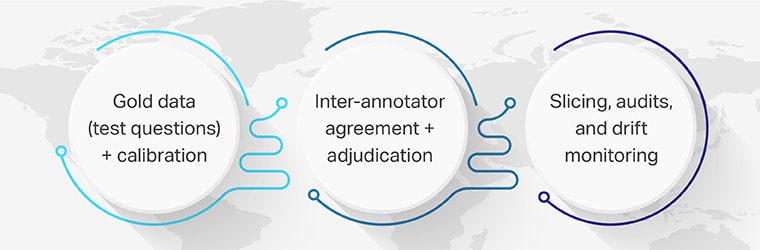
Gold data (Test Questions) + Calibration
Gold data—also called test questions or ground-truth benchmarks—lets you continuously check whether contributors are aligned. Gold sets should include:
- representative “easy” items (to catch careless work)
- hard edge cases (to catch guideline gaps)
- newly observed failure modes (to prevent recurring mistakes)
Inter-Annotator Agreement + Adjudication
Agreement metrics (and more importantly, disagreement analysis) tell you where the task is underspecified. The key move is adjudication: a defined process where a senior reviewer resolves conflicts, documents the rationale, and updates the guidelines so the same disagreement doesn’t repeat.
Slicing, audits, and drift monitoring
Don’t just sample randomly. Slice by:
- Rare classes
- New data sources
- High-uncertainty items
- Recently updated guidelines
Then monitor drifts over time: label distribution shifts, rising disagreement, and recurring error themes.