
Analogy: Think of labeling like a restaurant kitchen.
- In-house is building your own kitchen and training chefs.
- Crowdsourcing is ordering from a thousand home kitchens at once.
- Outsourcing is hiring a catering company with standardized recipes, staffing, and QA.
The best choice depends on whether you need a “signature dish” (domain nuance) or “high throughput” (scale), and how expensive mistakes are.
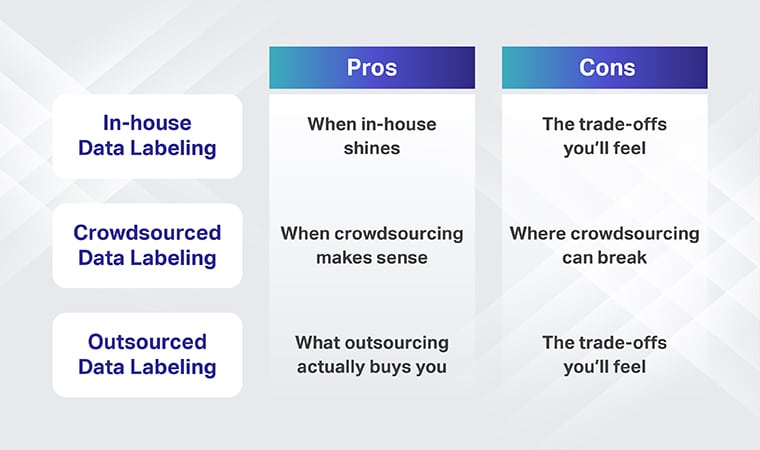
In-House Data Labeling: Pros and Cons
When in-house shines
In-house labeling is strongest when you need tight control, deep context, and fast iteration loops between labelers and model owners.
Typical best-fit situations:
- Highly sensitive data (regulated, proprietary, or customer-confidential)
- Complex tasks requiring domain expertise (medical imaging, legal NLP, specialized ontologies)
- Long-lived programs where building internal capability compounds over time
The trade-offs you’ll feel
Building a coherent internal labeling system is expensive and time-consuming, especially for startups. Common pain points:
- Recruiting, training, and retaining labelers
- Designing guidelines that stay consistent as projects evolve
- Tool licensing/build costs (and the operational overhead of running the tool stack)
Reality check: The “true cost” of in-house isn’t just wages—it’s the operational management layer: QA sampling, retraining, adjudication meetings, workflow analytics, and security controls.
Crowdsourced Data Labeling: Pros and Cons
When crowdsourcing makes sense
Crowdsourcing can be extremely effective when:
- Labels are relatively straightforward (classification, simple bounding boxes, basic transcription)
- You need a large burst of labeling capacity quickly
- You’re running early experiments and want to test feasibility before committing to a bigger ops model
The “pilot-first” idea: treat crowdsourcing as a litmus test before scaling.
Where crowdsourcing can break
Two risks dominate:
- Quality variance (different workers interpret guidelines differently)
- Security/compliance friction (you’re distributing data more widely, often across jurisdictions)
Recent research on crowdsourcing highlights how quality-control strategies and privacy can pull against each other, especially in large-scale settings.
Outsourced Data Labeling Services: Pros and Cons
What outsourcing actually buys you
A managed provider aims to deliver:
- A trained workforce (often screened and coached)
- Repeatable production workflows
- Built-in QA layers, tooling, and throughput planning
Higher consistency than crowdsourcing, less internal build burden than in-house.
The trade-offs
Outsourcing can introduce:
- Ramp-up time to align guidelines, samples, edge cases, and acceptance metrics
- Lower internal learning (your team may not develop annotation intuition as quickly)
- Vendor risk: security posture, workforce controls, and process transparency
If you outsource, you should treat your provider like an extension of your ML team—with clear SLAs, QA metrics, and escalation paths.
The quality control playbook
If you only remember one thing from this article, make it this:
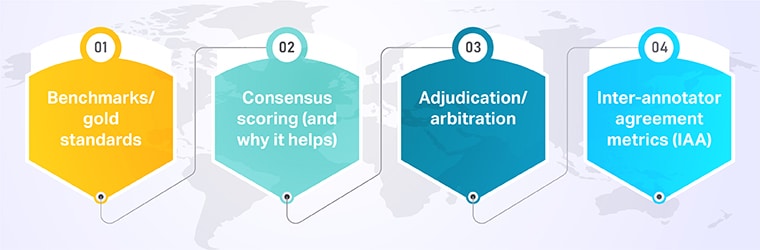
Quality doesn’t happen at the end—it’s designed into the workflow.
Here are the quality mechanisms that repeatedly show up in credible tooling docs and real-world case studies:
1. Benchmarks/Gold Standards
Labelbox describes “benchmarking” as using a gold standard row to assess label accuracy.
This is how you turn “looks good” into measurable acceptance.
2. Consensus Scoring (and why it helps)
Consensus scoring compares multiple annotations on the same item to estimate agreement.
It’s particularly useful when tasks are subjective (sentiment, intent, medical findings).
3. Adjudication/Arbitration
When disagreement is expected, you need a tie-breaker process. Shaip’s clinical annotation case study explicitly references dual voting and arbitration to maintain quality under volume.
4. Inter-Annotator Agreement metrics (IAA)
For technical teams, IAA metrics like Cohen’s kappa / Fleiss’ kappa are common ways to quantify reliability. For example, a medical segmentation paper from the U.S. National Library of Medicine discusses kappa-based agreement assessment and related methods.
Security & Certification Checklist
If you’re sending data outside your internal perimeter, security becomes selection criteria—not a footnote.
Two widely referenced frameworks in vendor assurance are:
- ISO/IEC 27001 (information security management systems)
- SOC 2 (controls relevant to security, availability, processing integrity, confidentiality, privacy)
For deeper reading, you can reference:
What to ask vendors
- Who can access raw data, and how is access granted/revoked?
- Is data encrypted at rest/in transit?
- Are labelers vetted, trained, and monitored?
- Is there role-based access control and audit logging?
- Can we run a masked/minimized dataset (only what’s needed for the task)?
A pragmatic decision framework
Use these five questions as a fast filter:
- How sensitive is the data?
If high sensitivity, prefer in-house or a provider with demonstrable controls (certifications + process transparency). - How complex are the labels?
If you need SMEs and adjudication, outsourcing (managed) or in-house usually beats pure crowdsourcing. - Do you need long-term capability or short-term throughput?
- Long-term: In-house compounding can be worth it
- Short-term: crowdsourcing/provider buys speed
- Do you have “annotation ops” bandwidth?
Crowdsourcing can be deceptively management-heavy; providers often reduce that burden. - What’s the cost of being wrong?
If label errors cause model failures in production, quality controls and repeatability matter more than the cheapest unit cost.
Most teams land on a hybrid:
- In-house for sensitive and ambiguous edge cases
- Provider/crowd for scalable baseline labeling
- A shared QC layer (gold sets + adjudication) across everything
If you want a deeper build-vs-buy lens, Shaip’s data annotation buyer’s guide is designed specifically around outsourcing decision points and vendor involvement.
Conclusion
“In-house vs crowdsourced vs outsourced data labeling” isn’t a philosophical choice—it’s an operational design decision. Your goal is not cheap labels; it’s usable, consistent ground truth delivered at the pace your model lifecycle demands.
If you’re evaluating options now, start with two moves:
- Define your QA bar (gold sets + adjudication).
- Pick the operating model that can meet that bar reliably—without draining your engineering team.
To explore production-grade options and tooling support, see Shaip’s data annotation services and data platform overview.