Why Data Neutrality Is More Critical Than Ever in AI Training Data
If AI is the engine of your business, training data is the fuel.
But here’s the uncomfortable truth: who controls that fuel – and how they use it – now matters as much as the quality of the data itself. That’s what the idea of data neutrality is really about.
In the last couple of years, big tech acquisitions, foundation model partnerships, and new regulations have turned data neutrality from a niche concept into a frontline business and compliance issue. Neutral, high-quality training data is no longer a “nice to have” – it’s core to protecting your IP, avoiding bias, and keeping regulators (and customers) on your side.
In this article, we’ll break down what data neutrality means in practice, why it matters more than ever, and how to evaluate whether your AI training data partner is truly neutral.
What Do We Actually Mean by “Data Neutrality” in AI?
Let’s skip the legalese and talk in plain language.
Data neutrality in AI is the idea that your training data is:
Collected and managed independently of your competitors’ interests
Used only in ways you agree to (no “mystery reuse” across clients)
Governed by transparent rules around bias, access, and ownership
Protected from conflicts of interest in how it’s sourced, annotated, and stored
Think of your AI’s training data like a city’s water supply.
If one private company owns all the pipes and also runs a competing water-intensive business, you’d worry about how clean, fair, and reliable that supply really is. Neutrality is about making sure your AI doesn’t become dependent on a data supply controlled by someone whose incentives don’t fully align with yours.
For AI training data, neutrality cuts across:
Fairness & bias – Are some groups or perspectives systematically underrepresented?
Independence – Is your provider also building their own competitive models?
Data sovereignty – Who ultimately controls where your data lives and how it can be reused?
IP protection – Could your hard-won insights leak into someone else’s model?
Data neutrality is the discipline of answering “yes, we’re protected” to all of those questions – and being able to prove it.
Why Data Neutrality Just Got Real
A few years ago, “neutral training data” sounded like a philosophical nice-to-have. Today, it’s a boardroom conversation.
Market consolidation and vendor lock-in
Recent moves – like hyperscalers deepening ties with data providers and large equity stakes in training data platforms – have changed the risk profile for any company that outsources data collection and annotation.
If your main training data supplier is now partly owned by a big tech company that:
Competes with you directly, or
Is building models in your domain,
Then you have to ask hard questions:
Will my data be used, even in aggregate, to sharpen my competitor’s models?
Will I get the same priority and quality if my roadmap conflicts with theirs?
How easy is it to move away if something changes?
Regulation and consumer expectations
Regulators are catching up. The EU AI Act’s Article 10explicitly demands high-quality datasets that are relevant, representative, and properly governed for high-risk AI systems.
At the same time, surveys show that a large majority of U.S. consumers want transparency in how brands source data for AI models – and are more likely to trust organizations that can explain this clearly.
In other words, the bar is rising. “We bought some data and threw it at a model” no longer flies with regulators, customers, or your own risk team.
A quick (hypothetical) story
Imagine you’re a CX leader at a fast-growing SaaS company. You outsource training data collection and annotation for your customer-support copilot to a well-known vendor.
Six months later, that vendor was acquired by a large tech company launching a competing CX product. Some of your board members ask if your training data – especially edge cases and sensitive feedback – might end up informing their model.
Your legal and compliance teams start digging into contracts, DPAs, and internal processes. Suddenly, AI is not just an innovation story; it’s a governance and trust story.
That’s what happens when data neutrality wasn’t a selection criterion from day one.
How Data Neutrality Shapes AI Training Data Quality
Neutrality isn’t just about politics and ownership – it’s tightly linked to data quality and the performance of your models.
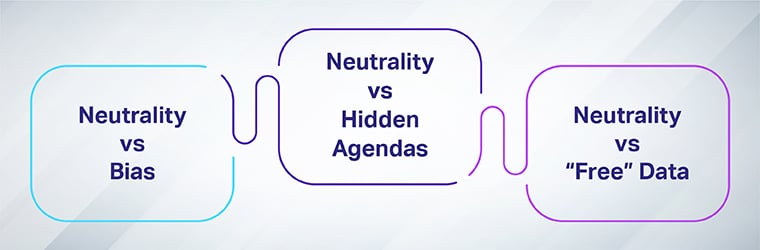
Neutrality vs bias: diversity by design
Neutral partners are more likely to prioritize diverse, representative training data – because their business model depends on being a trusted, unbiased provider rather than pushing a particular agenda.
For example, when you intentionally source diverse AI training data for inclusivity, you reduce the risk that your model systematically under-serves specific accents, regions, or demographic groups.
Neutrality vs hidden agendas: Who owns the pipeline?
If your data supplier also builds competing products, there’s always a risk – even if only perceived – that:
Your toughest edge cases become “training gold” for a rival model.
Your domain expertise informs their roadmap.
Resource allocation favors internal projects over your delivery timelines.
A truly neutral AI training data provider has one job: help you build better models, not themselves.
Neutrality vs “free” data: open-source ≠ neutral
Open or scraped datasets can look tempting: fast, cheap, abundant. But they often come with:
Licensing questions and legal ambiguity
Skewed distributions that reinforce existing power structures
Limited documentation about how the data was collected
Many analyses now highlight the hidden dangers of open-source data – from legal exposure to systemic bias.
Neutrality here means being honest about when “free” data makes sense – and when you need curated, ethically sourced, high-quality training data for AI instead.
Key Principles of Data Neutrality in AI Training Data
So what should you actually look for?
Independence and no-compete positioning
A neutral provider:
Don’t build core products that directly compete with your AI.
Has clear internal policies to ring-fence client data.
Is transparent about investors, partnerships, and strategic interests.
This is similar to choosing an independent auditor – you want someone whose incentives are aligned with trust and accuracy, not with your competitors’ growth.
Ethical, compliant, privacy-first sourcing
With regulations like the EU AI Act, GDPR, and sector-specific rules, data neutrality must sit on a foundation of robust data protection and governance.
Documented consent and collection methods
Strong de-identification where needed
Clear data-retention and deletion policies
Auditable trails for how data moves through the pipeline
This is where ethical AI training data overlaps strongly with neutrality: you can’t claim to be neutral if your sourcing is opaque or exploitative.
Quality, diversity, and governance by design
High-quality training data is not just accurate – it is governed:
Sampling plans to ensure representation across languages, demographics, and contexts
Multi-layer QA (reviewers, SMEs, golden datasets)
Continuous monitoring for drift, error patterns, and new edge cases.
Neutral providers invest heavily in these processes because trust is their product.
A Practical Checklist for Choosing a Neutral AI Training Data Partner
Here’s a vendor checklist you can literally drop into your RFP.
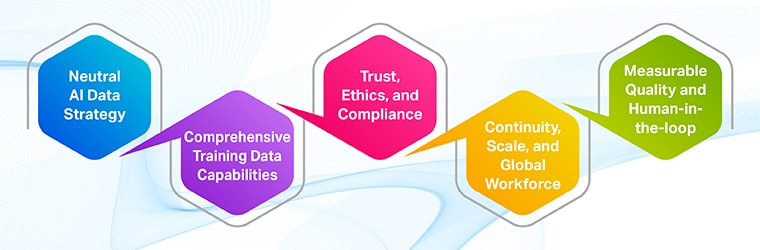
1. Neutral AI data strategy
Ask:
Do you build or plan to build products that compete with us?
How do you ensure our data isn’t reused – even in anonymized form – in ways we haven’t agreed to?
What happens to our data if your ownership or partnerships change?
2. Comprehensive AI training data capabilities
A neutral provider should still be strong on execution:
Collection, annotation, and validation across text, image, audio, and video
Experience in your domain (e.g., healthcare, automotive, finance) Ability to support both classic ML and generative AI use cases
3. Trust, ethics, and compliance
Your vendor should be able to show:
Compliance with relevant frameworks (e.g., GDPR; alignment with EU AI Act principles)
Clear approaches to consent, de-identification, and secure storage
Internal audits and external certifications where applicable
Transparent processes for handling incident reports and data subject requests
To go deeper on this, you can connect neutrality to broader ethical AI data discussions – like those covered in Shaip’s article on building trust in machine learning with ethical data.
4. Continuity, scale, and global workforce
Neutrality without operational strength isn’t enough. Look for:
Demonstrated ability to run large, multi-country projects at scale
A global contributor network and robust field operations
Strong project management, SLAs, and transition/onboarding support.
5. Measurable quality and human-in-the-loop
Finally, check that neutrality is backed by quality you can measure:
Multi-layer QA and SME review
Golden datasets and benchmark suites
Human-in-the-loop workflows for complex or sensitive tasks
Neutral partners are comfortable putting quality metrics on paper – because their business depends on delivering consistent, trusted outcomes.
How Shaip Approaches Data Neutrality in Training Data
At Shaip, neutrality is tightly linked to how we source, manage, and govern training data:
Independent focus on data: We specialize in AI training data – data collection, annotation, validation, and curation – rather than competing with customers in their end markets.
Ethical, privacy-first sourcing: Our workflows emphasize consent, de-identification where appropriate, and secure environments for sensitive data, aligned with modern regulatory expectations.
Quality and diversity by design: From open datasets to custom collections, we prioritize high-quality, representative training data for AI across languages, demographics, and modalities.
Human-in-the-loop and governance: We combine global human expertise with platform-level controls for QA, contributor management, and auditable workflows.
If you’re reassessing your data strategy, neutrality is a powerful lens: Are our data partners fully aligned with our goals – and only our goals?
What is data neutrality in AI?
Data neutrality is the practice of collecting, managing, and using training data in a way that is independent, fair, and free from conflicting interests. It ensures your data provider doesn’t reuse your data in ways you didn’t agree to, doesn’t compete directly with you using your own insights, and follows transparent, ethical governance.
Why is data neutrality important for AI training data?
Because training data shapes how your models behave. Without neutrality, you risk:
Hidden bias baked into datasets
IP leakage to competitors
Compliance issues with emerging AI regulations
Loss of customer trust if data sourcing practices are questioned
How does data neutrality relate to data sovereignty?
Data sovereignty is about who ultimately controls and governs your data (often linked to geography and regulation). Data neutrality is about whether that control is exercised fairly and independently. You want both: sovereign control over where your data lives, and neutral partners who don’t have conflicting incentives. Network World+1
How do I know if an AI training data provider is truly neutral?
Ask for:
Clear statements on whether they build products that compete with you
Contractual commitments about data reuse and model training
Transparency on investors and strategic partnerships
Evidence of ethical, compliant data sourcing and governance (audits, certifications, case studies)
If the answers are vague, neutrality may be more marketing than reality.
Is open-source training data neutral?
Not necessarily. Open-source datasets can be valuable, but they often:
Reflect the biases of who created and curated them
Lack detailed documentation on collection methods
Have licensing or consent gaps
You should treat open datasets as one ingredient in a broader, governed data strategy – not as automatically neutral or risk-free.