Text Annotation Services for NLP, Generative AI & LLM Training
Outsource text annotation in 150+ languages — entity recognition, sentiment, classification & LLM training data delivered by expert annotators
Why is Text Annotation – and why your NLP & LLM models need it
Text annotation is the process of labelling unstructured text — emails, chat logs, support tickets, clinical notes, legal contracts, social posts — so that natural language processing (NLP) and large language models (LLMs) can learn the patterns. Without high-quality annotated training data, even the strongest model architecture under-performs.
At Shaip we build annotated text datasets for four core jobs: training a model from scratch, fine-tuning an open-source LLM, evaluating model output, and running continuous reinforcement learning with human feedback (RLHF). Every dataset is labelled by a domain-expert annotator, double-reviewed by a Six Sigma–trained QA reviewer, and delivered in the schema your training pipeline expects.
If your data-science team currently spends 80% of its time cleaning and labelling text instead of building models, that is the gap text annotation outsourcing exists to close.
Accurate Text Annotation For Machine Learning
As much as the concept feels intriguing, preparing similar resources can take a lot of effort, professional experience, and expert-level intellect. This is where Shaip shows up as a reliable text annotation company, focusing extensively on labeling the collected data to perfection.
With Shaip on board, you can stop worrying about the perceptive abilities of your machine learning setups as the AI training data on offer is prepared to interpret responses, semantics, and yes, even sentiments.
Looking for more, here are some of the added benefits of relying on Shaip as your Text Annotation outsourcing partner:
- Goal-intensive approach
- Focus on context and clarity of communication
- Ability to train machines with linguistic elements
- Exhaustive search engine labeling
- Scalable offerings
- Multi-lingual machine translation
Our Expertise
Types of text annotation services we deliver
Every NLP and Generative AI use case maps to one or more of nine annotation techniques. Shaip delivers all nine — within one platform, one project manager and one quality framework.

Text Classification & Topic Tagging
Single-label, multi-label and hierarchical classification for spam detection, topic routing, news categorisation, intent triage and content moderation. Built to scale to taxonomies with hundreds of categories.

Linguistic Annotation (POS, Phonetic, Morphological)
Part-of-speech tagging, phonetic transcription, morphological tagging and dependency parsing — used for low-resource language modelling, machine translation training and academic corpora.

Named Entity Recognition (NER) & Entity Linking
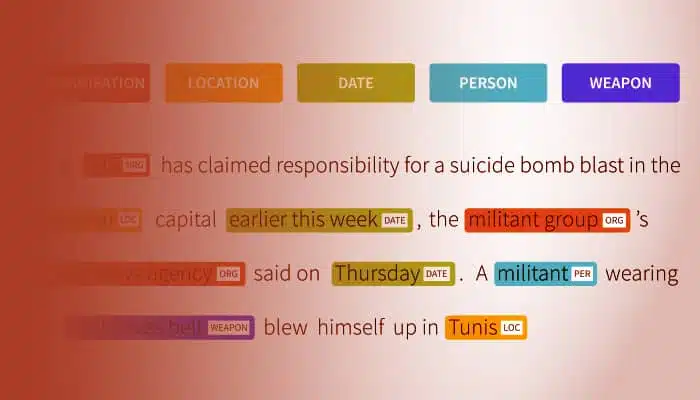
We tag people, organisations, locations, dates, monetary values, medical entities, legal clauses and product codes inside unstructured text — and link each entity to a canonical knowledge base (Wikidata, UMLS, ICD-10 or a client ontology).

Subject-Action-Object (SAO) & Relationship Annotation
Triplet extraction for knowledge-graph construction, event-extraction systems and patent intelligence. SAO labelling turns flat sentences into machine-reasonable structure.

Sentiment & Emotion Annotation
Multi-class sentiment (positive / neutral / negative) and finer-grained emotion labelling across reviews, social posts, support tickets and survey responses. Multilingual coverage handles cultural nuance — irony in English does not equal irony in Hindi or Arabic.

Intent Annotation for Chatbots & Virtual Assistants
Utterance-level intent and entity labelling — the foundational dataset for any conversational AI, IVR upgrade or voice-assistant skill.

Coreference Resolution & Document-Level Linking
Multi-sentence and cross-document coreference — resolving "she", "the patient", "the defendant" back to the canonical entity. Critical for long-form summarisation and clinical narrative AI.

Prompt-Response & RLHF Labelling for LLMs
Preference comparison, instruction-response pairs, chain-of-thought rationales, red-team adversarial prompts and harmlessness scoring — the human-feedback layer modern LLM fine-tuning depends on.

Document Annotation & OCR Post-Edit
Field-level labelling on scanned PDFs, invoices, EHRs, ID cards and structured forms — pairing OCR with human-in-the-loop correction for intelligent document processing (IDP) pipelines.
Why teams choose Shaip as their text annotation outsourcing partner
150+ Languages
Annotator coverage across all major Indo-European, Sino-Tibetan, Afroasiatic and Austronesian language, and low-resource Indic and African languages. Multilingual sentiment, NER & intent delivered under one SOW.
Six Sigma Quality Framework
Process owned by Six Sigma Black Belts. Two-stage annotation + QA workflow. Continuous IAA (inter-annotator agreement) monitoring with target thresholds set per-project.
Robust Annotation Platform
Web-based, audit-logged, role-segmented annotation interface. Supports text, audio and image in one workflow — useful when your roadmap includes multimodal annotation.
Domain-Trained Annotators
Annotation specialists routed by domain — clinical for healthcare projects, JD-credentialed reviewers for legal, finance graduates for capital-markets work, native speakers for every multilingual project.
Robust Compliance
HIPAA, GDPR, SOC 2 & ISO 27001 Compliance -Audited controls for healthcare PHI, EU personal data and SOC 2 Type II security. PII redaction available before any human annotator sees the data.
Flexible Commercial Model
Per labelled object, per annotation hour, per project, or fully-managed retainer.
Why outsource text annotation services to Shaip
Outsourcing text annotation is not a cost decision — it is a velocity decision. Four reasons in-house teams hand text labelling to Shaip:
Free your data scientists from the 80% time-tax
Industry benchmarks place 80% of a data-science team's effort on data cleaning and preparation. Outsourcing text annotation reclaims that bandwidth for model development, error analysis and production deployment — the work data scientists are actually paid to do.
Domain-expert quality, not generalist labour
A clinician annotates clinical notes correctly the first time. A paralegal annotates contracts correctly the first time. Generalist annotation teams — whether crowdsourced or in-house junior staff — re-do the work two or three times. Domain routing collapses the QA loop.
Elastic scale on demand
Annotation volume rarely arrives evenly. Pilot phases need ten annotators; pre-launch needs three hundred; production maintenance needs twenty. Outsourcing converts headcount risk into a variable cost and removes the hire-train-retain cycle.
Eliminate internal bias
Annotator pools sourced from a single team, region or background unintentionally encode their view of the world into the model. Multi-region, multi-background annotation pools — combined with bias-aware QA sampling — produce datasets that generalise across the populations your model will actually serve.
Services Offered
Expert image data collection isn’t all-hands-on-deck for comprehensive AI setups. At Shaip, you can even consider the following services to make models way more widespread than usual:

Audio Annotation Services
Labeling audio sources, speech, and voice-specific datasets via relevant tools like speech recognition, speaker diarization, emotion recognition, and more, is something Shaip specializes in.

Image Annotation Services
We take pride in labeling, segmented image datasets to train discerning computer vision models. Some of the relevant techniques include boundary recognition & image classification.

Video Annotation Services
Shaip offers high-end video labeling services for training Computer Vision models.
The aim here is to make datasets usable with tools like pattern recognition,object detection, and more.
Recommended Resources
Buyer’s Guide
Buyer’s Guide for Data Annotation and Data Labeling
So, you want to start a new AI/ML initiative and are realizing that finding good data will be one of the more challenging aspects of your operation. The output of your AI/ML model is only as good as the data.
Offerings
Case-specific Text Data Collection
The true value of Shaip cognitive text data collection services is that it gives organizations the key to unlock critical information found deep within unstructured text data.
Blog
Ensuring Accurate Data Annotation for AI Projects
A robust AI-based solution is built on data – not just any data but high-quality, accurately annotated data. Only the best and most refined data can power your AI project, and this data purity will have a huge impact on the project’s outcome.
Featured Clients
Empowering teams to build world-leading AI products.
NLP System in the Pipeline? Invest in Avant-grade text labeling services – our experts take care of complex labeling
Frequently Asked Questions (FAQ)
1. What is text annotation?
Text annotation is the process of labelling unstructured text — emails, contracts, support tickets, clinical notes, social posts — with structured tags so that NLP and large language models can learn the patterns inside it. Common annotation types include named entity recognition (NER), sentiment analysis, intent annotation, text classification, entity linking and SAO (subject-action-object) tagging. Text annotation is the foundation of every production NLP system, every chatbot, every domain-specific LLM and every modern document-AI pipeline.
2. Should I outsource text annotation or build it in-house?
The decision usually comes down to three factors. (1) Speed: in-house teams typically take 8–12 weeks to hire and train annotators; outsourcing starts producing labelled data within 7–14 days. (2) Quality: domain-trained outsourced annotators deliver higher inter-annotator agreement than generalist in-house teams, especially on healthcare, legal and financial text. (3) Cost-elasticity: annotation volume fluctuates; outsourcing converts a fixed headcount cost into a variable per-object or per-hour cost. Most teams outsource the bulk and keep a small in-house QA reviewer pool — the hybrid model.
3. How does Shaip handle multi-lingual text annotation projects?
Shaip manages multi-lingual projects with global expertise and advanced tools, ensuring accurate labeling across diverse languages and regions.
4. How is text annotation used to train AI chatbots and virtual assistants?
Text annotation helps chatbots and virtual assistants understand user queries by tagging entities, intents, and sentiments, enabling them to provide accurate and context-aware responses.
5. What are the common types of text annotation offered by Shaip?
Shaip offers services such as entity annotation, sentiment annotation, text classification, entity linking, subject-action-object (SAO) annotation, and linguistic annotation to train NLP models effectively.
6. How does text annotation improve sentiment analysis in AI models?
Text annotation tags data with emotions like positive, negative, or neutral, allowing AI to detect opinions and sentiments for better customer feedback analysis.
7. Why is entity annotation critical for chatbot development?
Entity annotation identifies key information like names, dates, and locations, enabling chatbots to deliver relevant and personalized responses.
8. What tools and techniques does Shaip use for text annotation?
Shaip uses advanced annotation tools and techniques like semantic analysis, knowledge linking, and parts of speech tagging, ensuring high-quality results.
9. How does Shaip ensure data quality and eliminate bias in text annotation?
Shaip employs strict quality control processes, multi-layered reviews, and expert annotators to deliver accurate, unbiased datasets suitable for AI training.
10. What are the challenges of annotating large datasets for NLP?
Challenges include maintaining data consistency, handling domain-specific data, and managing multi-lingual projects. Shaip addresses these with scalability, expertise, and robust quality assurance.
11. What are some industry-specific use cases for text annotation?
Shaip supports applications in healthcare, eCommerce, conversational AI, and technology by training AI models for tasks like medical data analysis, personalized recommendations, and translation systems.
12. Can Shaip provide text annotation for Generative AI and LLM training?
Yes. Shaip runs four LLM-specific annotation workflows: Supervised Fine-Tuning (SFT) instruction-response pair creation, RLHF preference comparison and rationale labelling, RAG evaluation for retrieval faithfulness and citation correctness, and Red Teaming for adversarial prompts and harmlessness scoring. Outputs ship in JSONL or the OpenAI chat-format for direct ingestion into Hugging Face, OpenAI fine-tuning or custom training pipelines.