


If you’re building computer vision models today, you’re no longer asking whether you need video data—you’re asking how to collect the right video data without creating a privacy, bias, or quality nightmare.
This guide walks through what video data collection actually means in AI projects, how it connects to video annotation, and the best practices that separate successful deployments from expensive experiments.
What is video data collection for AI?
In the context of AI and machine learning, video data collection is the process of gathering raw video footage that will later be annotated and used to train, validate, and test computer vision models.
Instead of isolated images, you’re working with sequences of frames over time. That temporal information lets models learn things like:
- How objects move and interact (pedestrians crossing, shoppers walking, machinery in motion)
- How scenes evolve (day vs night, rain vs sunshine, low vs high traffic)
- How actions unfold (falls, gestures, lane changes, theft, handovers, etc.)
In practice, video data collection never stands alone:
- You collect video clips in specific contexts.
- You annotate those clips (objects, actions, events, regions, timestamps).
- You review and validate the labels, then feed them into training pipelines.
If step 1 is messy, steps 2 and 3 become painfully slow and expensive—and your model accuracy plateaus.
Why video data collection matters more than ever
Most real-world AI use cases now rely on continuous scenes rather than static snapshot:
Autonomous vehicles & ADAS need to understand motion, traffic flow, and rare “edge case” events.
Smart retail uses video to detect queues, monitor shelves, and reduce shrinkage.
Healthcare leverages video-like feeds (endoscopy, ultrasound, gait analysis) to support diagnosis and triage.
Industrial safety &; robotics rely on continuous monitoring of workspaces, human–robot interactions, and hazards.
| Aspect | Agentic AI | Generative AI |
|---|---|---|
| Primary goal | Complete multi-step tasks and workflows autonomously | Generate high-quality content (text, code, media) |
| Typical input | Goal plus context (e.g., “renew contract X”) | Prompt (e.g., “write an email about Y”) |
| Typical output | Actions taken plus updated state across systems | New content (text, images, code, etc.) |
| Data focus | Real-time interaction logs, tool traces, events | Large, curated corpora and domain-specific fine-tuning |
| Evaluation | Task completion, efficiency, safety, policy adherence | Coherence, factuality, style, toxicity |
| Tooling | Orchestration, multi-agent frameworks, monitoring | Prompt engineering, RAG, fine-tuning |
A still image is like a single frame from a movie—useful, but missing cause and effect. Video gives your model the whole scene, before–during–after.
Core methods of video data collection
You can think of video data collection methods as a toolbox. Most mature programs combine several.
Crowdsourced video collection
You recruit a distributed pool of contributors—often via a specialized platform—to capture video on their own devices and upload it under detailed instructions.
Best when you need:
- Natural environments (homes, streets, offices, vehicles)
- Diverse demographics and conditions
- Rapid scale across geographies
Pros:
- Scales quickly across countries and devices
- Great for diversity and edge-case coverage
Trade-offs:
- Device variability (different cameras, resolutions, frame rates)
- Requires strong instructions, validation, and QA to avoid noisy data.
Onsite or studio collection
Here, you control the environment—a studio, lab, or secure facility—and either your team or a partner directs participants and scenes.
Best when you need:
- Precise lighting, camera angles, or sensor setups
- Sensitive scenarios (biometric capture, healthcare, regulated environments)
- Reproducible conditions for benchmarking
Example: capturing high-resolution facial videos at different angles and expressions under specific lighting to train or test detection of spoofing or deepfakes.
Field operations and in-site capture
For complex environments like roads, warehouses, hospitals, or infrastructure, a team runs field operations—equipping vehicles or spaces with cameras and sensors, planning routes, and capturing video under defined scenarios.
This method is:
- Logistically heavy (permits, equipment, safety, routing)
- Critical for autonomous driving, smart cities, logistics, and industrial robotics
Automated, scraped, or archival sources
Sometimes you have access to existing video archives (CCTV, body cams, user-generated content under license, internal test footage) or use automation (e.g., web scraping) to collect from external platforms.
While powerful, this is where privacy, licensing, and ethics become non-negotiable:
- Do you own or properly license the footage?
- Are you allowed to use it for AI training, not just viewing?
- Does it contain personal data that triggers GDPR/CCPA or sector regulations?
This is why many teams adopt ethical data sourcing playbooks and prefer consented, purpose-built datasets over opportunistic scraping.

Key challenges in video data collection
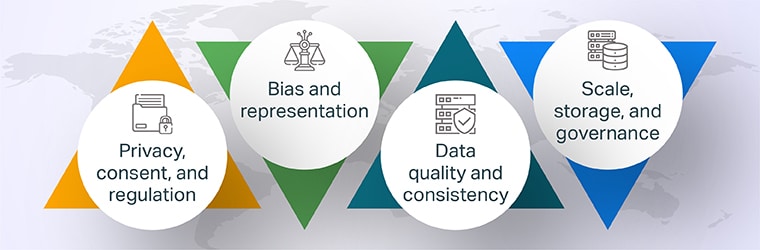
1. Privacy, consent, and regulation
Video is rich in personally identifiable information (PII)—faces, license plates, locations, behavior. In regions like the EU, GDPR treats video of identifiable people as personal data, with strict rules on purpose, minimization, retention, and consent.
Key questions to answer:
- Do you have informed consent where required?
- Are subjects clearly informed about how and why their video will be used?
- How long do you retain raw videos, and who can access them?
2. Bias and representation
If your video dataset over-represents certain demographics, locations, or conditions, your model may underperform—or fail—in underrepresented contexts, sometimes with serious safety implications.
Common pitfalls:
- Urban footage only, no rural scenes
- Certain age groups, skin tones, or clothing styles underrepresented
- All daylight, no night, rain, or snow
Diversity must be designed into your collection plan, not added as an afterthought.
3. Data quality and consistency
Even when you have “enough” video data, quality issues like:
- Motion blur
- Poor lighting
- Low resolution or inconsistent frame rates
- Occlusion and partial views
Can limit your model’s performance. High-performing programs define acceptance criteria for video quality and enforce them across contributors and collection methods.
4. Scale, storage, and governance
Video is big—tens or hundreds of terabytes per project are common. Without governance, you end up with:
- Duplicated footage
- Unknown lineage (“Where did this clip come from?”)
- Compliance risk (untracked retention, unclear access control)
This is where data management, cataloging, metadata, and “golden datasets” matter.
Best practices for video data collection (with comparison table)
Think of video data collection as designing a production pipeline, not just “recording some clips”.
1. Start from the model and use case
Before you turn on a single camera, define:
- Target task (e.g., vehicle detection, fall detection, shelf analytics)
- Target environment (indoor/outdoor, camera height, static vs moving camera)
- Success metrics (precision/recall, false-positive tolerance, latency)
- Edge cases you care about (adverse weather, occlusions, occluded pedestrians)
This informs how much and what kind of video you need.
2. Write clear data specs & collection protocols
Translate the use case into a collection spec:
- Camera types and resolutions
- Frame rate and compression settings
- Locations, angles, routes
- Duration per scene, number of participants
- Required metadata (timestamp, GPS, scenario tags)
This spec becomes the “script” your collectors follow, whether they’re crowdsourced or in the field.
3. Bake in privacy & compliance from day one
Following guidance like Google’s data collection best practices and privacy-centric frameworks, plan privacy into the pipeline, not as cleanup:
- Consent flows and participant information sheets
- Blurring or masking of faces/license plates where needed
- Data minimization (only what’s needed for training)
- Retention limits and secure deletion processes
- Role-based access controls for raw footage
4. Design for diversity and bias mitigation
During planning, explicitly list your coverage targets:
- Demographics (age ranges, skin tones, body types)
- Environments (geography, indoor/outdoor, urban/rural)
- Conditions (lighting, weather, time of day)
Then ensure your collection quotas reflect that mix, and track it as you go.
5. Integrate video collection with video annotation best practices
Collection and video annotation should be treated as a single workflow:
- Use consistent labeling ontologies when scoping collection (what classes, attributes, and events you’ll annotate).
- Capture footage that makes annotation feasible (good view of objects, no systematic occlusion).
- Use human-in-the-loop checks, multi-layer QA, and domain SMEs to validate labels in complex domains (healthcare, industrial).
6. Plan robust data management and governance
At minimum, define:
- A canonical dataset catalog with versions (v1, v2, etc.)
- Metadata standards (sensor info, scenario, location, consent flags)
- Transparent lineage of each clip: who captured it, when, under what contract
- A process to promote “golden datasets” used for benchmarking and regression tests
7. Ad hoc scraping vs structured video data collection (comparison)
| Aspect | Ad hoc / scraped footage | Structured, consented collection program |
|---|---|---|
| Legal & licensing | Often unclear, risky for training | Explicit rights and usage clauses |
| Privacy & consent | Hard to prove; PII common | Documented consent & minimization |
| Coverage & bias | Whatever the internet gives you | Deliberately designed for coverage & fairness |
| Metadata & lineage | Sparse, unreliable | Rich metadata, traceable origin |
| Long-term sustainability | Fragile; sources can disappear | Repeatable and extendable over time |
For safety-critical or regulated use cases, the structured approach usually wins—especially when you need to pass audits or meet internal AI governance standards.
Real-world applications & use cases
Autonomous vehicles & ADAS
Self-driving and driver-assist systems rely heavily on continuous road scenes to learn:
- Lane detection and road boundaries
- Pedestrians, cyclists, other vehicles
- Rare events like near-misses, accidents, and unusual behavior
Here, field operations and sensor fusion (video + LiDAR + radar) matter, along with highly diverse geographies and conditions.
Retail & Smart Checkout
Retailers use video data collection to:
- Count people and queue lengths
- Monitor product availability and shelf gaps
- Detect suspicious behavior (e.g., item concealment)
Privacy and signage rules become crucial, along with selective blurring and access control.
Healthcare & Medical Video
Healthcare applications include:
- Endoscopy and colonoscopy video analysis
- Ultrasound motion analysis
- Patient gait and rehab movement tracking
This is where domain SMEs, strict consent, and de-identification are non-negotiable—and where Shaip’s experience with medical data and de-identification is highly relevant.
Industrial Safety & Robotics
Computer vision monitors:
- PPE compliance (helmets, vests, goggles)
- Unsafe behaviors near machinery
- Robot navigation and obstacle avoidance
Here, video data collection is closely tied to safety regulations and incident investigation.
How Shaip approaches video data collection + annotation
Shaip operates as an end-to-end training data partner for video-based AI:
- Custom video data collection: Sourcing high-quality, consented video datasets across 60+ geographies for use cases like facial recognition, retail analytics, and ADAS.
- Video annotation services: Frame-by-frame labeling of objects, actions, and events using techniques like bounding boxes, polygons, keypoints, and tracking.
- Human-in-the-loop QA: Multi-layer quality checks, SME review for sensitive domains, and continuous feedback loops.
For deeper dives, readers can explore:
- Guide to annotate and label videos for ML
- What is Data Annotation: A Basic to Advanced Guide for 2025
- How to Choose the Right AI Data Collection Company
Conclusion
Video data collection is no longer just “recording some footage.” It’s a designed, governed pipeline that must balance:
- Rich, diverse coverage for robust models
- Strong privacy and compliance guarantees
- Operational scalability and cost control
- Tight integration with video annotation and QA
Organizations that treat video data collection as a strategic capability—not an afterthought—ship safer, more accurate computer vision systems faster.
If you’re exploring video data collection or looking to scale existing efforts, partnering with a provider like Shaip can help you combine global collection, expert annotation, and rigorous QA into a single, reliable workflow.
How much video data do I need to train an AI model?
There’s no universal number; it depends on the complexity of the task and the variability of the environment. For narrow, controlled tasks, thousands of short clips might be enough; for autonomous driving or nationwide retail, you may need thousands of hours across diverse conditions. Focus first on coverage and diversity, then scale volume as needed.
Do I always need fresh video, or can I reuse existing footage?
You can absolutely reuse existing archives (CCTV, test videos, historical footage) if:
- You have the legal rights to use them for AI training
- They match your current use case and environment
- They meet your quality and diversity requirements
However, for new products, you often still need fresh, purpose-built datasets to cover edge cases and modern conditions.
What’s the difference between video data collection and video annotation?
- Video data collection is about capturing the raw footage under the right conditions.
- Video annotation is about labeling objects, actions, and events in that footage so models can learn from it.
In a mature workflow, they’re designed together: you collect video that’s easy and meaningful to annotate.
How do I protect privacy when collecting video data?
Core practices include:
- Obtaining informed consent where applicable
- Minimizing captured PII (or blurring/masking it)
- Following regulations like GDPR for storage, retention, and access control
- Using secure infrastructure, encryption, and strict role-based access
Working with experienced partners who have privacy-by-design processes greatly reduces risk.
When should I work with a specialist like Shaip instead of collecting video in-house?
Consider a partner when:
- You need global coverage or specific demographics
- You’re in a regulated industry (healthcare, finance, automotive)
- You lack internal capacity for large-scale collection and annotation
- You want end-to-end quality and governance, not just raw footage
A specialist can help you avoid costly missteps while accelerating time-to-production.