
Imagine asking a voice assistant to summarize a long meeting, translate it into Spanish, and push the action items into your CRM—all from a single voice note.
Behind that “magic” is not just a powerful model like Whisper or an LLM like Gemini or ChatGPT. It’s the speech recognition datasets used to train and fine-tune those models.
In 2025, speech and voice recognition is a multi-billion-dollar market, projected to exceed $80B by 2032.
If your AI product relies on spoken input—whether that’s contact center calls, dictation, or voice search—the quality, diversity, and legality of your speech datasets will determine how well your AI “listens”.
In this article, we’ll talk about the diverse speech recognition datasets. We’ll explore their types to help you choose the best datasets for your AI model.
But first, let’s get into some basics.
What is a speech recognition dataset?
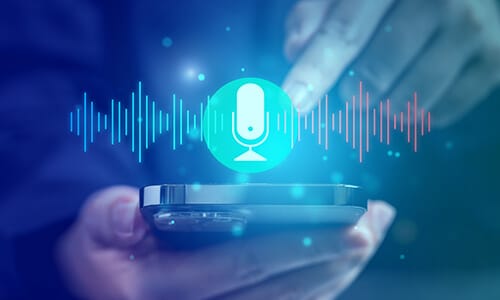
For instance, a person from Texas sounds different from someone in London, even if they say the same phrase. A good dataset captures this diversity. It helps the AI to hear and comprehend the nuances of human speech.
This dataset plays a crucial role in developing AI models. It provides the data necessary for the AI to learn language comprehension and production. With a rich and diverse dataset, an AI model becomes more capable of understanding and interacting with human language. Therefore, a speech recognition dataset can help you create intelligent, responsive, and accurate voice AI models.
Why do you need Quality Speech Recognition Dataset?
With the rise of speech-native LLMs, new dataset types are emerging:
- Expressive speech with natural language descriptions (e.g., SpeechCraft) – supports training models that understand style, emotion, and prosody.
- Synthetic speech corpora created with TTS + LLM-generated text (e.g., Magpie Speech) to augment real data.
- Fake speech / spoof detection datasets (e.g., LlamaPartialSpoof) for voice security and fraud detection.
Use when: You’re working on speech-language models, expressive TTS, or AI safety/fraud detection.

How to Choose the Right Speech Recognition Dataset (Step-by-Step)
Use this as a practical decision framework.
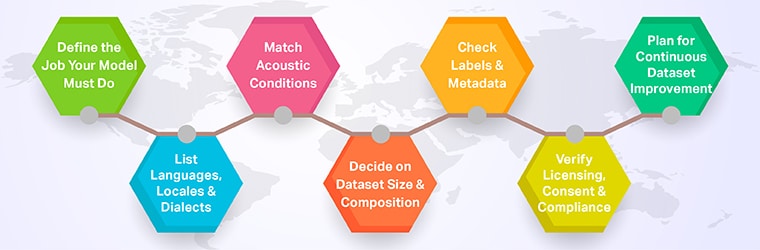
Step 1 – Define the Job Your Model Must Do
- Task: dictation, voice search, contact center analytics, real-time captions, compliance monitoring, etc.
- Channel: telephony (8 kHz), mobile app, far-field smart speakers, in-car microphones.
- Quality bar: target WER, latency, response times, regulatory requirements.
Step 2 – List Languages, Locales & Dialects
- Which languages and variants (e.g., US English vs Indian English vs Singapore English)?
- Do you need code-mixed speech (Hindi–English, Spanish–English, etc.)?
- Are you targeting low-resource languages where open data is sparse?
Step 3 – Match Acoustic Conditions
- Telephony vs wideband vs multi-mic arrays.
- Quiet office vs noisy street vs moving car.
- Near-field vs far-field microphones.
Your dataset should mirror the environments your users will actually be in.
Step 4 – Decide on Dataset Size & Composition
Rules of thumb (not strict):
- Fine-tuning a pre-trained model (Whisper, wav2vec2, etc.)
- Dozens to a few hundred hours of high-quality, domain-matched data can move the needle a lot.
- Training a model from scratch
- Usually requires thousands to tens of thousands of hours, which is why many teams start from pre-trained systems and focus budget on fine-tuning data.
Mix:
- Some clean scripted data (for core phonetics, numbers).
- Realistic conversational data (for robustness).
- Domain-specific edge cases (rare entities, long numbers, jargon).
Step 5 – Check Labels & Metadata
For classic ASR, you at least need:
- Accurate transcripts
- Basic speaker tags
- Consistent punctuation & casing rules
For LLM + ASR pipelines, you also want:
- Speaker turn segmentation (who said what, when)
- Call/conversation outcomes (resolved, escalated, complaint type)
- Entity annotations (names, account numbers, product names)
- Sentiment or emotion tags, where relevant.
These labels let you build summarization, QA, coaching, routing, and RAG pipelines on top of transcripts—where a lot of business value now lives.
Step 6 – Verify Licensing, Consent & Compliance
Before you train:
- Is the dataset licensed for commercial use (not just research)?
- Were speakers informed and consented for this use?
- Are PII and sensitive attributes handled according to GDPR / HIPAA / local regulations?
Many open datasets use licenses like CC-BY or CC0, each with different obligations. When in doubt, treat legal review as a non-negotiable step.
Step 7 – Plan for Continuous Dataset Improvement
Languages evolve, your product evolves, and so should your dataset:
- Monitor real-world errors and feed misrecognitions back into your training set.
- Add new entities (brands, SKUs, regulatory terms) as your domain changes.
- Periodically rebalance accents and demographics to reduce bias.
This closed loop is often the biggest differentiator between “good enough” and “market-leading” speech products.
[Also Read: Enhance AI models with our quality Indian language audio datasets.]
How Shaip Can Help
If you’re at the stage of “I know I need better speech data, but I’m not sure where to start”, Shaip can help you:
- Audit your existing datasets and identify coverage gaps
- Provide off-the-shelf speech recognition datasets across 65+ languages and dozens of domains (scripted, call center, wake words, TTS, etc.)
- Design and execute custom data collection programs (remote, in-country, multi-device)
- Handle annotation, transcription, quality control, and de-identification end-to-end
So your team can focus on models and products, while we make sure your AI has the high-quality, compliant speech data it needs to listen—and understand.