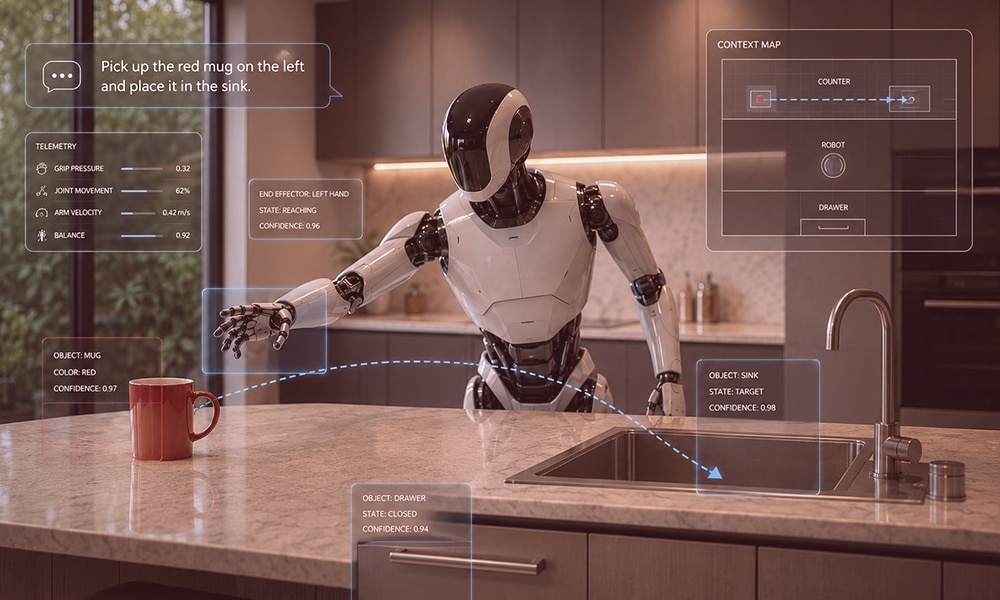
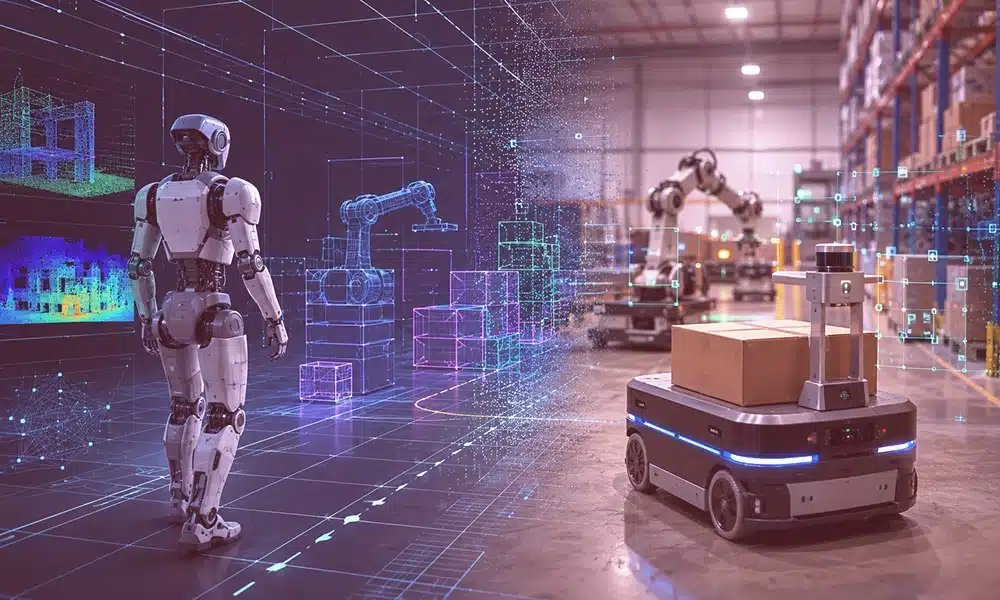
In physical AI, the model is rarely the bottleneck — the data is. A robot policy that runs flawlessly in a demo and then stalls in a live warehouse almost always fails on the data it never saw, not the architecture. That puts a budget question in front of every robotics team: when you decide between synthetic vs real-world data for robotics, which one should you actually buy? Both have real strengths, both have real costs, and the right answer depends on where your project sits today.
Key Takeaways
- Synthetic data is cheap, scalable, and safe for generating edge cases at volume.
- Real-world data captures the sensor noise and long-tail variability that simulation misses.
- The sim-to-real gap is the main reason synthetic-only models fail in deployment.
- Real-world data collection cost scales with capture hours; synthetic scales cheaply once built.
- Synthetic data fills gaps; real-world data anchors training. Hybrid wins in 2026.
- Buy synthetic early, buy real-world data before fine-tuning and deployment.
What is synthetic data for robotics?
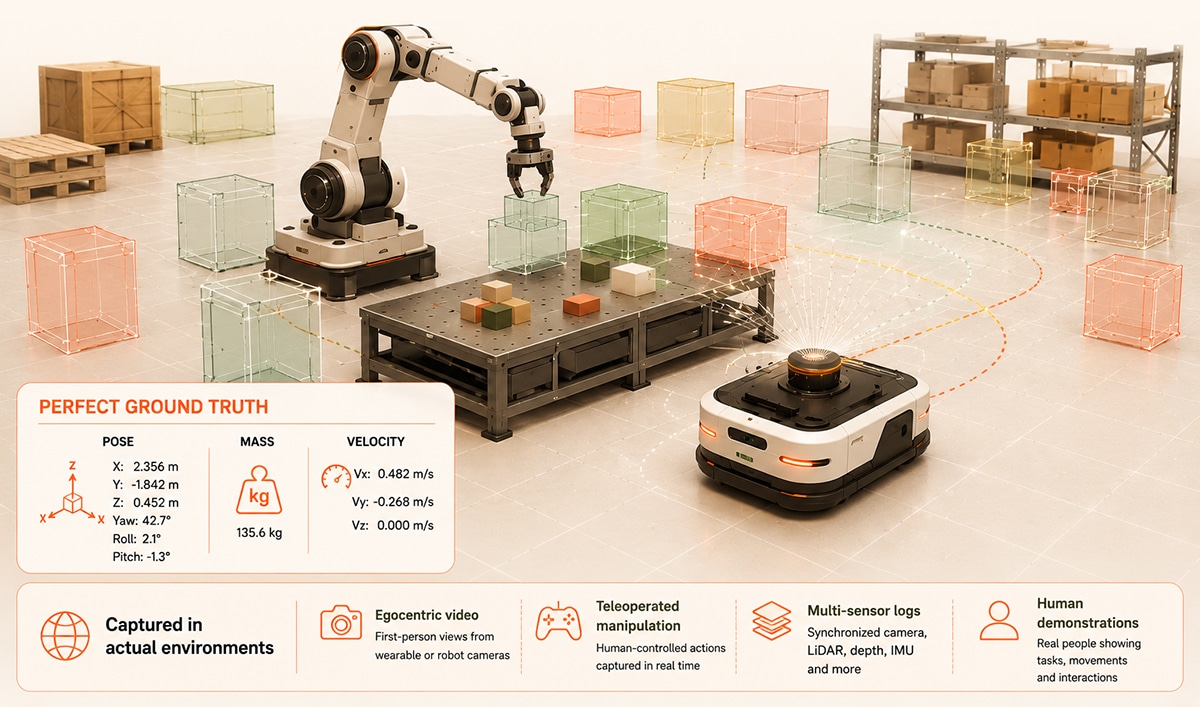
Synthetic data for robotics is artificially generated training data produced in simulation rather than captured from physical robots in the real world. A physics engine or world model renders scenes, motion, and sensor readings, and labels every frame automatically with perfect ground truth.
Because the simulator knows the exact position, mass, and motion of every object, it produces flawless labels at a speed no manual pipeline can match. Synthetic data covers four broad types: vision (segmented images, varied lighting), 3D and depth (point clouds, navigation maps), motion (trajectories, joint angles, velocity), and interaction (grasping, contact, collision). Domain randomization — deliberately varying colors, textures, and lighting beyond realistic ranges — pushes models to focus on task-relevant features.
Domain randomization: A technique that varies simulation appearance beyond realistic limits so models generalize to real conditions they were never explicitly shown.
[Also Read: The Physical AI dataset stack]
What is real-world data for robotics?
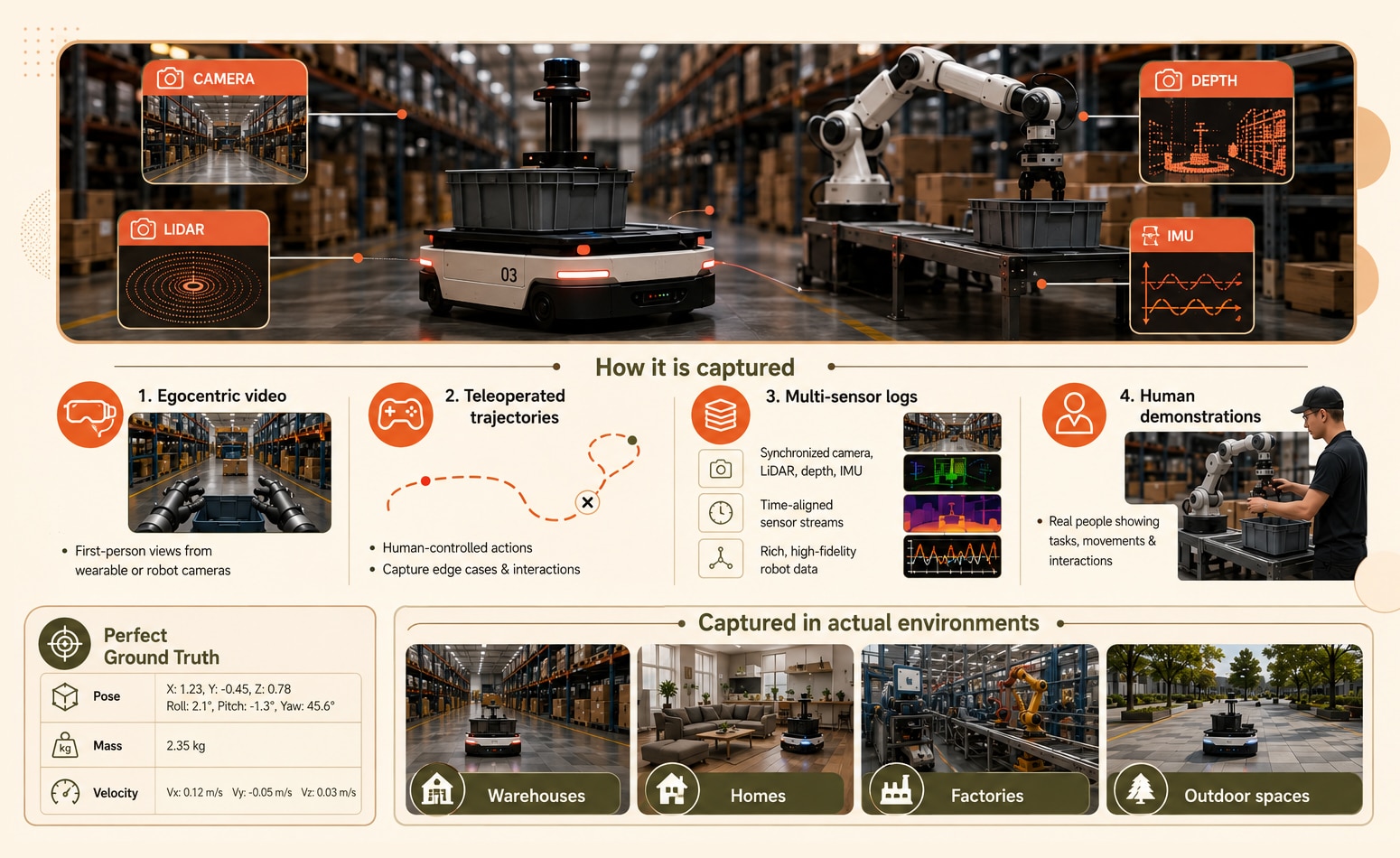
Real-world data for robotics is training data captured from physical sensors, teleoperation, or human demonstrations in actual environments. It carries the true noise, lighting shifts, and unpredictable variability that a robot meets the moment it leaves the lab.
This is the data that grounds a model in reality. It includes egocentric (first-person) video, teleoperated manipulation trajectories, multi-sensor logs combining camera, LiDAR, depth, and IMU streams, and human demonstration recordings. Shaip’s real-world data collection spans egocentric video, teleoperation, and manipulation capture across diverse global environments — exactly the high-variance scenarios that simulation struggles to reproduce.
Egocentric data: First-person video and sensor recordings captured from a head, chest, or wrist-mounted camera, mirroring what a robot sees during a task.
Synthetic vs real-world data: how do they compare?
Synthetic and real-world data solve opposite problems. Synthetic data wins on cost, scale, and edge-case coverage; real-world data wins on realism, sensor fidelity, and trustworthiness for deployment. The table below maps the trade-offs buyers weigh most.
What is the sim-to-real gap — and why does it matter?
The sim-to-real gap is the performance drop that happens when a model trained in simulation meets real-world conditions its training never reproduced. It is the single biggest reason synthetic-only robotics models break in production.
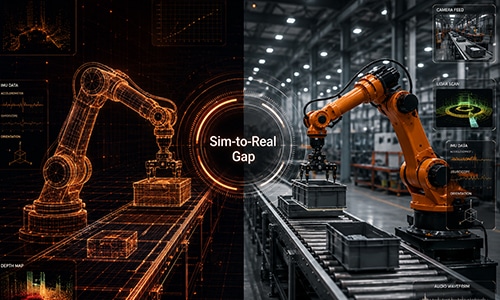
Think of it like a pilot who has only ever flown a simulator. They can nail every scripted scenario, but the first time real turbulence hits — the kind the simulator smoothed over — their training shows its limits. Robots behave the same way: a system that mastered a clean virtual warehouse can freeze when a real forklift appears from an unmodeled angle, or when sunlight floods a sensor in a way the renderer never captured.
Simulations rely on simplified physics assumptions, and they rarely model sensor artifacts, material edge cases, or genuinely adversarial conditions. Real-world data closes that gap by anchoring the model in the long tail of variability that only physical capture contains.
[Also Read: What VLA models need from training data]
How does the cost of synthetic vs real-world data compare?
The cost difference between synthetic and real-world data is structural, not just a matter of price tags. Synthetic data carries a high upfront cost to build the generation pipeline, after which the marginal cost of each additional frame collapses toward compute alone. Real-world data works the opposite way: cost scales roughly linearly with every hour of physical capture and every labeled sequence.
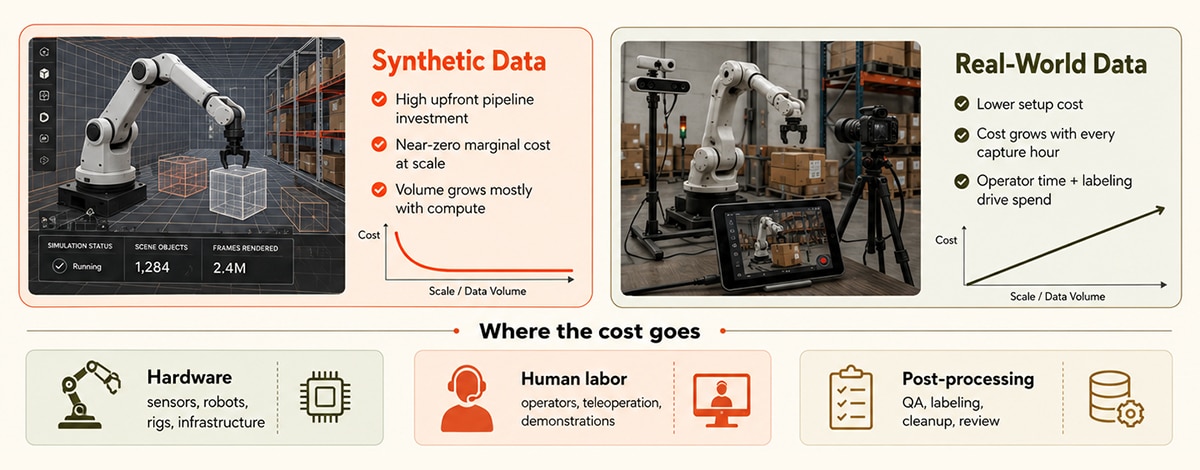
Robot training data cost splits into three buckets — hardware, human labor, and post-processing — and the balance between them depends on your approach:
- Synthetic: high upfront pipeline investment, near-zero marginal cost to scale volume.
- Real-world: lower setup, but cost grows with each hour of capture, operator time, and labeling.
- Hybrid: synthetic absorbs the high-volume load; real-world spend concentrates where realism matters most.
This asymmetry is the heart of the buy decision. Synthetic data lets you scale cheaply once the pipeline exists, while real-world data is where budget concentrates as you approach deployment. Lower cost, though, is not the same as lower risk — and that is where the decision gets nuanced.
Which should you buy for your physical AI project?
Buy synthetic data when you need scale, safety, and speed early in development; buy real-world data when you need to close the sim-to-real gap before fine-tuning and deployment. The stage of your project, not ideology, should drive the split.
Picture a mid-size logistics company building an autonomous mobile robot for a new fulfillment center. Early on, they have no hardware on the floor, so they lean almost entirely on synthetic data — generating thousands of virtual aisle layouts, spills, and near-miss forklift encounters to pre-train perception and navigation safely. As the first physical units arrive, the picture flips: they invest in real-world capture of their actual facility to fine-tune behavior against the quirks no simulator predicted — reflective floors, a loading-dock glare at 4 p.m., a pallet wrapped in unusual film. Synthetic got them moving; real-world data made them deployable.
A practical decision framework:
- Pre-hardware or early R&D → weight toward synthetic to pre-train and stress-test.
- Rare, dangerous, or privacy-sensitive scenarios → synthetic to generate them safely at volume.
- Fine-tuning for a specific environment → real-world data from that environment.
- Validation and safety certification → real-world data, every time.
Why a hybrid robotics data strategy wins in 2026
A hybrid robotics data strategy uses synthetic data to fill specific gaps while anchoring training on real-world data that grounds the model in genuine variability. This is the approach production teams converge on once synthetic-only pilots hit the sim-to-real wall.
The reasoning is straightforward. Synthetic data delivers the volume and the edge cases; real-world data delivers the realism and the trust. Shaip anchors physical AI programs on real-world demonstration and egocentric data while supporting synthetic generation for the long tail — so teams get scale without sacrificing the grounding that keeps a robot safe on the floor. For teams that need ready datasets fast, curated off-the-shelf data licensing can shorten the path further.
How do you evaluate a robotics data partner?
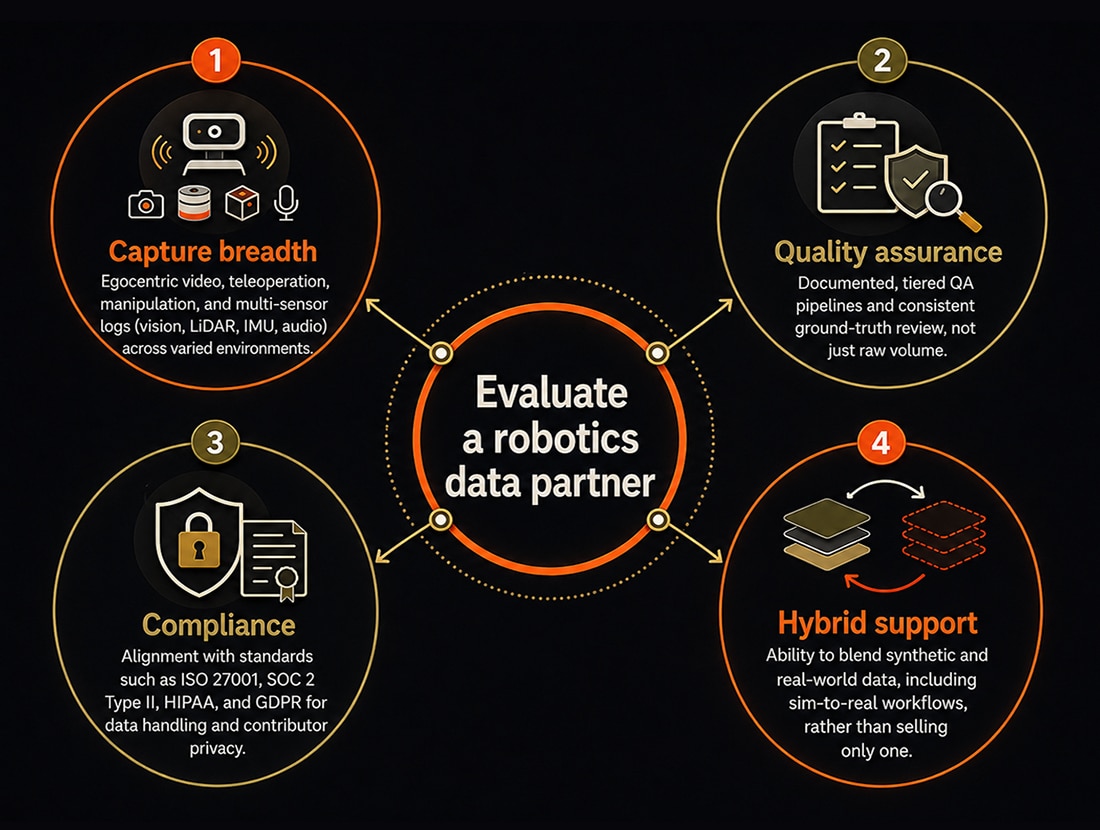
Evaluate a robotics data partner on real-world capture capability, embodiment coverage, quality assurance, and compliance — not price alone. Because real-world collection touches sensitive environments and human contributors, security and governance matter as much as label accuracy.
- Capture breadth: egocentric video, teleoperation, manipulation, and multi-sensor logs (vision, LiDAR, IMU, audio) across varied environments.
- Quality assurance: documented, tiered QA pipelines and consistent ground-truth review, not just raw volume.
- Compliance: alignment with standards such as ISO 27001, SOC 2 Type II, HIPAA, and GDPR for data handling and contributor privacy.
- Hybrid support: the ability to blend synthetic and real-world data, including sim-to-real workflows, rather than selling only one.
On every one of those criteria, Shaip’s Physical AI data services are built for robotics and embodied AI teams as an end-to-end partner — spanning multimodal collection, complex VLA and action annotation, synthetic data generation, RLHF, and evaluation under one engagement. Shaip captures from real environments where models actually operate — kitchens, warehouses, factories, streets, and healthcare facilities — through a managed global collector network rather than open crowdsourcing, with ISO 27001, SOC 2 Type II, HIPAA-ready, and GDPR-aligned controls.
That experience shows up at scale. In one humanoid robotics program, Shaip built the full data ops backbone — QR-mapped scene setup, five-sensor tracking, moderated rehearsal, and model-ready QA — to generate 10,000 hours of egocentric VR motion data across roughly 4,000 participants and 100 tasks in just 30 days. Read the full case study to see how the program was structured from setup to deployment-ready delivery.